A Private Guide Briefing from Travel Assist Japan
Your first sushi in Tokyo: rice side down, full dunk in the soy sauce, and the chef behind the counter quietly winces. Before you dip, it’s worth knowing where that little dish of brown liquid came from. Soy sauce and miso have shaped Japanese food for 1,300 years, sailed to Europe on Dutch ships, and, chances are, they’re hiding in your fridge at home right now.
- You Already Know These Two
- The Family Tree: From Paste to Sauce
- Meanwhile, in Your Kitchen’s Family History
- 701 AD: The Word “Miso” Is Born
- Why Japan Became a Fermentation Superpower
- 1254: The Happy Accident in Yuasa
- Miso Soup Joins the Samurai Diet
- Every Region Swears Its Miso Is Best
- Soy Sauce Becomes the Flavor of Tokyo
- Soy Sails to Europe on Dutch Ships
- The Asian Secret in Your Fridge
- 1908: Japan Names a Fifth Taste
- Made in Wisconsin: Soy Sauce Comes to America
- Miso Goes Gourmet
- Taste the Story with Your Private Guide
The basics
You Already Know These Two
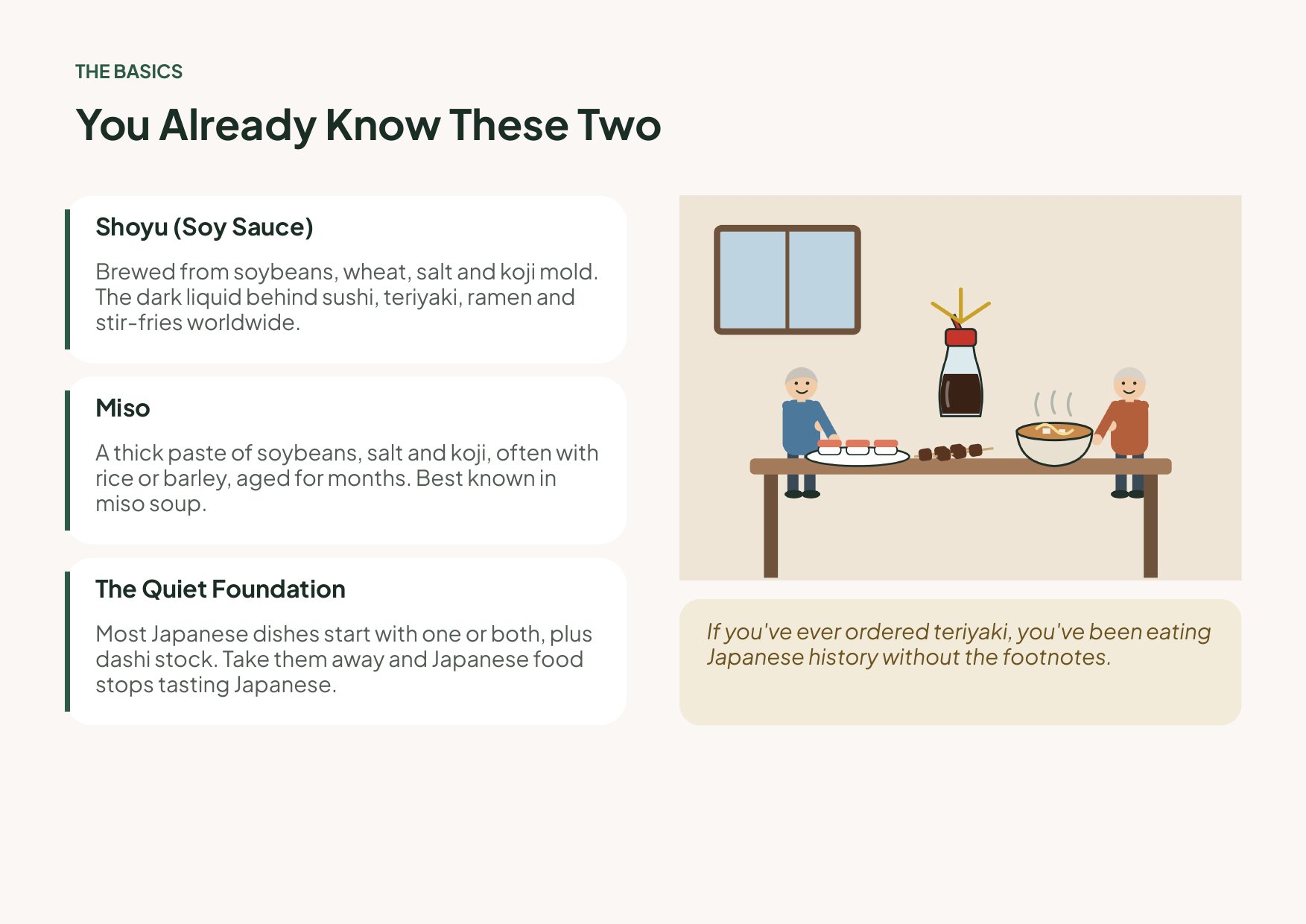
Shoyu (soy sauce) is brewed from soybeans, wheat, salt and koji mold. Miso is a thick paste of soybeans, salt and koji, often with rice or barley, aged for months. Together with dashi stock, they are the quiet foundation of almost every Japanese dish.
On your trip: you’ll taste them far beyond sushi: in the glaze on yakitori, the broth of soba, the dressing on a ryokan breakfast salad.
The basics
The Family Tree: From Paste to Sauce
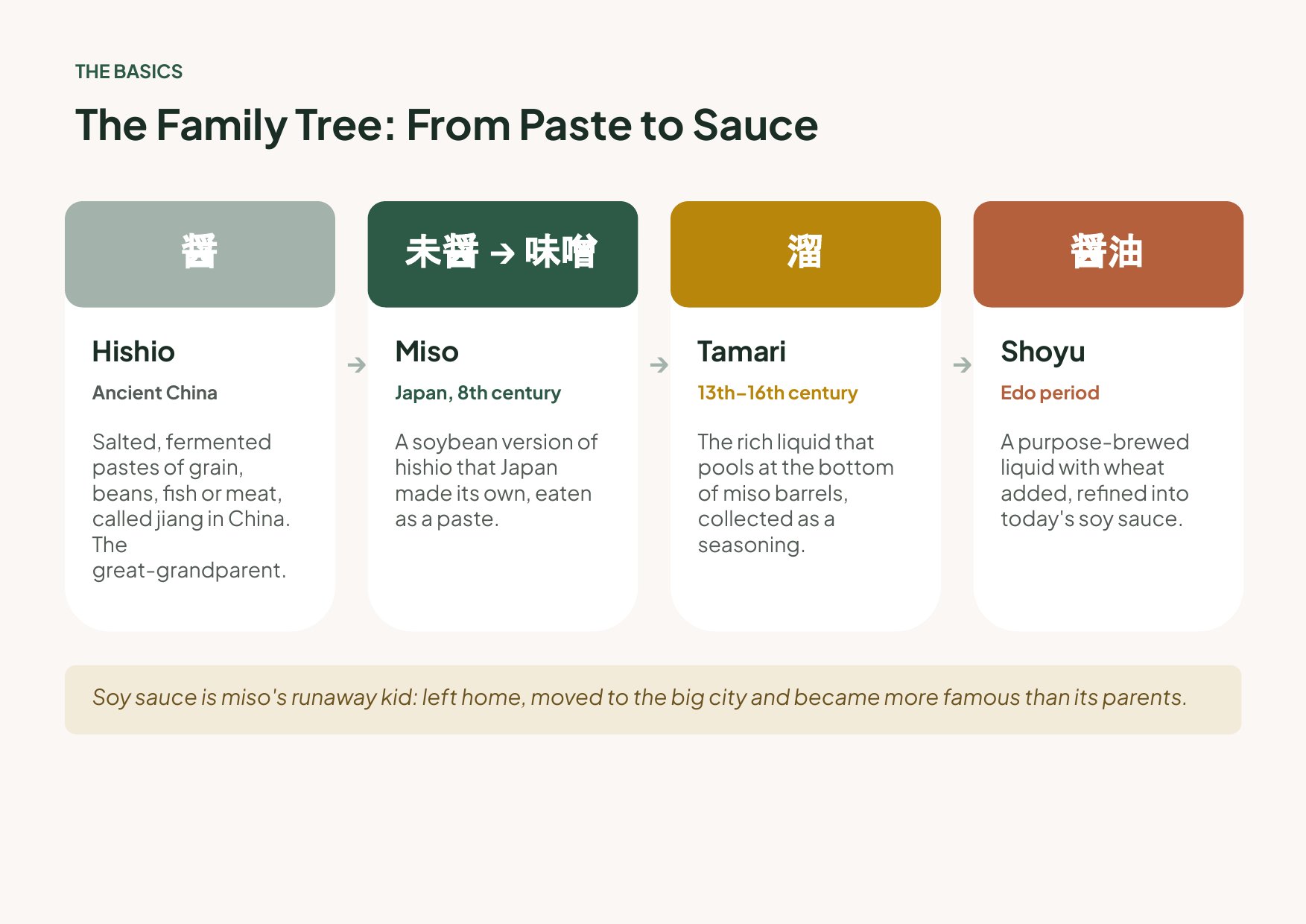
The great-grandparent is hishio (jiang in Chinese): salted, fermented pastes of grain, beans, fish or meat. Japan made a soybean version its own as miso. The rich liquid that pooled at the bottom of miso barrels became tamari, and by the Edo period brewers were making a dedicated liquid with wheat: modern shoyu.
Soy & the world
Meanwhile, in Your Kitchen’s Family History
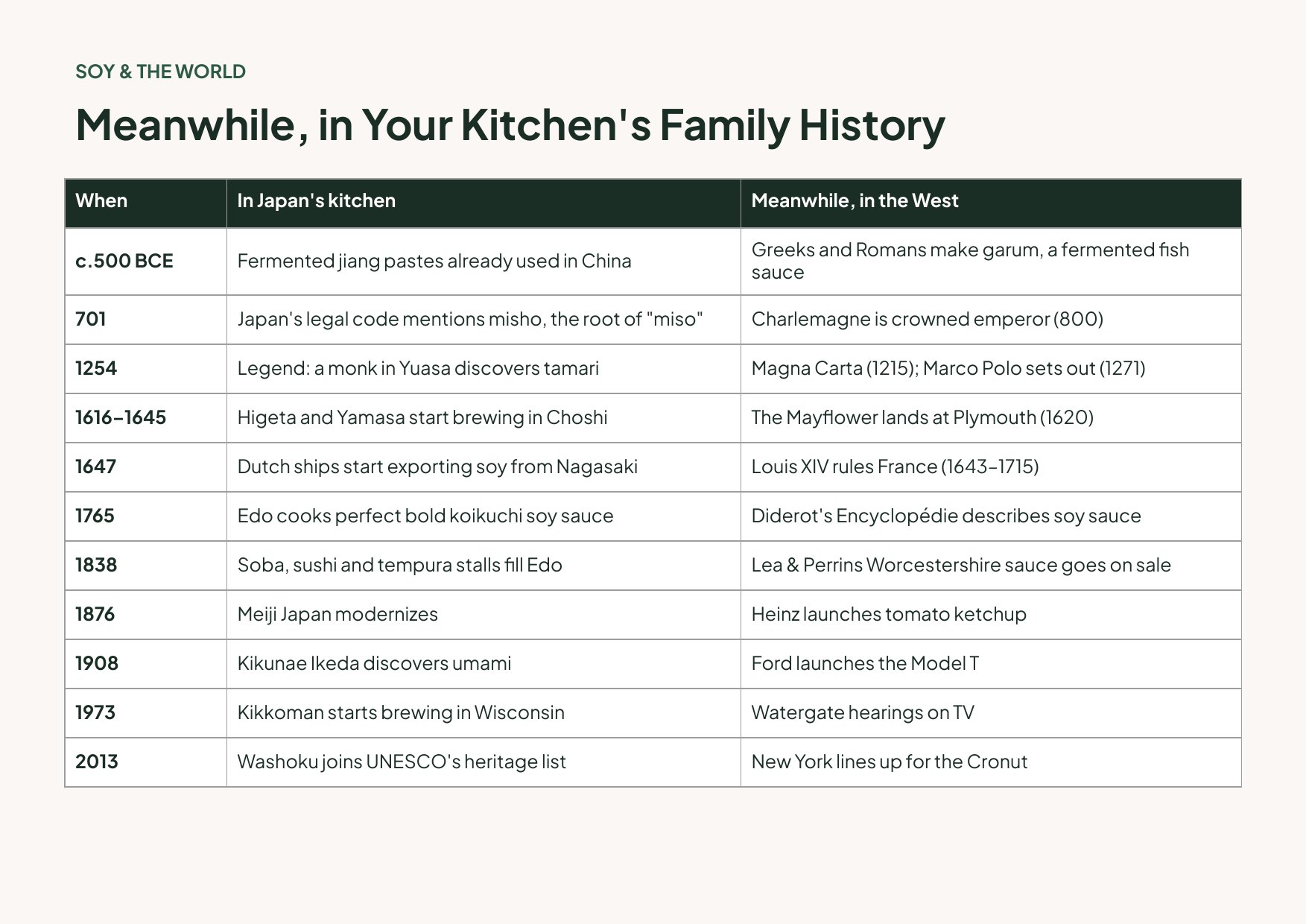
Line it up against Western history and soy sauce suddenly feels familiar. While the Romans were enjoying garum, a fermented fish sauce, China already had jiang. Japan’s soy dynasties were founded around the time the Mayflower landed, and umami was named the same year Ford launched the Model T.
Part 1 · Ancient roots
701 AD: The Word “Miso” Is Born
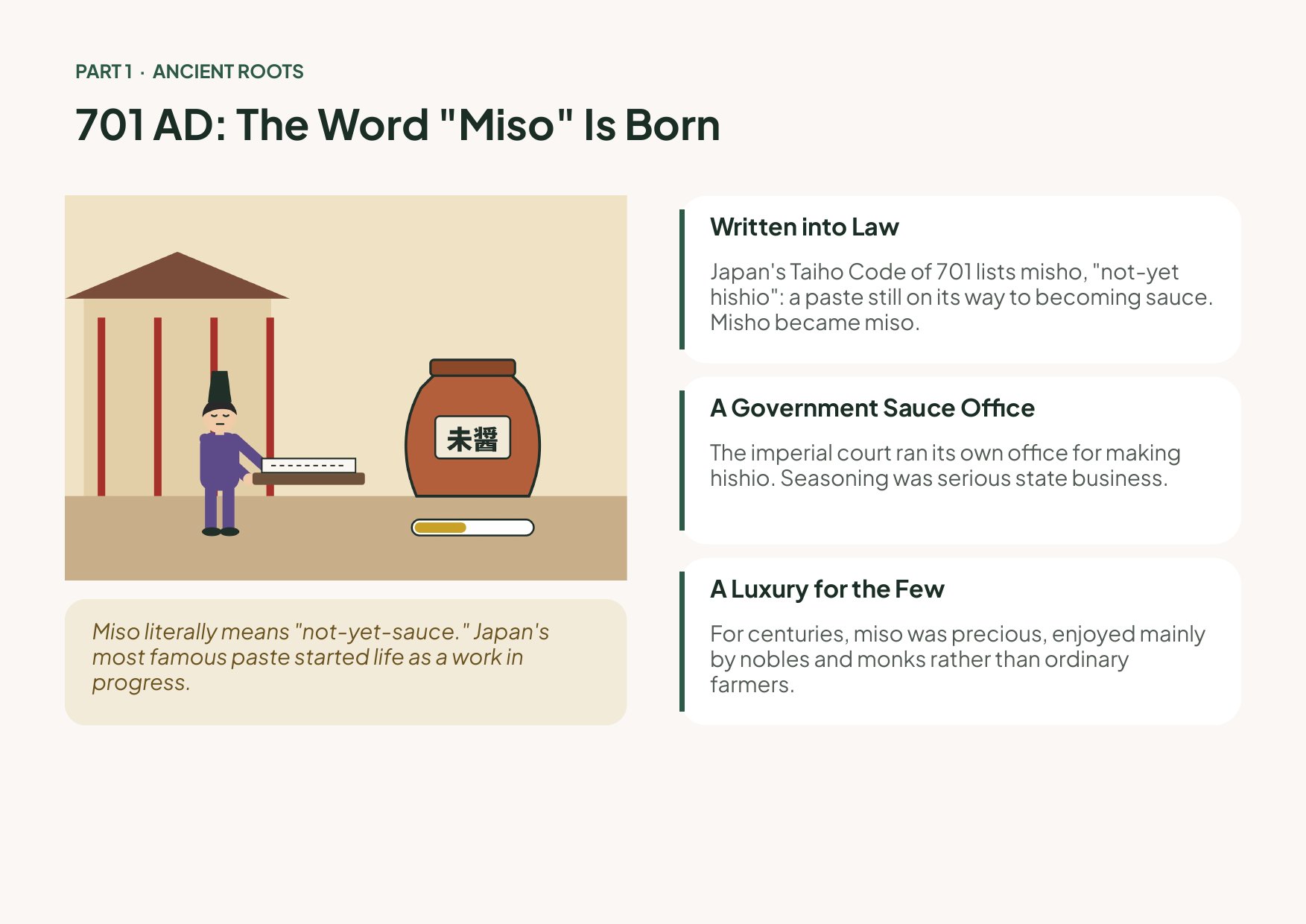
Japan’s Taiho Code of 701 mentions misho (未醤), “not-yet hishio”: a paste still on its way to becoming sauce. Over time misho became miso. The imperial court even had its own office for making hishio, and for centuries miso remained a luxury for nobles and monks.
Part 1 · Ancient roots
Why Japan Became a Fermentation Superpower
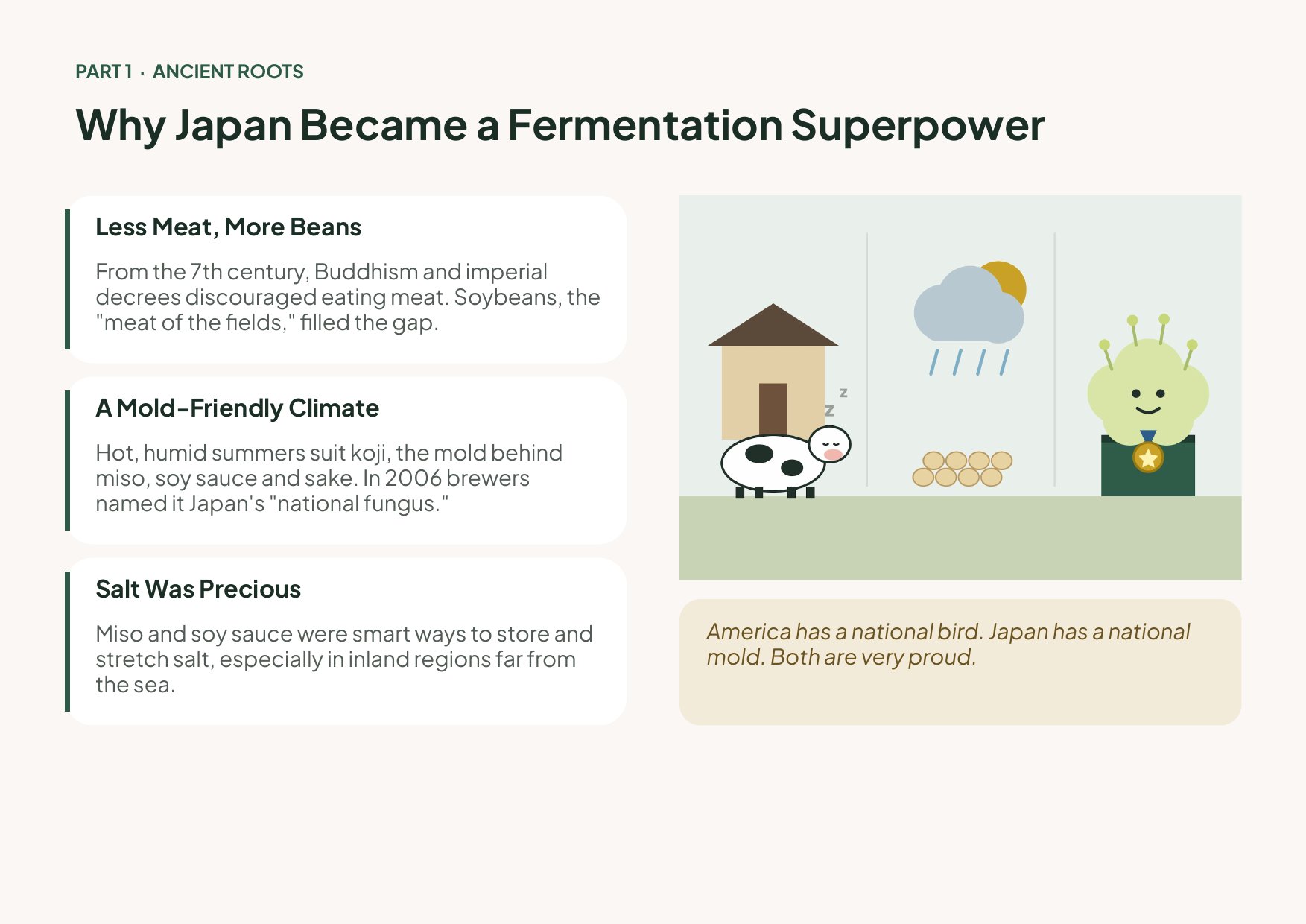
Three things came together. Buddhism and imperial decrees from the 7th century discouraged eating meat, so soybeans, the “meat of the fields,” filled the gap. Hot, humid summers suit koji, the mold behind miso, soy sauce and sake; in 2006 Japanese brewers named it the country’s “national fungus.” And salt was precious, so miso and soy sauce were smart ways to store and stretch it.
Part 2 · A legend, not history
1254: The Happy Accident in Yuasa
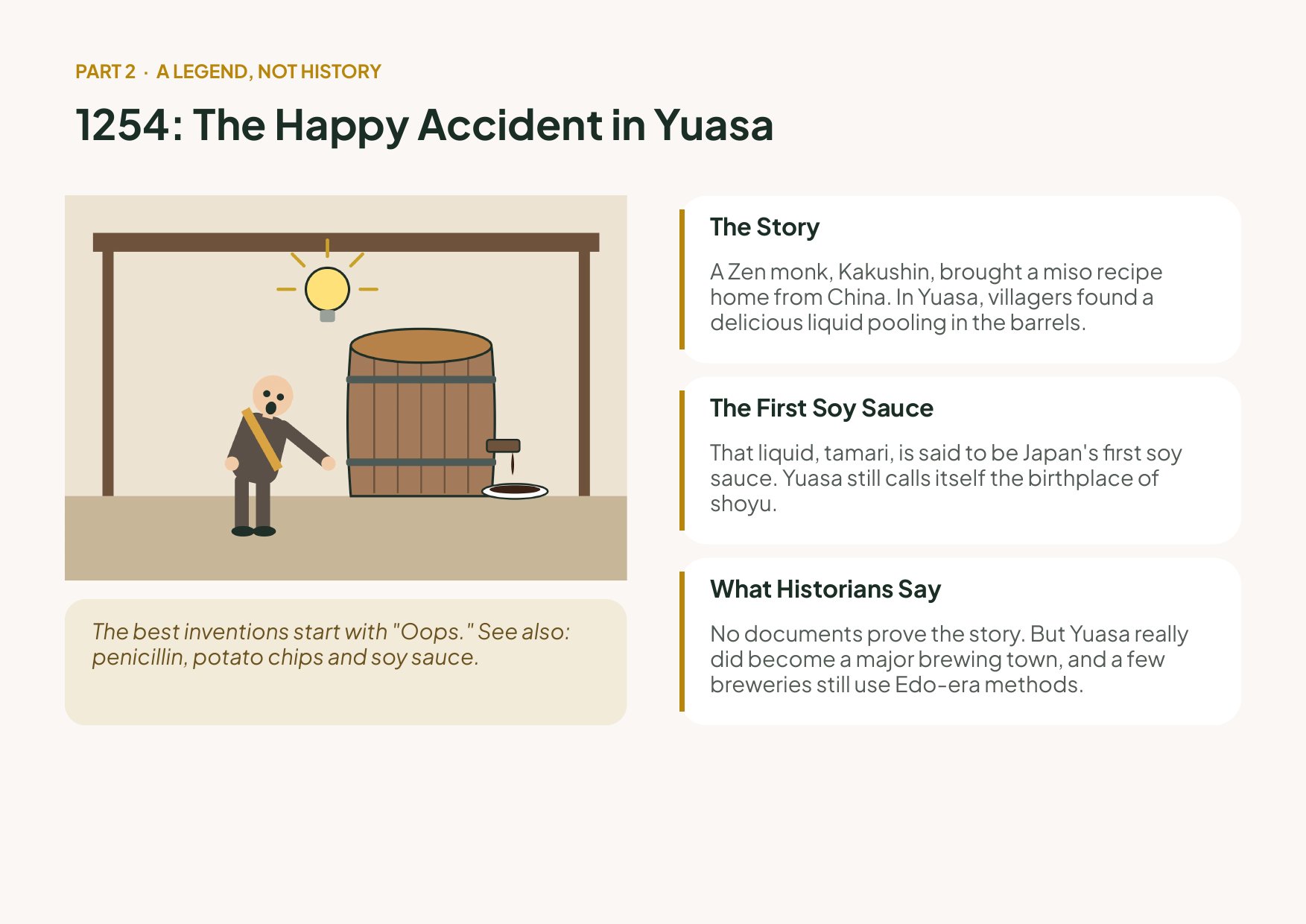
The story goes that a Zen monk, Kakushin, brought a miso recipe home from China in 1254. While teaching it to villagers in Yuasa, on the Kii Peninsula, they noticed the delicious liquid pooling in the barrels: tamari, said to be Japan’s first soy sauce.
No documents prove it, so treat it as a legend. But Yuasa really did become a major brewing town, and still calls itself the birthplace of shoyu.
Part 2 · The samurai kitchen
Miso Soup Joins the Samurai Diet
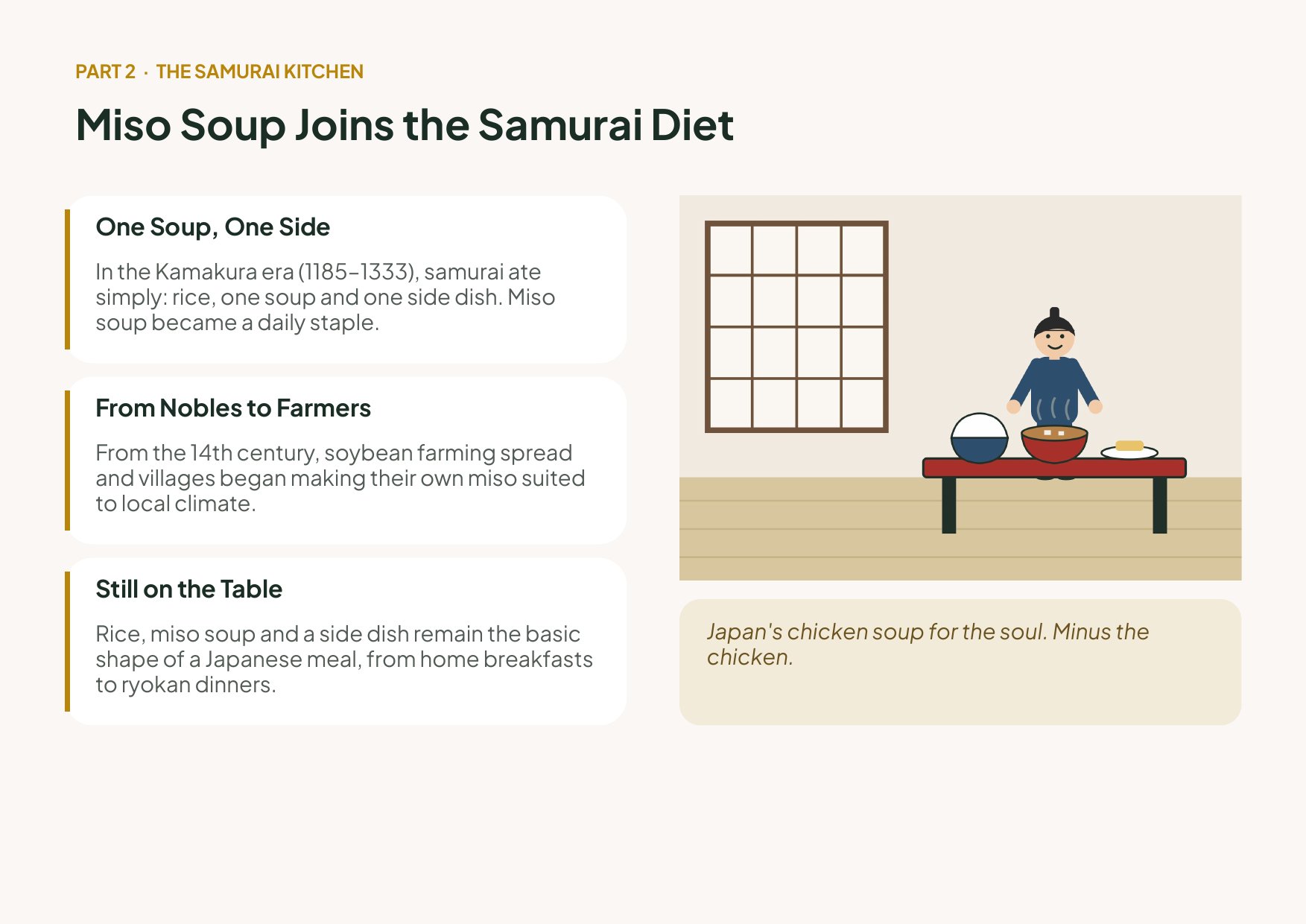
In the Kamakura era (1185–1333), samurai ate simply: rice, one soup and one side dish, a style called ichiju-issai. Miso soup became a daily staple, and from the 14th century villages across Japan began making their own miso. On the battlefield, warlords carried dried miso balls: add hot water and you had instant soup. Takeda Shingen’s push for miso as army food is said to be why Nagano is still Japan’s biggest miso region.
On your trip: rice, miso soup and a side dish remain the shape of a Japanese meal, from a hotel breakfast to a ryokan dinner.
Part 2 · The samurai kitchen
Every Region Swears Its Miso Is Best
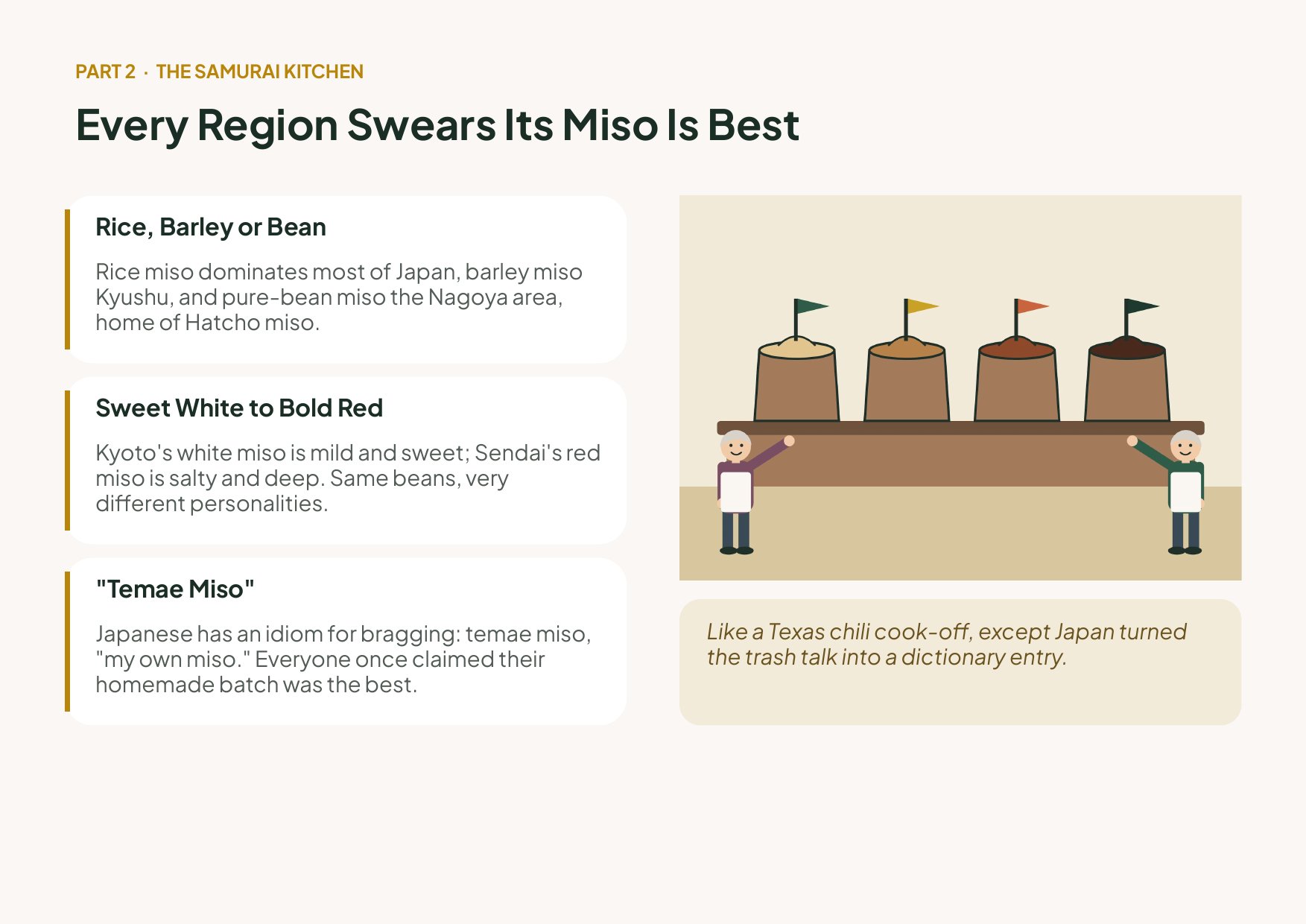
Rice miso dominates most of Japan, barley miso Kyushu, and pure-bean miso the Nagoya area, home of Hatcho miso. Kyoto’s white miso is mild and sweet; Sendai’s red miso is salty and deep. There’s even an idiom for bragging: temae miso, “my own miso,” because everyone once claimed their homemade batch was the best.
Part 3 · Edo: the flavor of Tokyo
Soy Sauce Becomes the Flavor of Tokyo
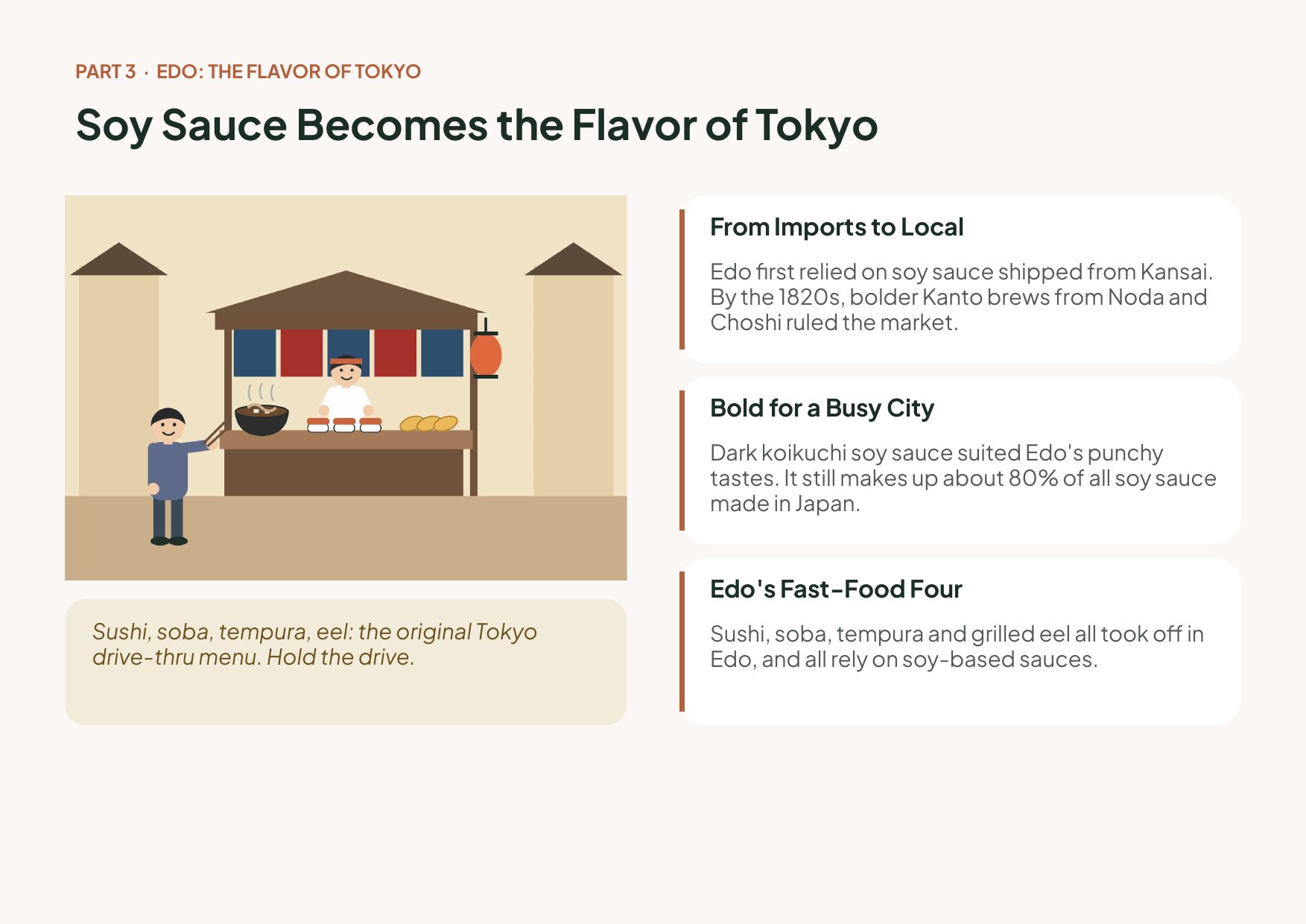
Edo (old Tokyo) first relied on soy sauce shipped from Kansai, but by the 1820s bolder local brews from Noda and Choshi ruled the market. Dark koikuchi soy sauce suited the city’s punchy tastes, and it still makes up about 80% of all soy sauce made in Japan. Sushi, soba, tempura and grilled eel, Edo’s original fast food, all depend on it.
The great brewing houses are old: Higeta traces its roots to 1616 and Yamasa to 1645, both in Choshi. Brewing families in Noda merged in 1917 into the company later called Kikkoman.
Part 3 · Edo: the flavor of Tokyo
Soy Sails to Europe on Dutch Ships
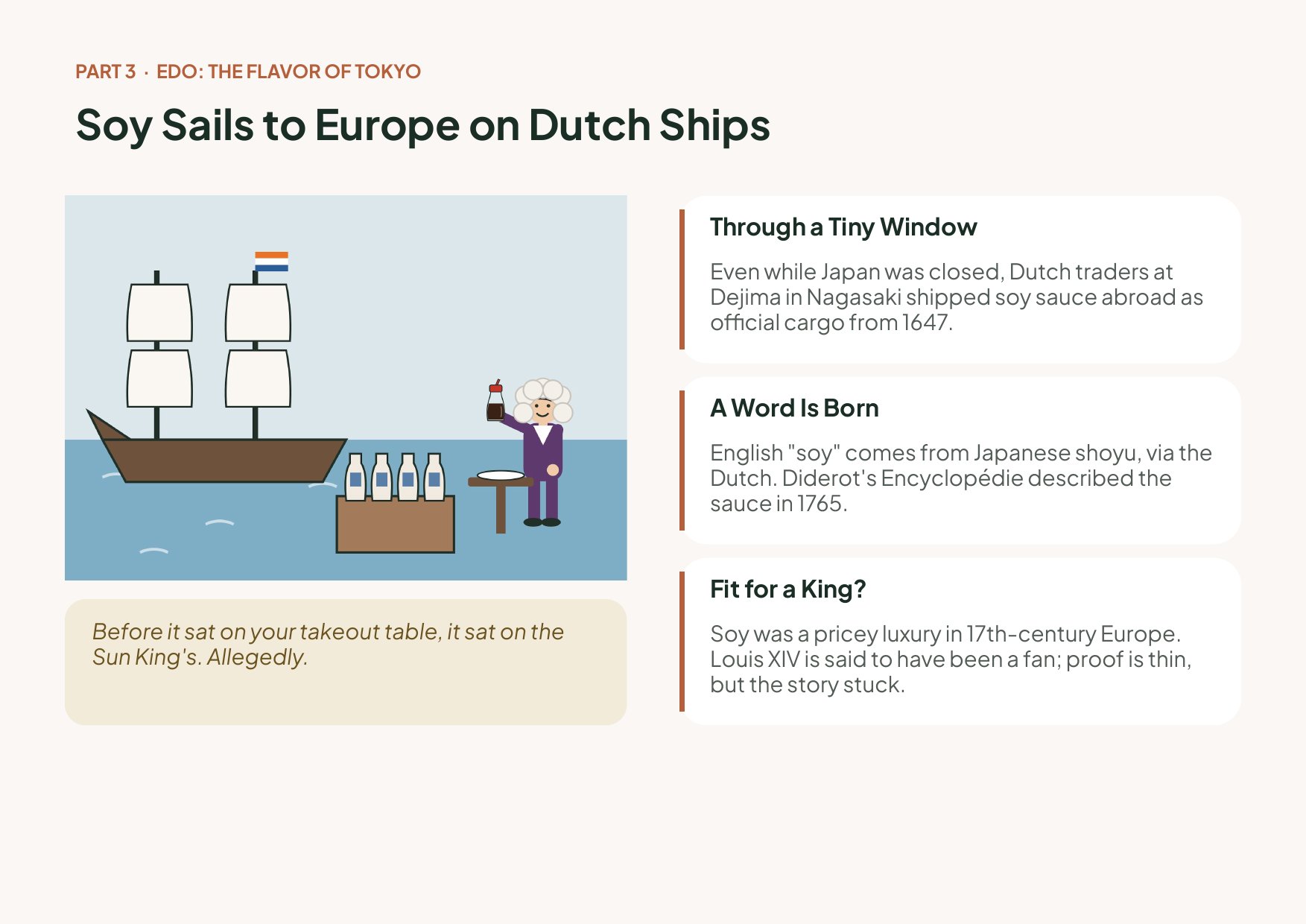
Even while Japan was closed to most of the world, Dutch traders at Dejima in Nagasaki shipped soy sauce abroad as official cargo from 1647. The English word “soy” comes from Japanese shoyu, via the Dutch, and Diderot’s Encyclopédie described the sauce in 1765. Louis XIV is said to have been a fan; the proof is thin, but the story stuck.
Part 3 · Edo: the flavor of Tokyo
The Asian Secret in Your Fridge
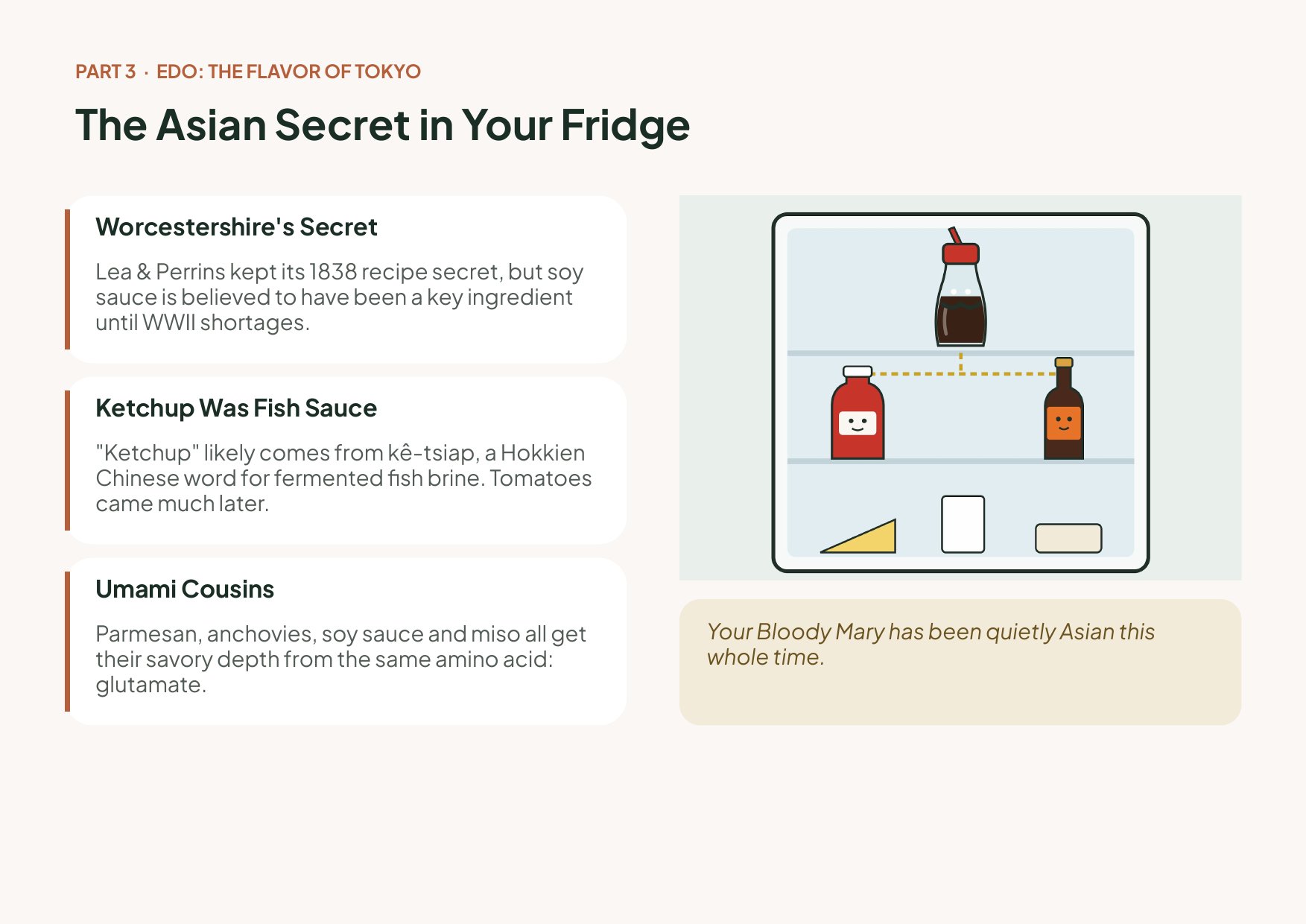
Lea & Perrins kept its 1838 Worcestershire recipe secret, but soy sauce is believed to have been an ingredient until wartime shortages. “Ketchup” likely comes from kê-tsiap, a Hokkien Chinese word for fermented fish brine; tomatoes came much later. And parmesan, anchovies, soy sauce and miso all owe their savory depth to the same amino acid: glutamate.
Part 4 · Going global
1908: Japan Names a Fifth Taste
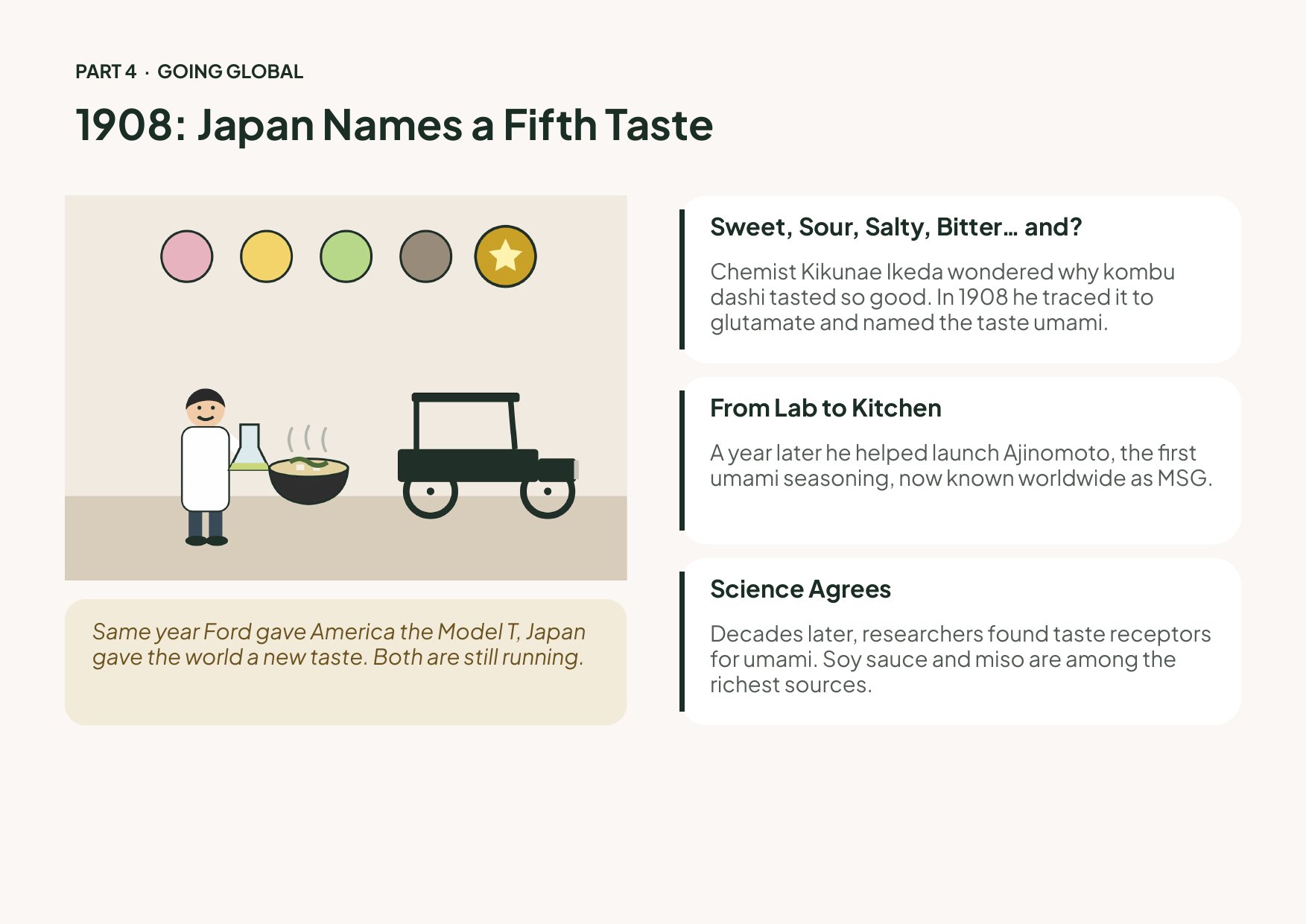
Chemist Kikunae Ikeda wondered why kombu dashi tasted so good. In 1908 he traced it to glutamate and named the taste umami. Decades later, scientists found the taste receptors for it, and soy sauce and miso turned out to be among its richest sources.
Part 4 · Going global
Made in Wisconsin: Soy Sauce Comes to America
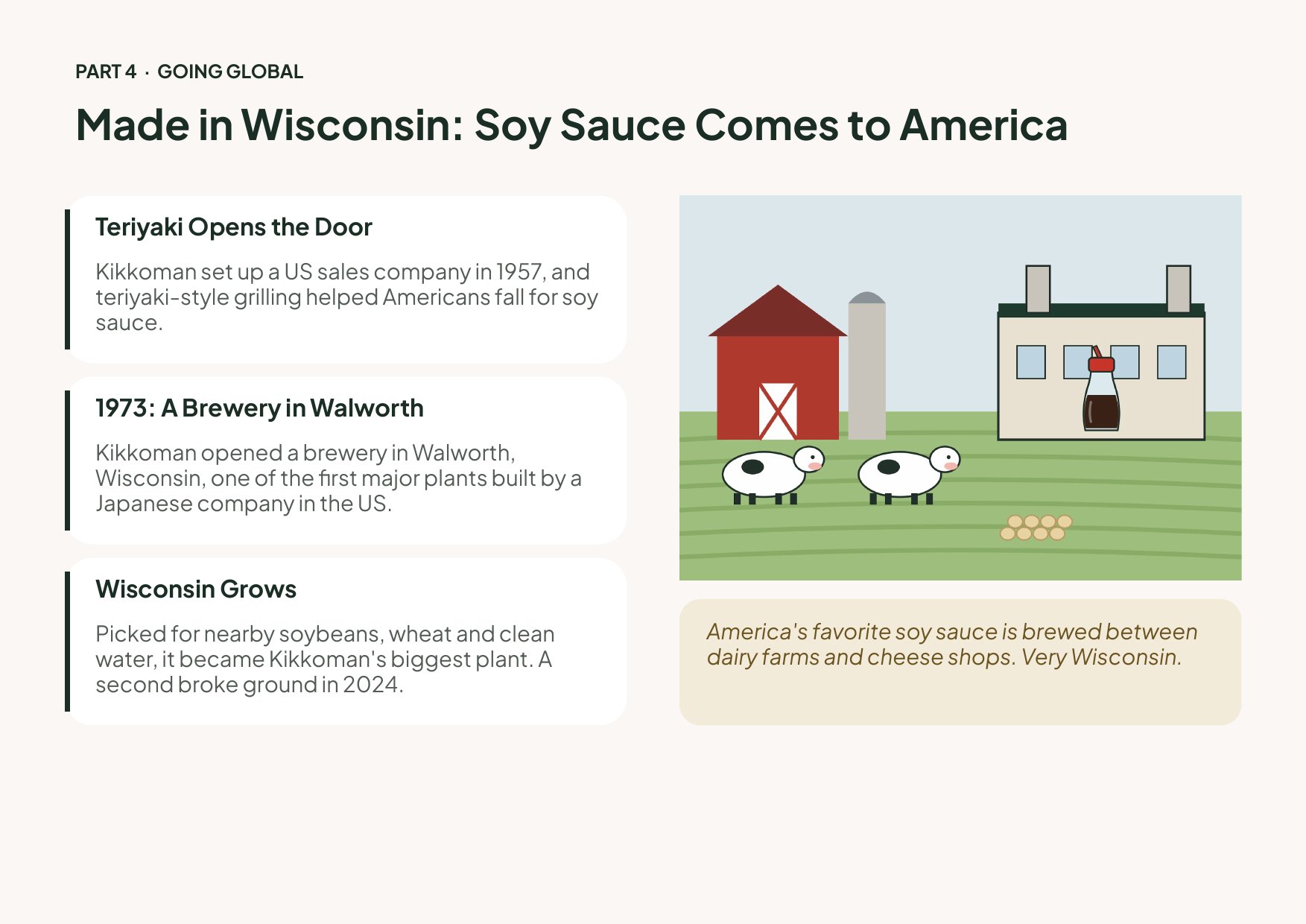
Kikkoman set up a US sales company in 1957, and teriyaki-style grilling helped Americans fall for soy sauce. In 1973 it opened a brewery in Walworth, Wisconsin, one of the first major plants built by a Japanese company in the US, chosen for nearby soybeans, wheat and clean water.
Part 4 · Going global
Miso Goes Gourmet
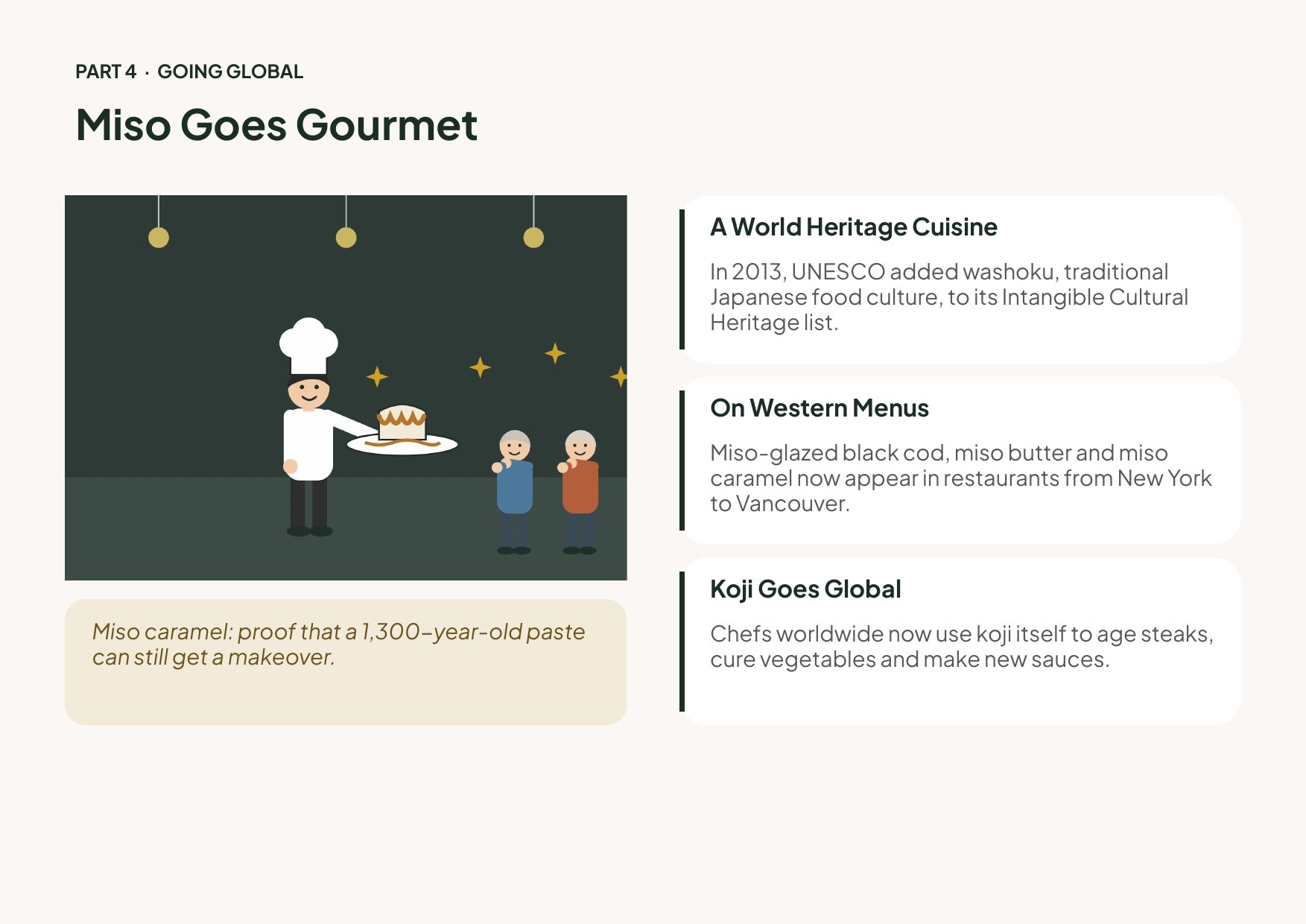
In 2013 UNESCO added washoku, traditional Japanese food culture, to its Intangible Cultural Heritage list. Today miso-glazed black cod, miso butter and miso caramel appear on menus from New York to Vancouver, and chefs worldwide use koji itself to age steaks and invent new sauces.
On your trip
Taste the Story with Your Private Guide
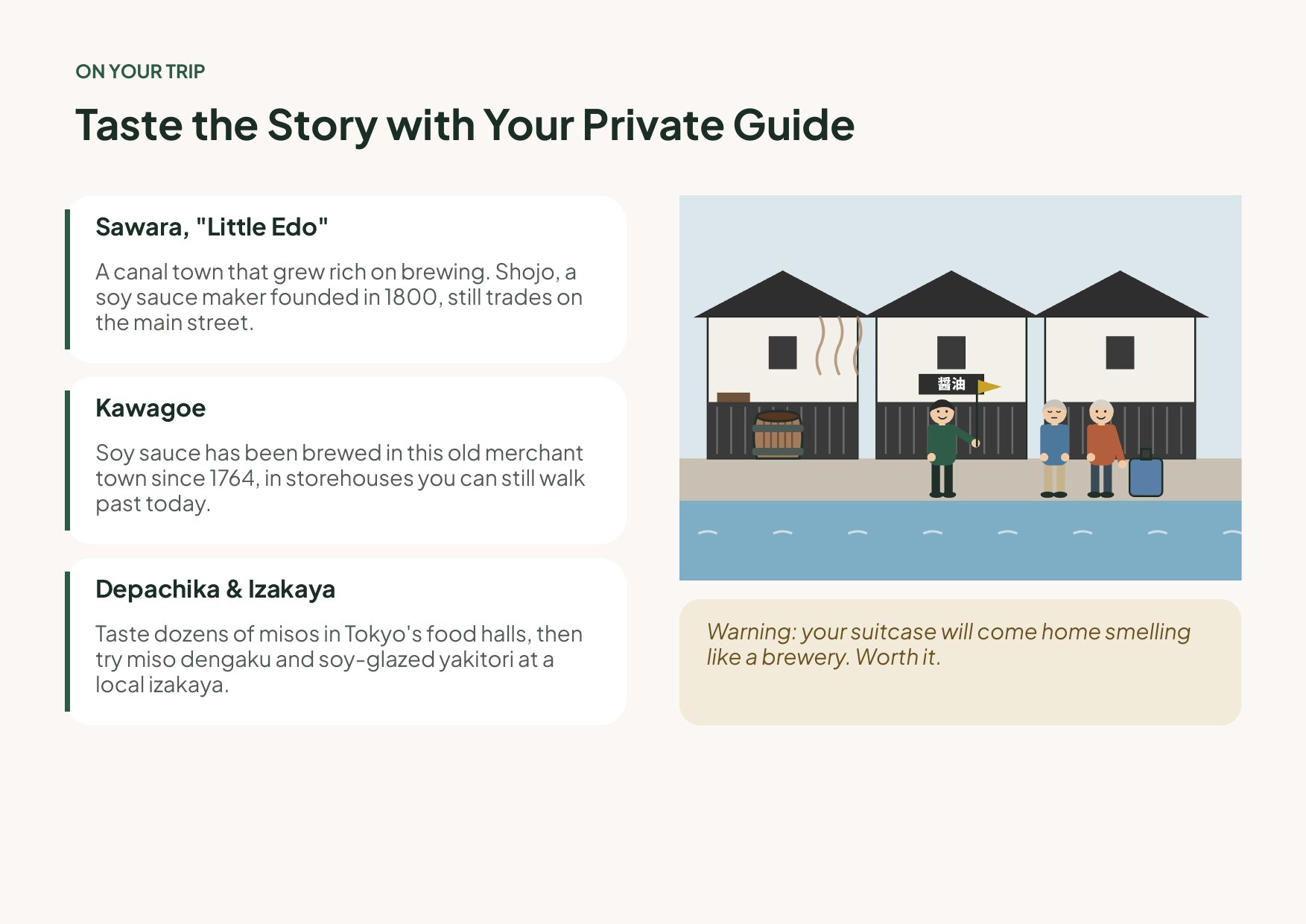
Sawara, “Little Edo”: a canal town that grew rich on brewing. Shojo, a soy sauce maker founded in 1800, still trades on the main street.
Kawagoe: soy sauce has been brewed in this old merchant town since 1764, in storehouses you can still walk past today.
Depachika and izakaya: taste miso in Tokyo’s food halls, then try miso dengaku and soy-glazed yakitori over a drink.
Why it matters at the table
What Soy and Miso Tell You About Japan
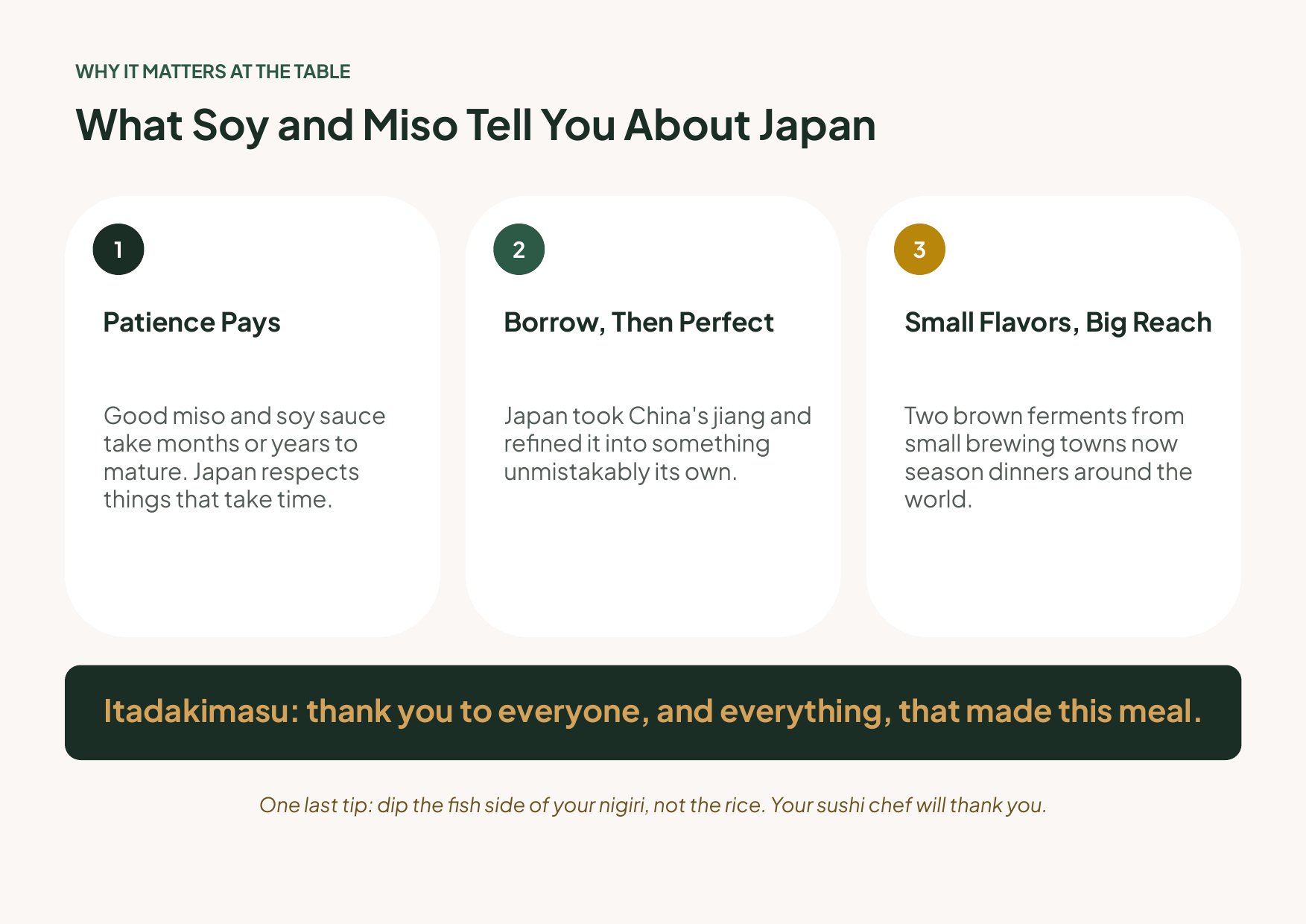
- Patience pays. Good miso and soy sauce take months or years to mature. Japan respects things that take time.
- Borrow, then perfect. Japan took China’s jiang and refined it into something unmistakably its own.
- Small flavors, big reach. Two brown ferments from small brewing towns now season dinners around the world.
Before each meal, Japanese people say itadakimasu: thank you to everyone, and everything, that made this meal. Now you know a little more about who to thank.
Taste 1,300 years of flavor with your own guide
From old brewing towns to Tokyo’s food halls and izakaya, your private guide brings the story to the table. Tell us what you’d like to taste, and we’ll plan a day around you.
More briefings: 16,000 Years of Japan · Decoding Japanese Mindsets · All Private Guide Briefings
Illustrations: original artwork by Travel Assist Japan. Stories marked as legends (the Yuasa monk, Louis XIV) are traditional accounts without firm historical proof.