A Private Guide Briefing from Travel Assist Japan
Why does “that might be a little difficult” mean no? Why is a packed Tokyo train so quiet? And why does everyone arrive ten minutes early? Our private guides get these questions on almost every tour. This briefing answers them with five Japanese ideas that explain a surprising amount of everyday life. It was first written for people moving to Japan for work, so below each slide we’ve added how the idea shows up on your trip.
Core foundations
Five Pillars of Japanese Cultural Logic
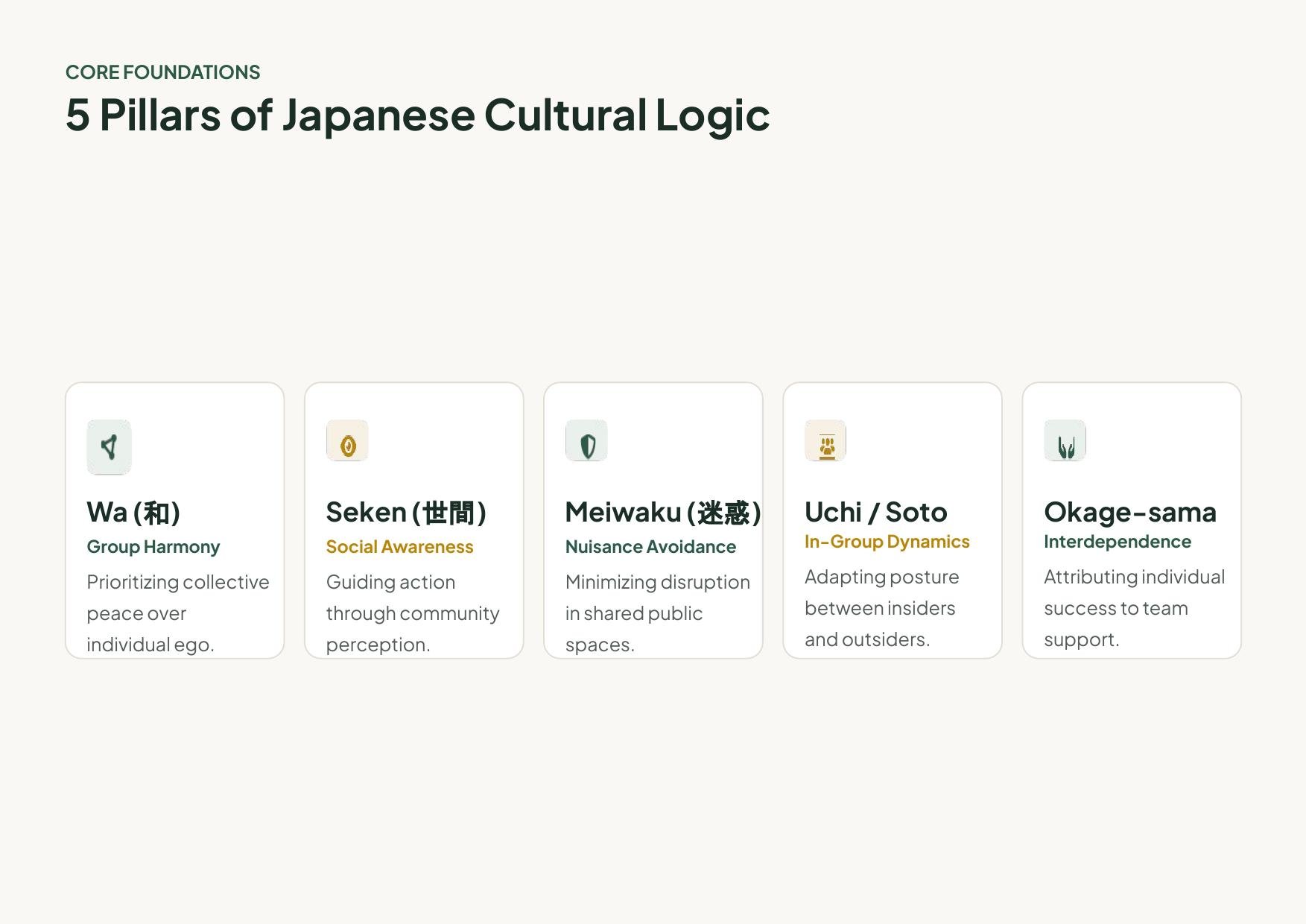
None of these words translates neatly into English, which is exactly why they’re worth learning. Together they explain why Japan can feel so calm, so orderly and occasionally so puzzling: wa (harmony), seken (the eyes of society), meiwaku (being a nuisance), uchi/soto (insiders and outsiders) and okage-sama (shared credit).
Pillar 01
Wa (和): Keeping the Group in Harmony
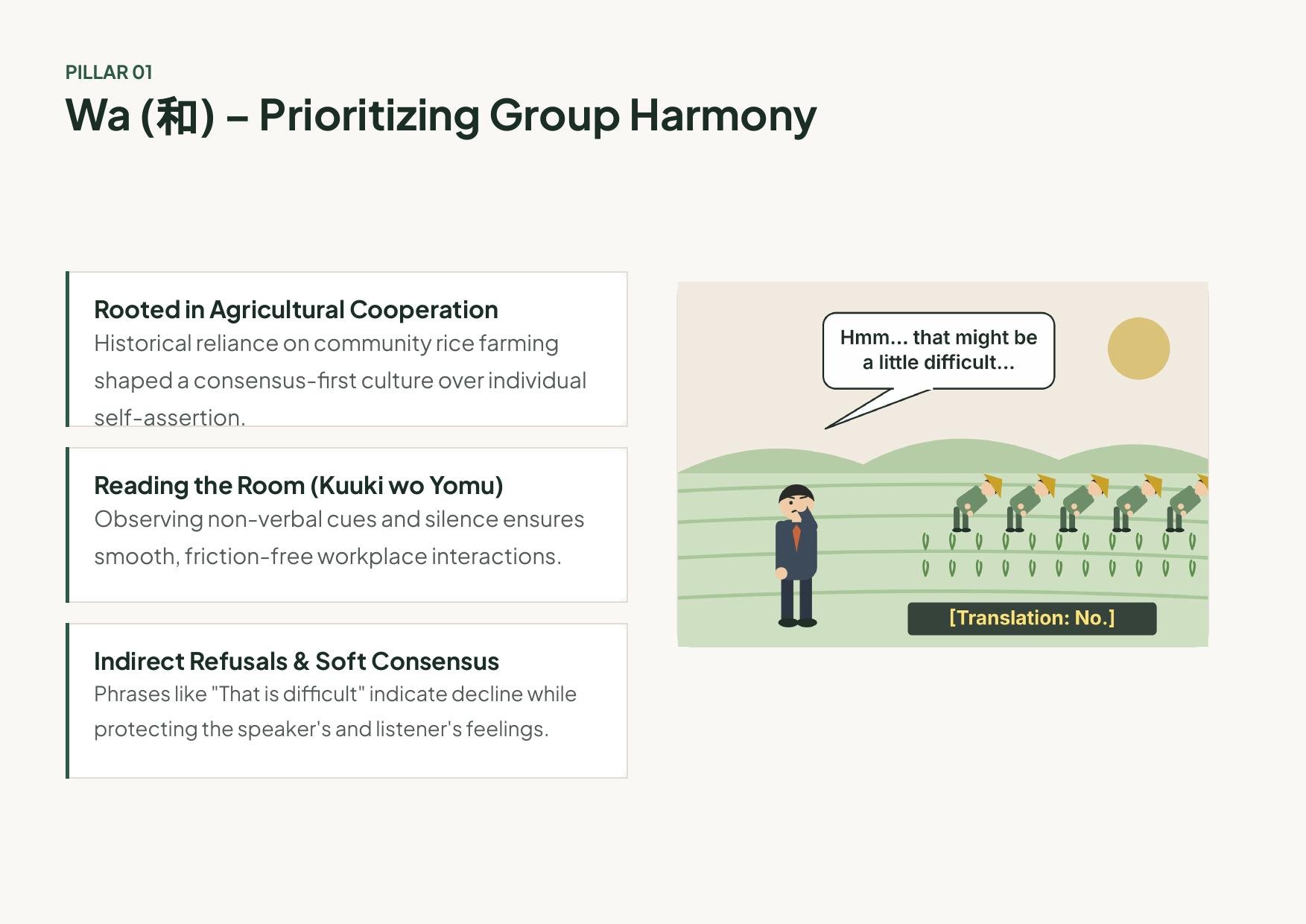
For centuries, Japanese villages grew rice together, sharing water, labor and harvests. Getting along wasn’t a nicety; it was survival. That habit lives on as wa, a preference for consensus over confrontation. Japanese people talk about kuuki wo yomu, “reading the air”: noticing what isn’t said and adjusting before anyone has to spell it out.
On your trip: you’ll rarely hear a flat “no.” Instead you’ll hear “chotto…” (“that’s a little…”) with a sharp intake of breath, or “that might be difficult.” Take it as a polite no, and don’t push. Asking again, more loudly, only makes everyone more uncomfortable.
Pillar 02
Seken (世間): Living in Society’s Eye
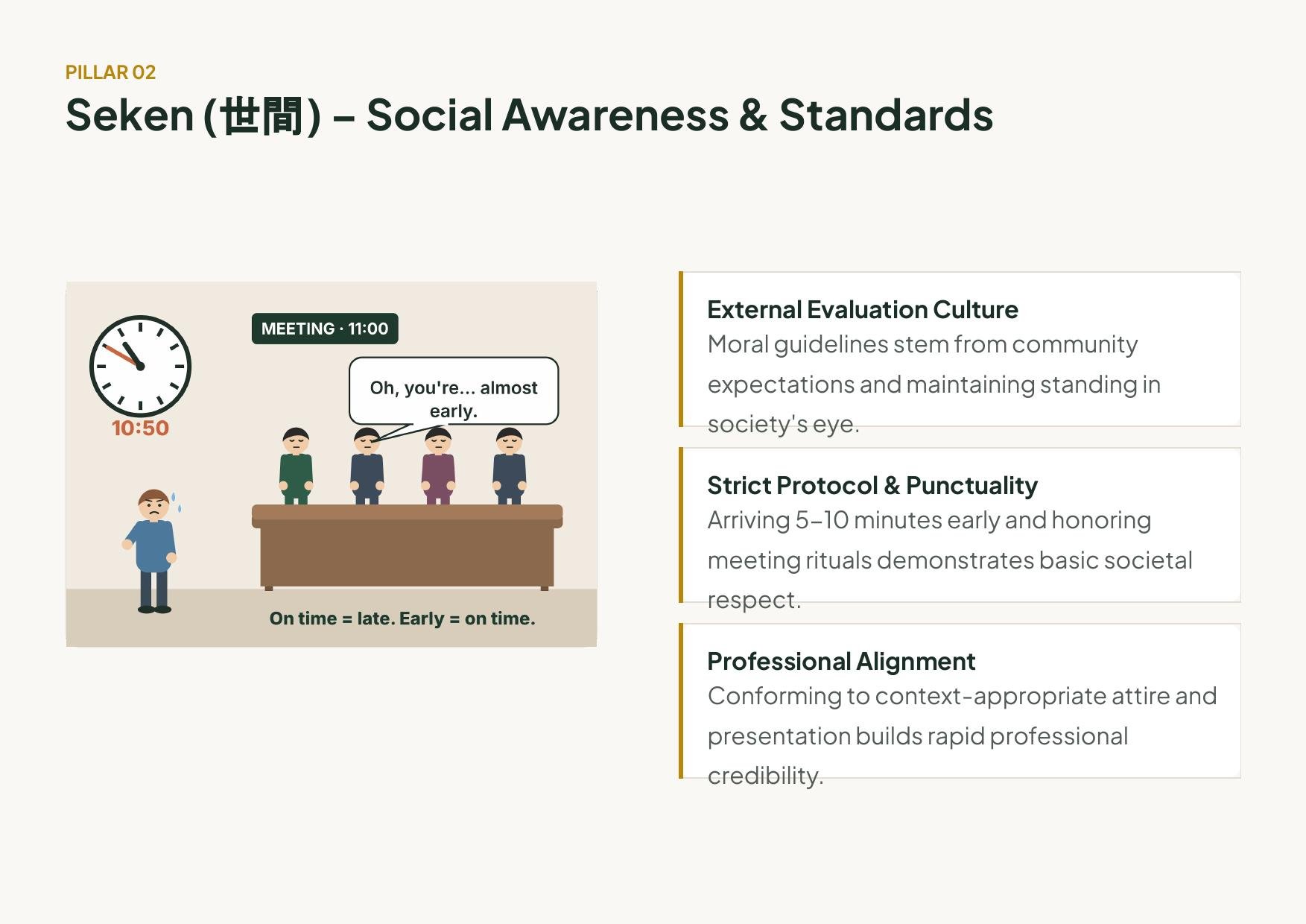
Seken is the watching world: neighbors, colleagues, strangers on the platform. Much of Japanese behavior is guided less by fixed rules than by a sense of how things look to everyone else. The result is a society that runs remarkably smoothly, where trains depart to the minute and people dress carefully for the occasion.
On your trip: be a few minutes early for tours, restaurant bookings and tea ceremonies. Your guide will be there before you. If you’re running late, a quick message is very much appreciated.
Pillar 03
Meiwaku (迷惑): Don’t Be a Bother
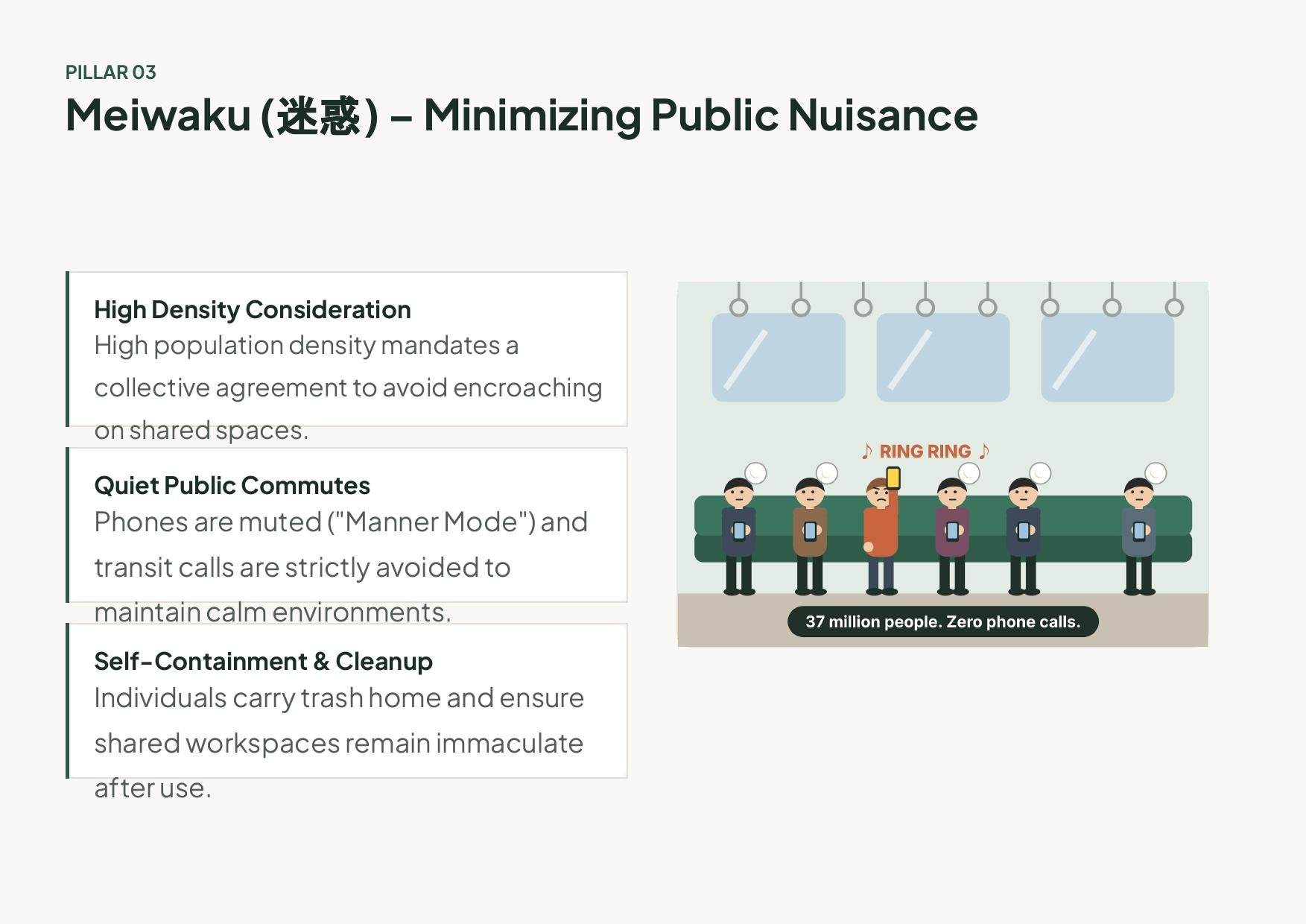
When tens of millions of people share one metropolitan area, small courtesies add up. Meiwaku means causing trouble for others, and avoiding it shapes public life: phones on silent (“manner mode”), no calls on trains, standing on one side of the escalator, and taking your rubbish home with you.
On your trip: set your phone to silent on trains and keep conversations low. Don’t be surprised by how few public trash cans there are; most people carry a small bag for their own rubbish until they find a bin at a station or convenience store.
Pillar 04
Uchi and Soto (内・外): Insiders and Outsiders
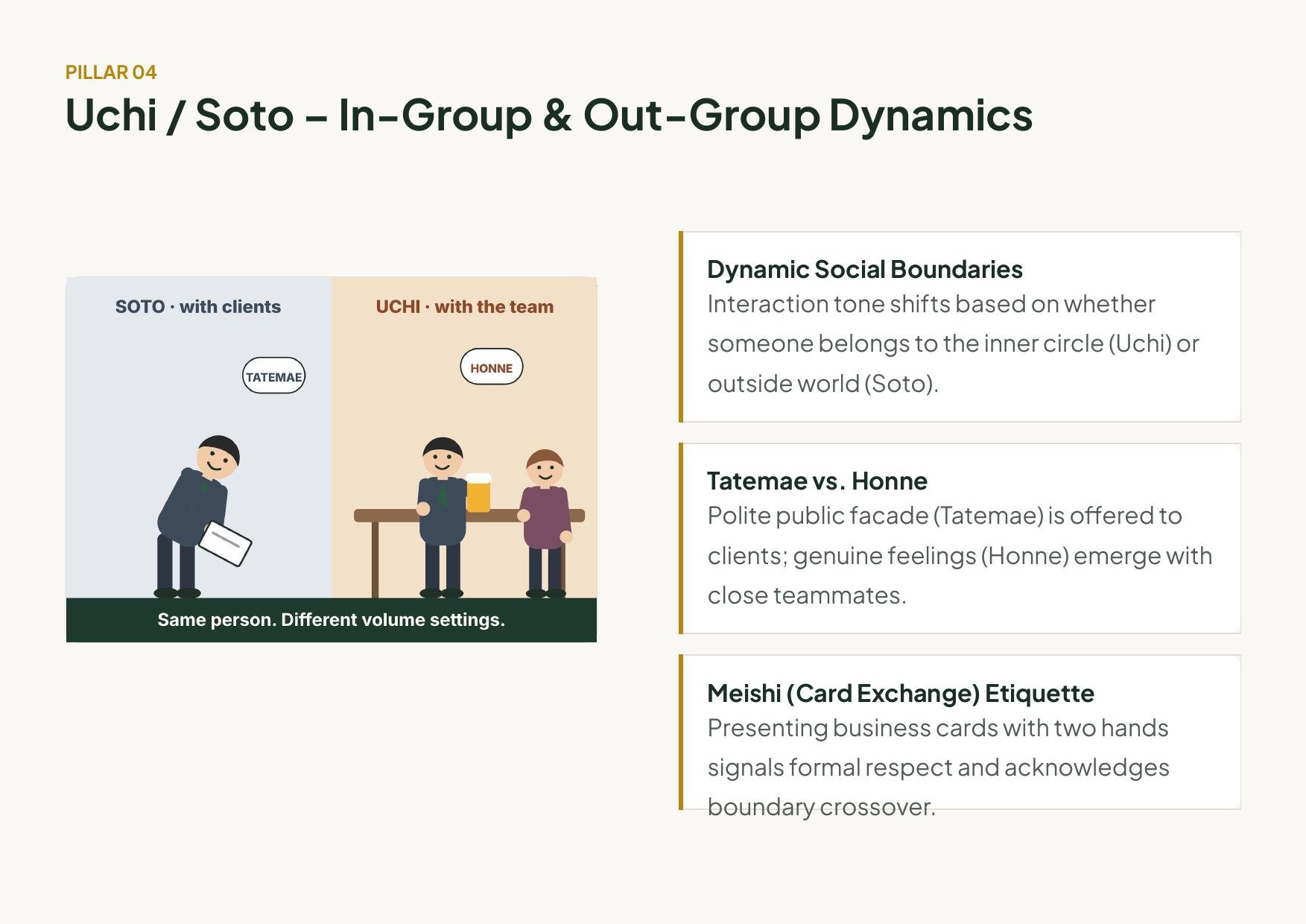
Japanese life draws a clear line between uchi (inside: family, close colleagues) and soto (outside: everyone else). With outsiders, people show tatemae, the polite public face. With insiders, honne, their true feelings, comes out. Business cards (meishi) are exchanged with both hands and a small bow, because they mark the moment an outsider is formally introduced.
On your trip: the polished courtesy you meet in shops and hotels is genuine hospitality, not coldness. To glimpse the honne side, go where locals relax after work: a small neighborhood izakaya, where the formality melts by the second drink.
Pillar 05
Okage-sama (お陰様): Thanks to Everyone
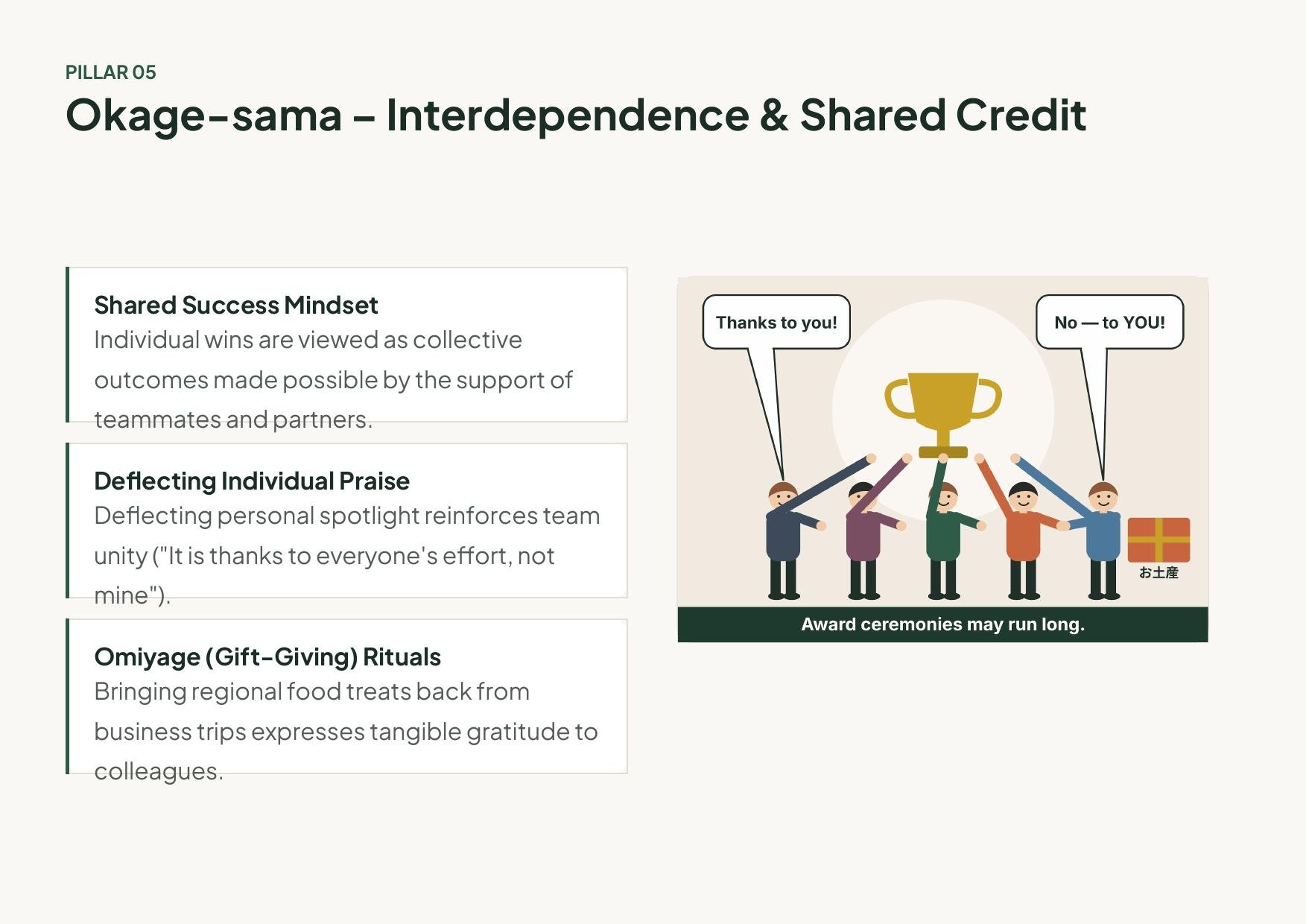
Okage-sama de roughly means “thanks to you” (or “thanks to everyone”), and it’s a common answer to “How are you?” Success in Japan is rarely credited to one person; it’s shared with the team, the family and the people who helped. Gifts are part of the same idea: after a trip, people bring back omiyage, beautifully packaged regional sweets for colleagues and friends.
On your trip: you’ll see whole shops of omiyage at train stations and airports. Bringing a small gift from home for a host, or picking up local sweets to share, is always well received.
Practical application
Three Tips for Your Trip

The slide above was written for the workplace, but the same three ideas work beautifully for travelers:
- Ask early (a traveler’s nemawashi). In Japanese offices, ideas are quietly agreed with each person before the big meeting. For you, that means sharing special requests (dietary needs, mobility, must-see places) with your guide or hotel in advance, not on the day.
- Listen for subtlety. “We’ll consider it,” a pause or a “chotto…” usually means no. Smile, thank them and move on to plan B.
- Say thank you, a lot. A simple arigatō gozaimasu and a small nod go a long way. And there’s no need to tip: good service is simply expected, and leaving money can cause confusion.
Travel with someone who can read the air for you
Your private guide translates more than the language: the pauses, the polite “maybe” and the unwritten rules. Tell us what you’d like to experience, and we’ll plan a day around you.
Next briefing: 16,000 Years of Japan: A Private Guide’s History Briefing. All briefings: Private Guide Briefings.
Illustrations: original artwork by Travel Assist Japan.