
A Private Guide Briefing from Travel Assist Japan
Before you land, our private guides like to give guests a quick tour of the 16,000 years behind what they’re about to see. This is that briefing: three ages, a few surprises, and one or two jokes, in about 15 minutes. Read it on the plane, and your first shrine, castle town or bullet-train ride will make a lot more sense.
The big picture
Three Ages, One Timeline
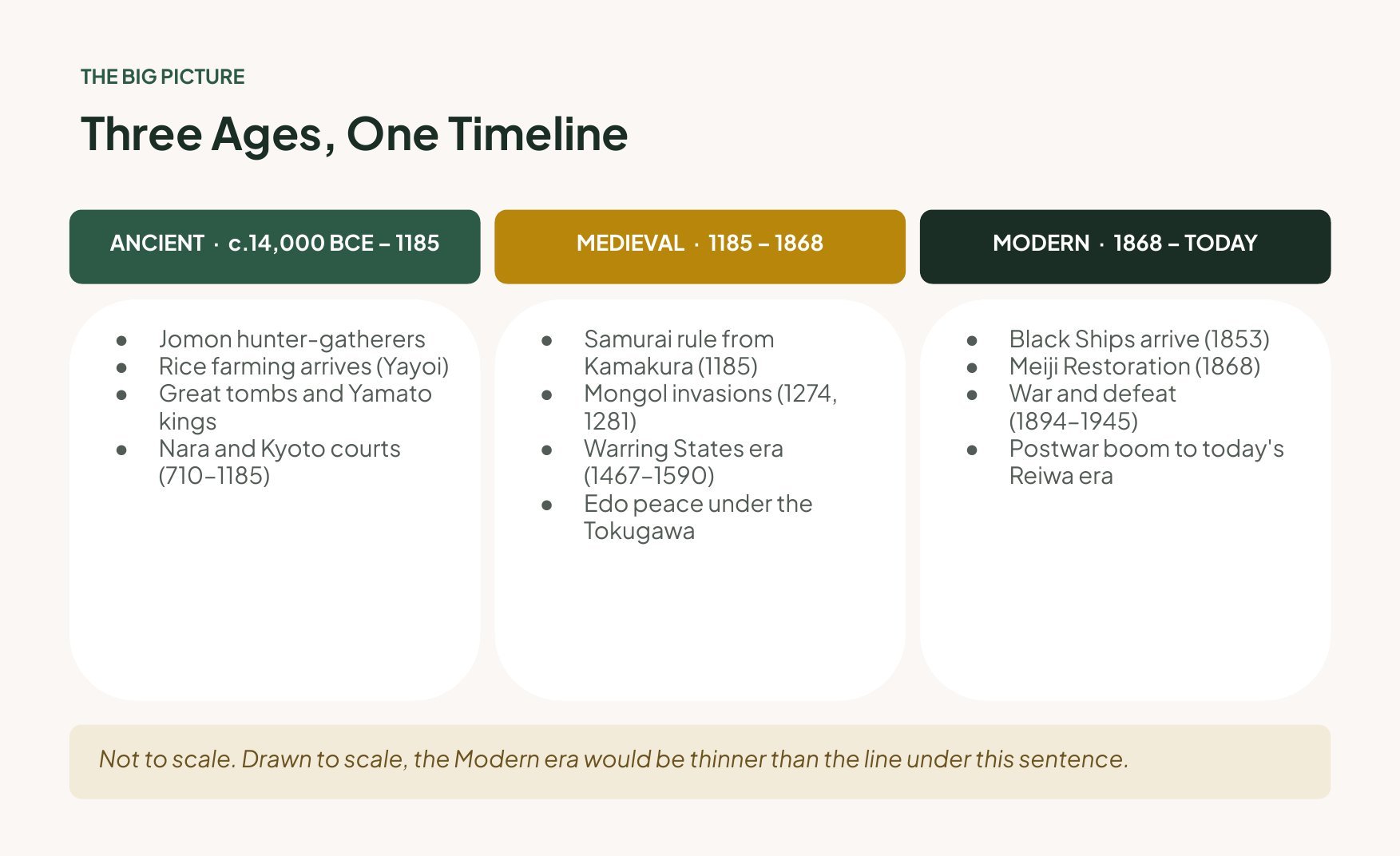
Japanese history is easiest to hold in your head as three ages. The Ancient age runs from the first Jomon villages to the elegant court of Kyoto. The Medieval age belongs to the samurai, from the first warrior government in Kamakura to 250 peaceful years under the Tokugawa shoguns. The Modern age begins in 1868, when Japan reinvented itself at astonishing speed.
Meanwhile, Elsewhere in the World
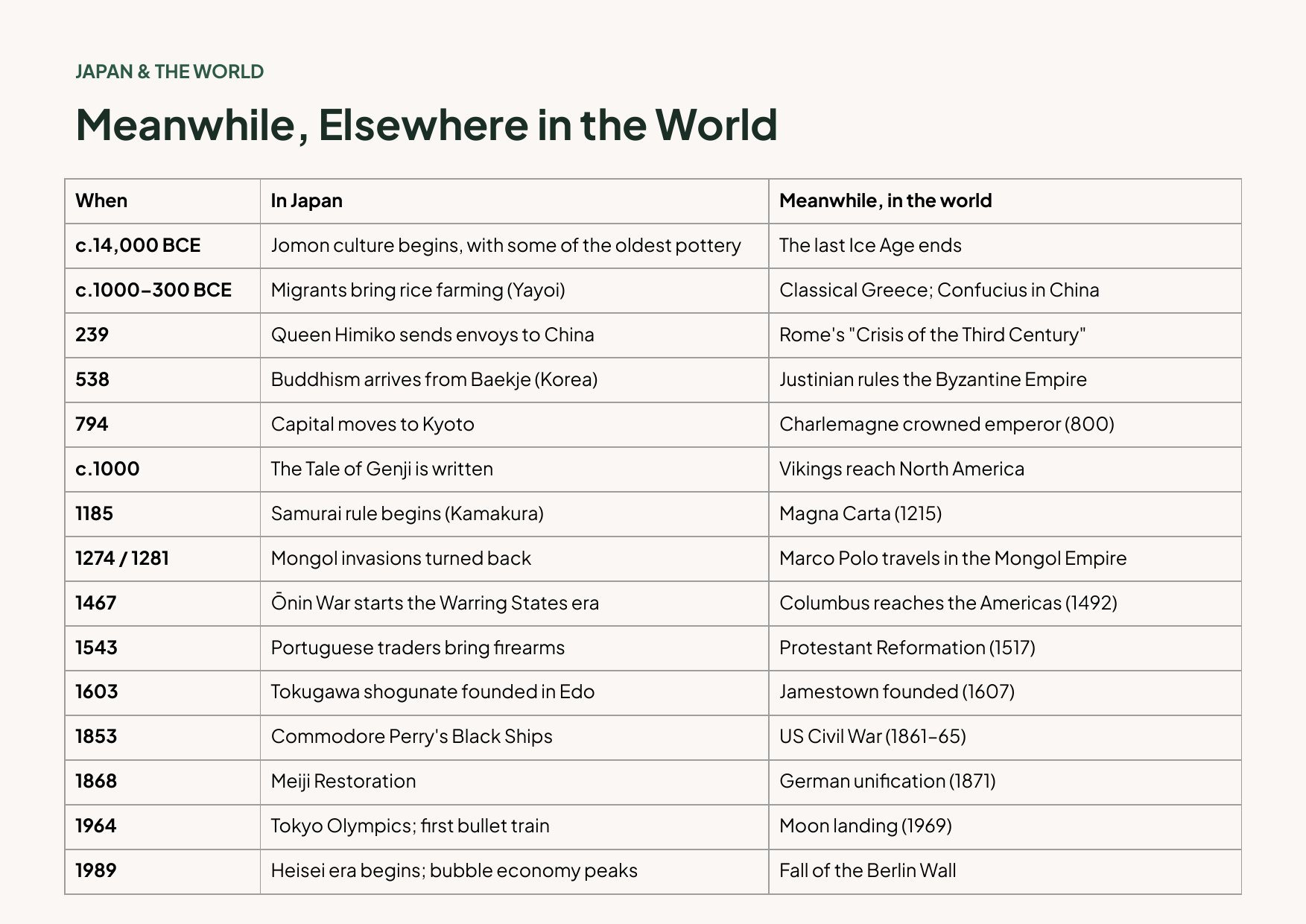
Dates stick better when you can hang them on something you already know:
| When | In Japan | Meanwhile, in the world |
|---|---|---|
| c.14,000 BCE | Jomon culture begins, with some of the oldest pottery | The last Ice Age ends |
| c.1000–300 BCE | Migrants bring rice farming (Yayoi) | Classical Greece; Confucius in China |
| 239 | Queen Himiko sends envoys to China | Rome’s “Crisis of the Third Century” |
| 538 | Buddhism arrives from Baekje (Korea) | Justinian rules the Byzantine Empire |
| 794 | Capital moves to Kyoto | Charlemagne crowned emperor (800) |
| c.1000 | The Tale of Genji is written | Vikings reach North America |
| 1185 | Samurai rule begins (Kamakura) | Magna Carta (1215) |
| 1274 / 1281 | Mongol invasions turned back | Marco Polo travels in the Mongol Empire |
| 1467 | Ōnin War starts the Warring States era | Columbus reaches the Americas (1492) |
| 1543 | Portuguese traders bring firearms | Protestant Reformation (1517) |
| 1603 | Tokugawa shogunate founded in Edo | Jamestown founded (1607) |
| 1853 | Commodore Perry’s Black Ships | US Civil War (1861–65) |
| 1868 | Meiji Restoration | German unification (1871) |
| 1964 | Tokyo Olympics; first bullet train | Moon landing (1969) |
| 1989 | Heisei era begins; bubble economy peaks | Fall of the Berlin Wall |
Part 1 · Ancient Japan
The Jomon: 10,000+ Years of Hunter-Gatherers
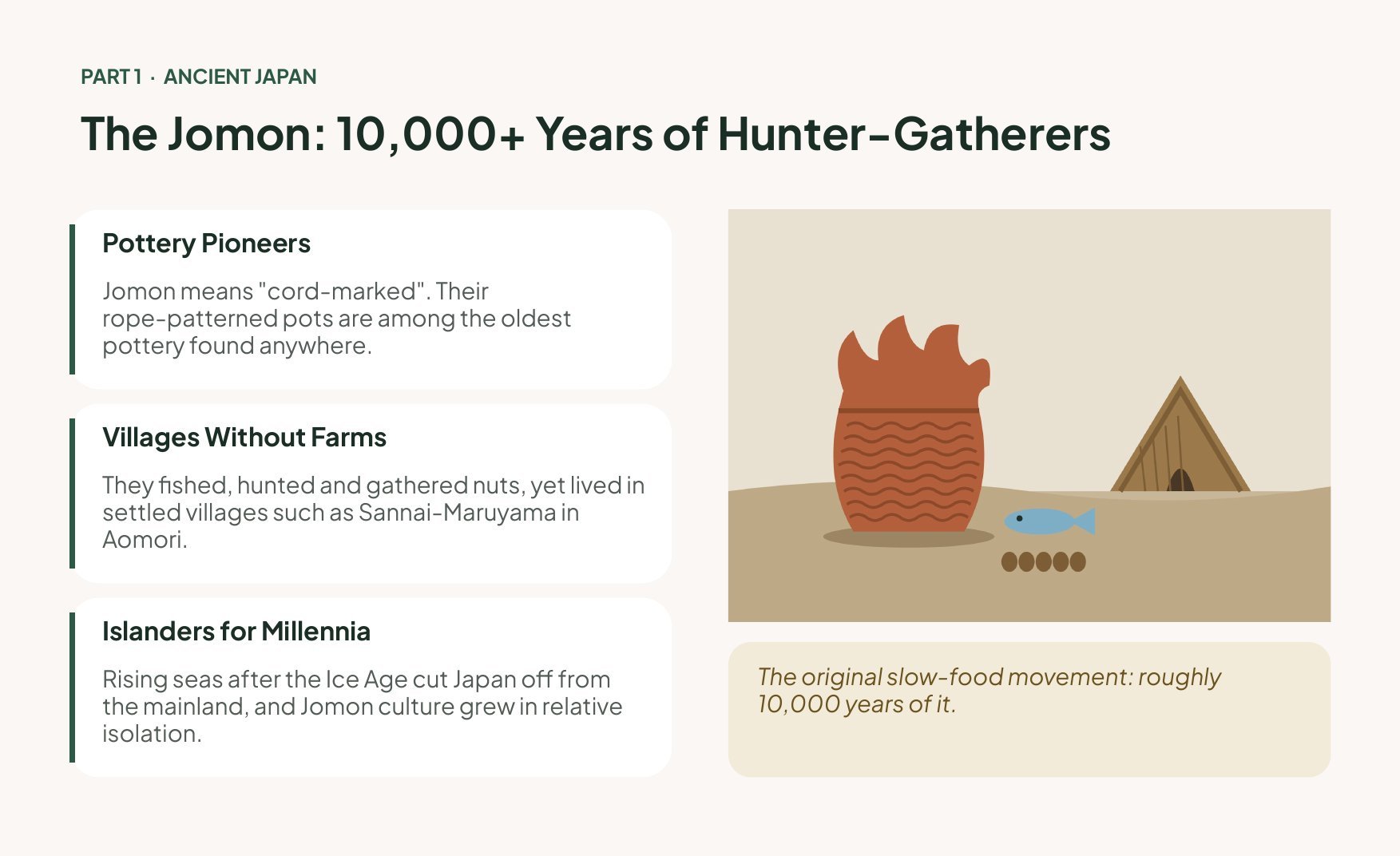
For more than ten thousand years, the Jomon people lived by fishing, hunting and gathering, yet they settled in villages and made some of the earliest pottery anywhere, decorated with twisted cord. Their name literally means “cord-marked.” In 2021, a group of Jomon sites in northern Japan, including the large Sannai-Maruyama village in Aomori, became a UNESCO World Heritage Site.
Japan Was Built by Three Waves of People
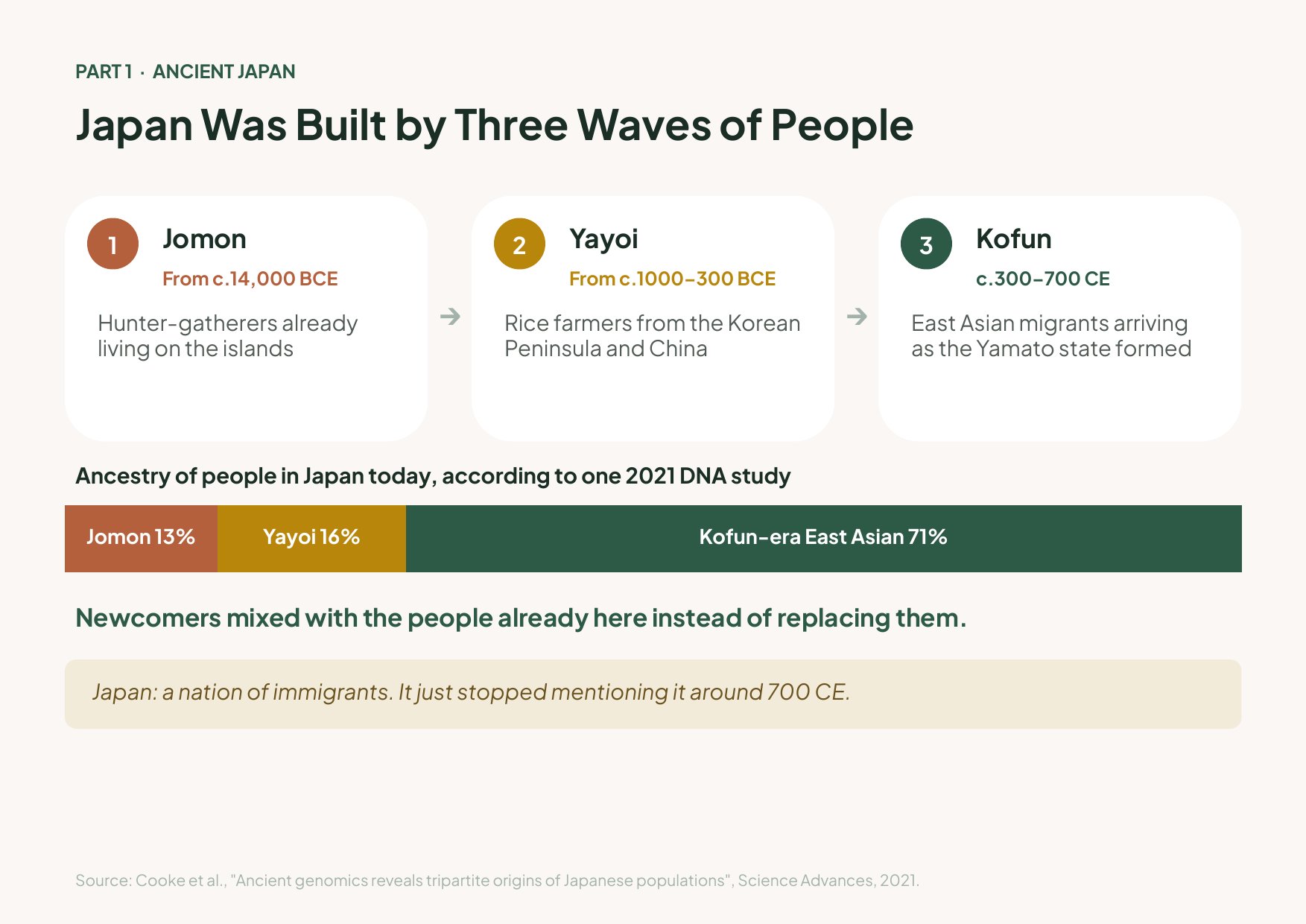
Japan is sometimes imagined as a single, unchanging people. The DNA tells a more interesting story. A 2021 study of ancient genomes found three ancestral groups: the Jomon hunter-gatherers; Yayoi rice farmers who arrived from the Korean Peninsula and China from roughly 1000 BCE; and a later wave of East Asian migrants during the Kofun period (about 300–700 CE), when the Yamato state was forming. People in Japan today carry all three.
Unlike much of Europe, where incoming farmers largely replaced hunter-gatherers, the newcomers in Japan mixed with the people already living there.
North and South Kept the Jomon Legacy
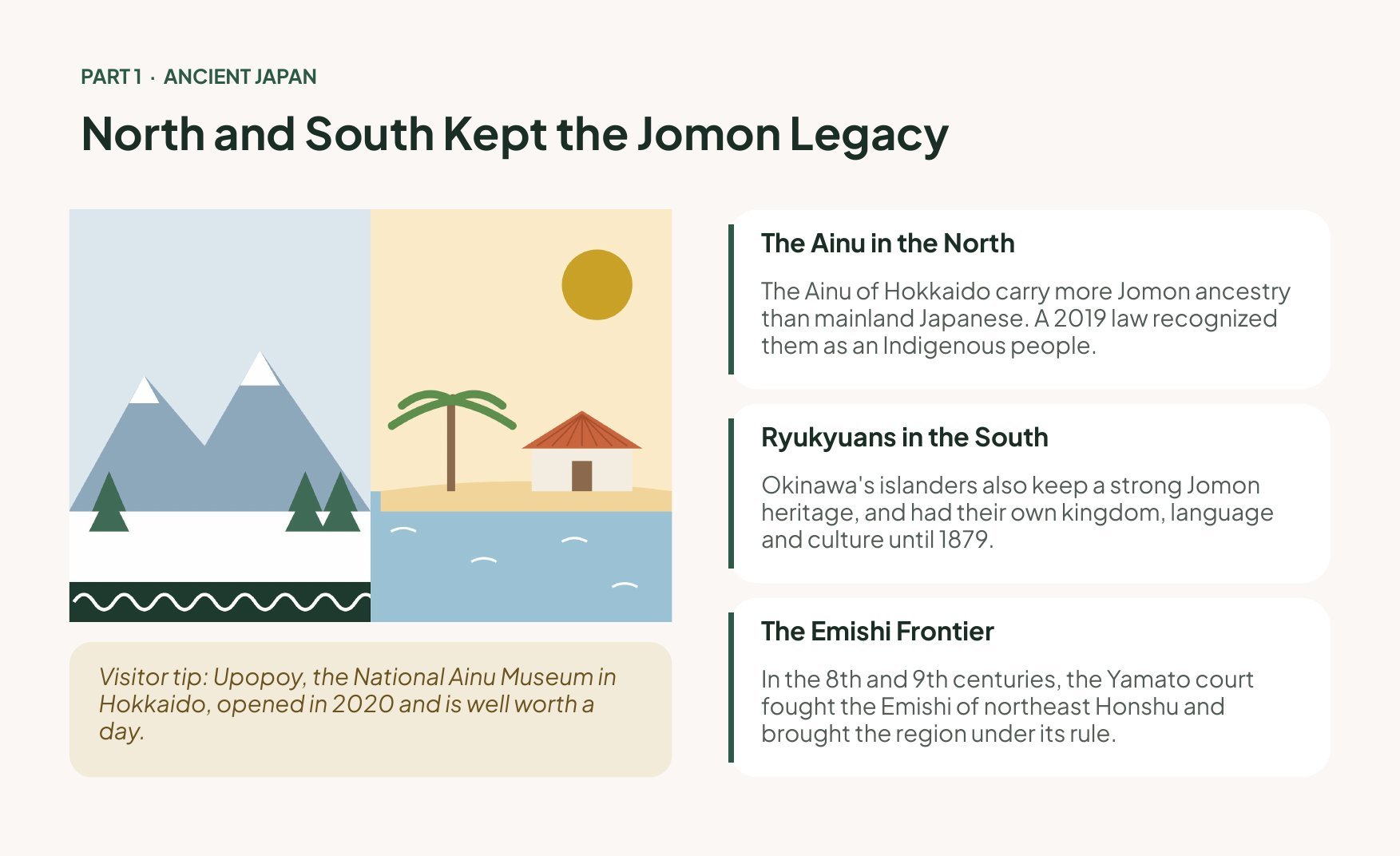
The Jomon heritage is strongest at the two ends of the country. The Ainu of Hokkaido and the people of the Ryukyu Islands (Okinawa) carry more Jomon ancestry than mainland Japanese. Okinawa was an independent kingdom with its own language until 1879, and a 2019 law formally recognized the Ainu as an Indigenous people of Japan. In northeast Honshu, the Yamato court fought the Emishi in the 8th and 9th centuries before bringing the region under its rule.
Yamato Kings and the Korean Connection
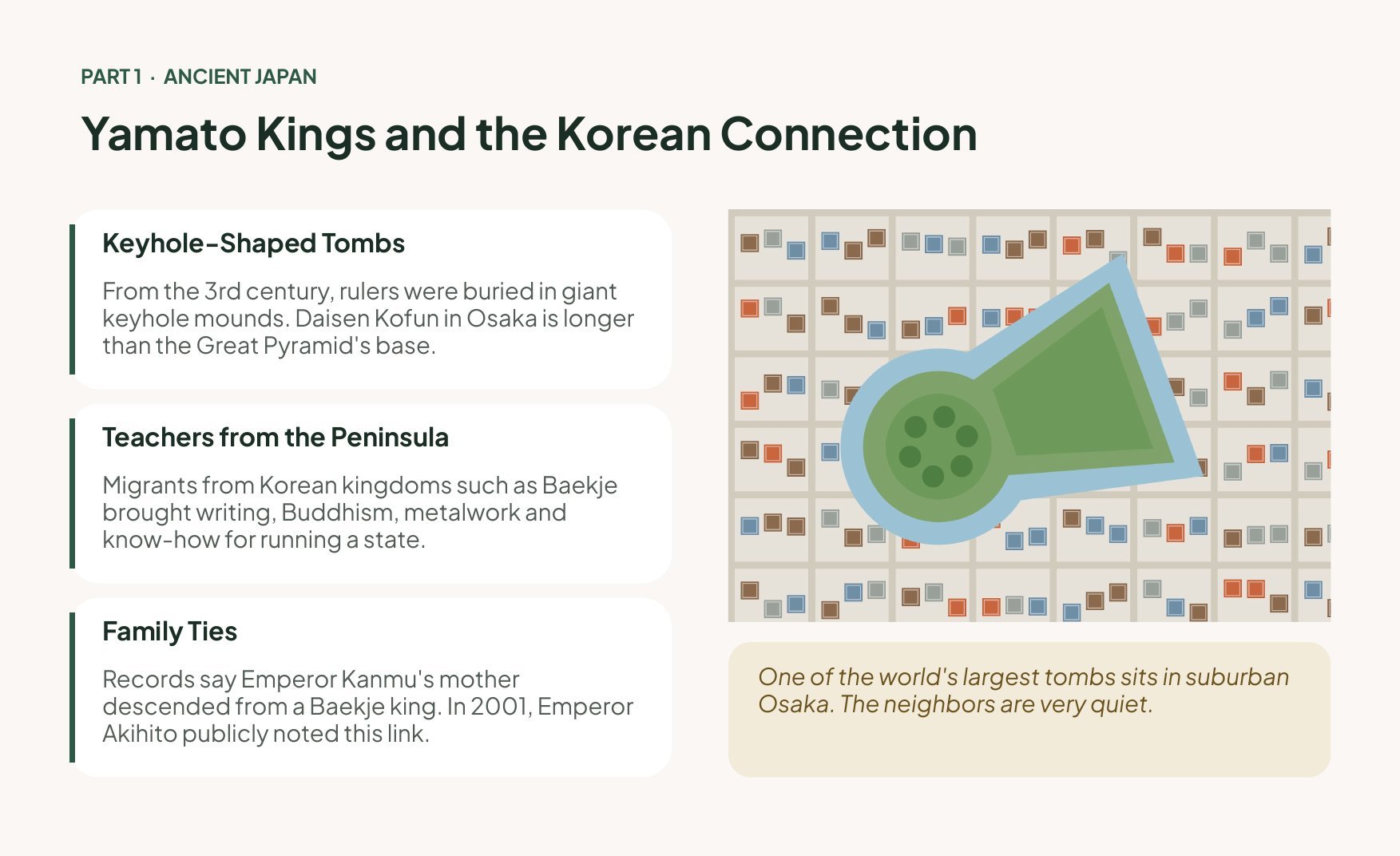
From the 3rd century, Japan’s rulers were buried in enormous keyhole-shaped mounds called kofun. The largest, Daisen Kofun in Sakai, Osaka, is longer than the base of the Great Pyramid. Migrants from Korean kingdoms such as Baekje brought writing, Buddhism, metalwork and the know-how to run a state, and the connection reached the imperial family itself: records say the mother of Emperor Kanmu (737–806) descended from a Baekje king, something Emperor Akihito publicly noted in 2001.
Japan’s Wildest Legend: Did Jesus Retire in Aomori?
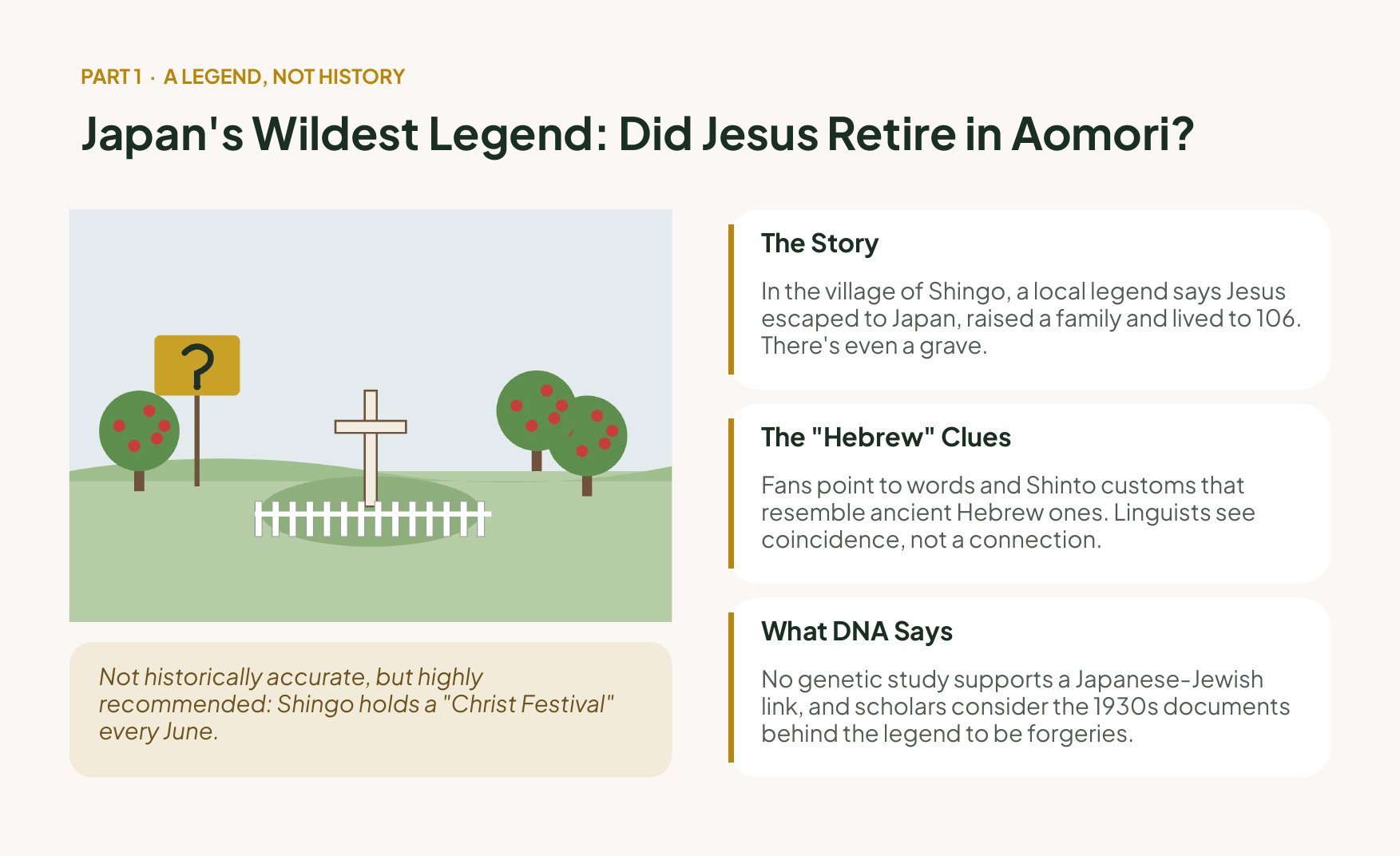
Every country has its legends, and this is one of Japan’s strangest. In the village of Shingo in Aomori, a local story says Jesus escaped to Japan, raised a family and lived to 106. There’s a grave, a small museum and an annual festival. Enthusiasts also point to Japanese words and Shinto customs that resemble ancient Hebrew ones.
Historians treat all of this as legend: no genetic study supports a Japanese-Jewish link, and the documents behind the Shingo story, which surfaced in the 1930s, are widely considered forgeries. But the legend says something real about Japan: its religious life has always been remarkably open to stories from far away.
Borrowing from China, Then Making It Japanese
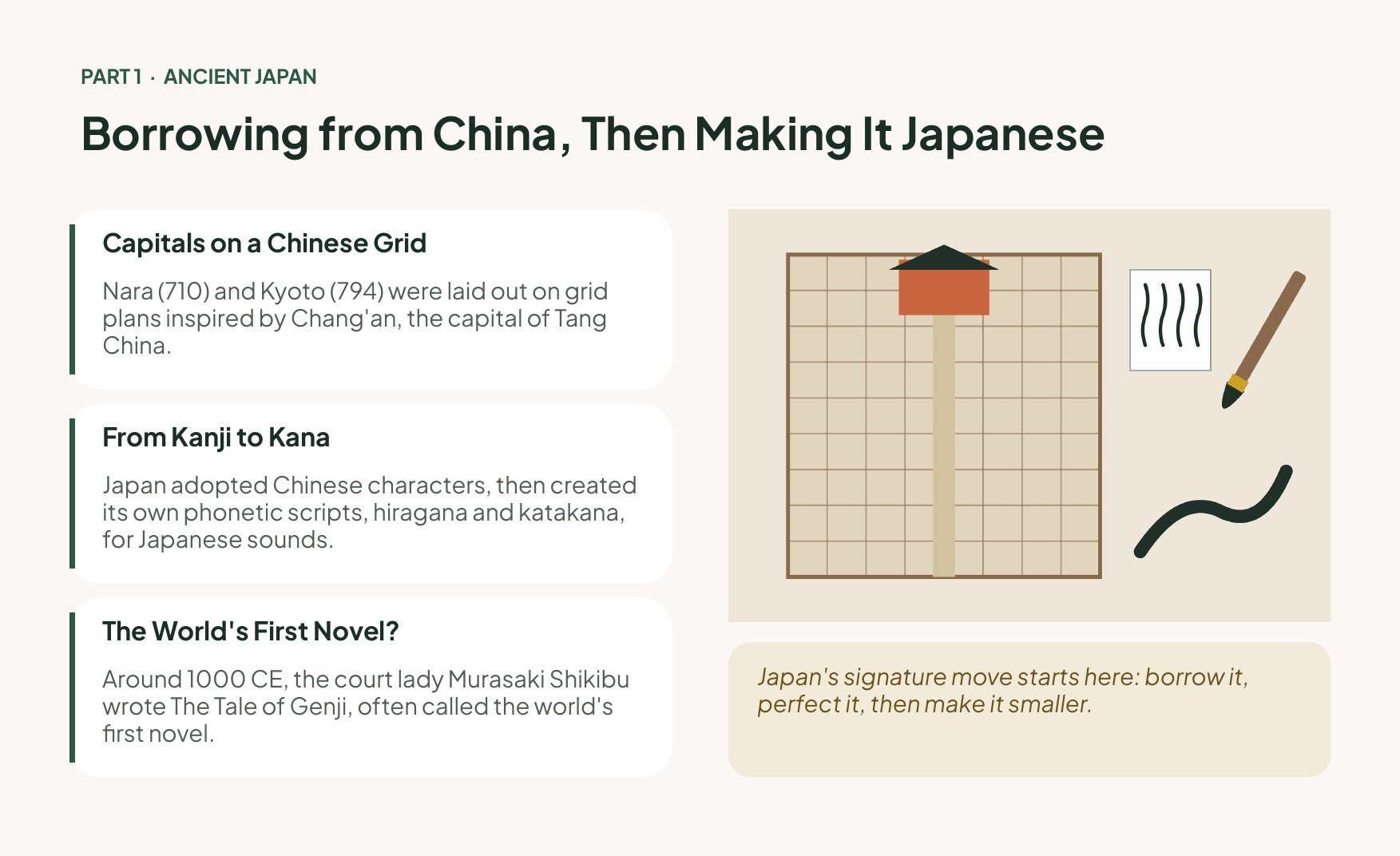
Nara (710) and then Kyoto (794) were laid out on grid plans modeled on Chang’an, the capital of Tang China. Japan adopted Chinese characters, then created its own phonetic scripts, hiragana and katakana. Around the year 1000, the court lady Murasaki Shikibu wrote The Tale of Genji, often called the world’s first novel.
Part 2 · Medieval Japan
The Samurai Take Over (1185)
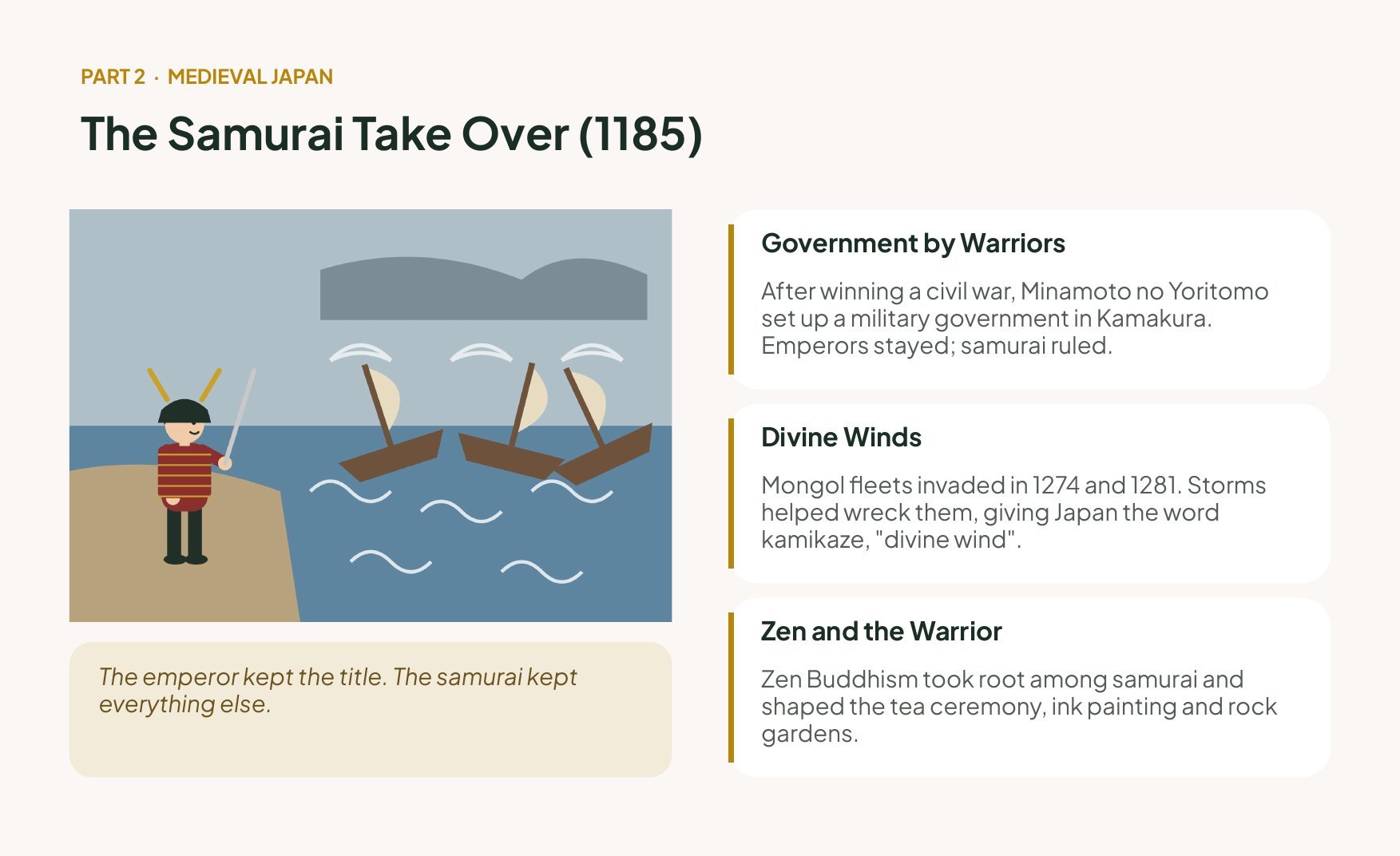
After winning a civil war, Minamoto no Yoritomo set up a military government in Kamakura, just south of today’s Tokyo. Emperors kept their title in Kyoto, but warriors ran the country for nearly 700 years. When Mongol fleets invaded in 1274 and 1281, storms helped wreck them, giving Japan the word kamikaze, “divine wind.” Zen Buddhism took root among the samurai and shaped the tea ceremony, ink painting and rock gardens.
150 Years of Civil War, Then Unification
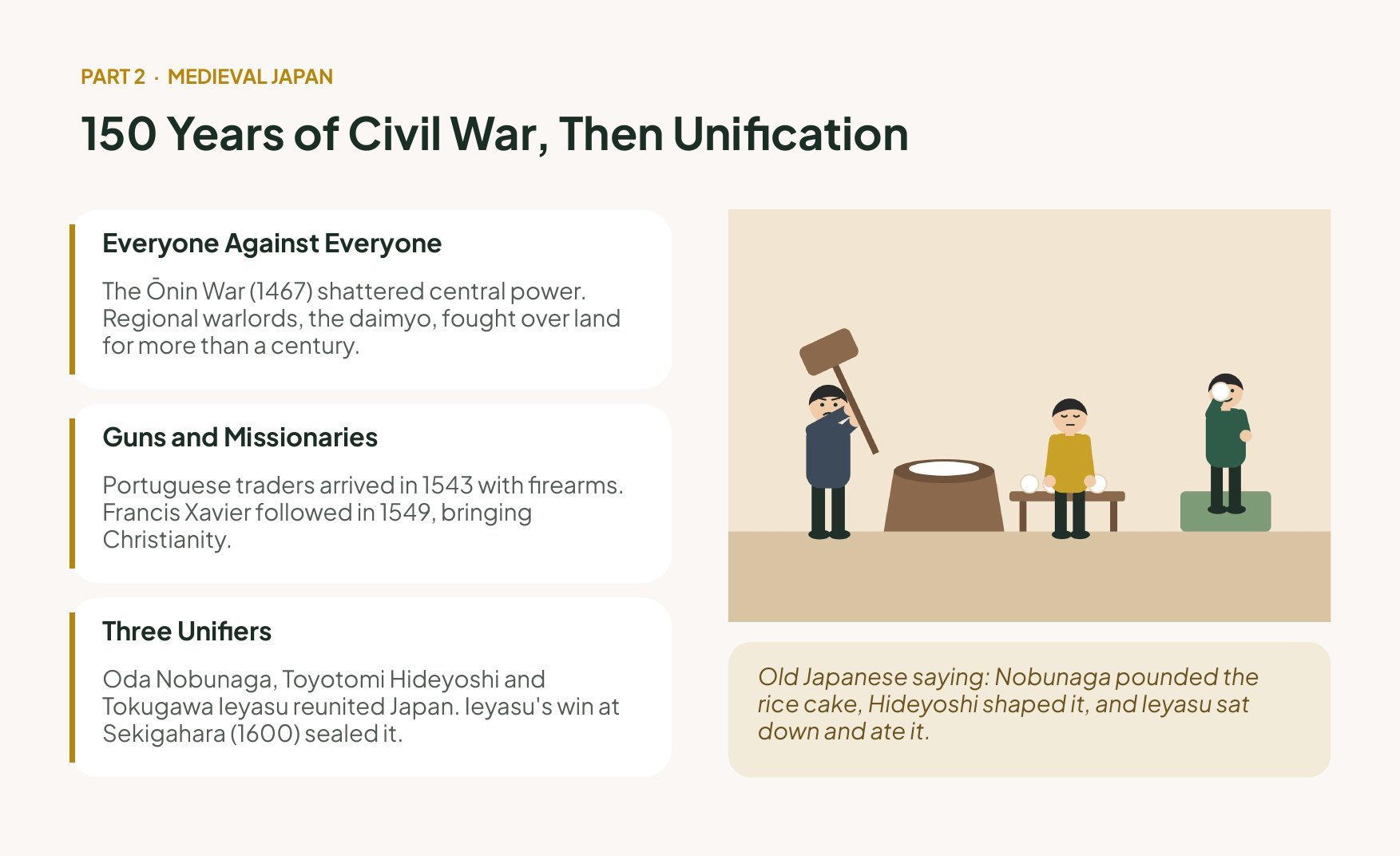
The Ōnin War of 1467 shattered central power, and for more than a century regional warlords, the daimyo, fought over land. Portuguese traders arrived in 1543 with firearms, and the missionary Francis Xavier followed in 1549. Three men finally reunited Japan: Oda Nobunaga, Toyotomi Hideyoshi and Tokugawa Ieyasu, whose victory at Sekigahara in 1600 sealed it.
250 Years of Peace Behind Closed Doors
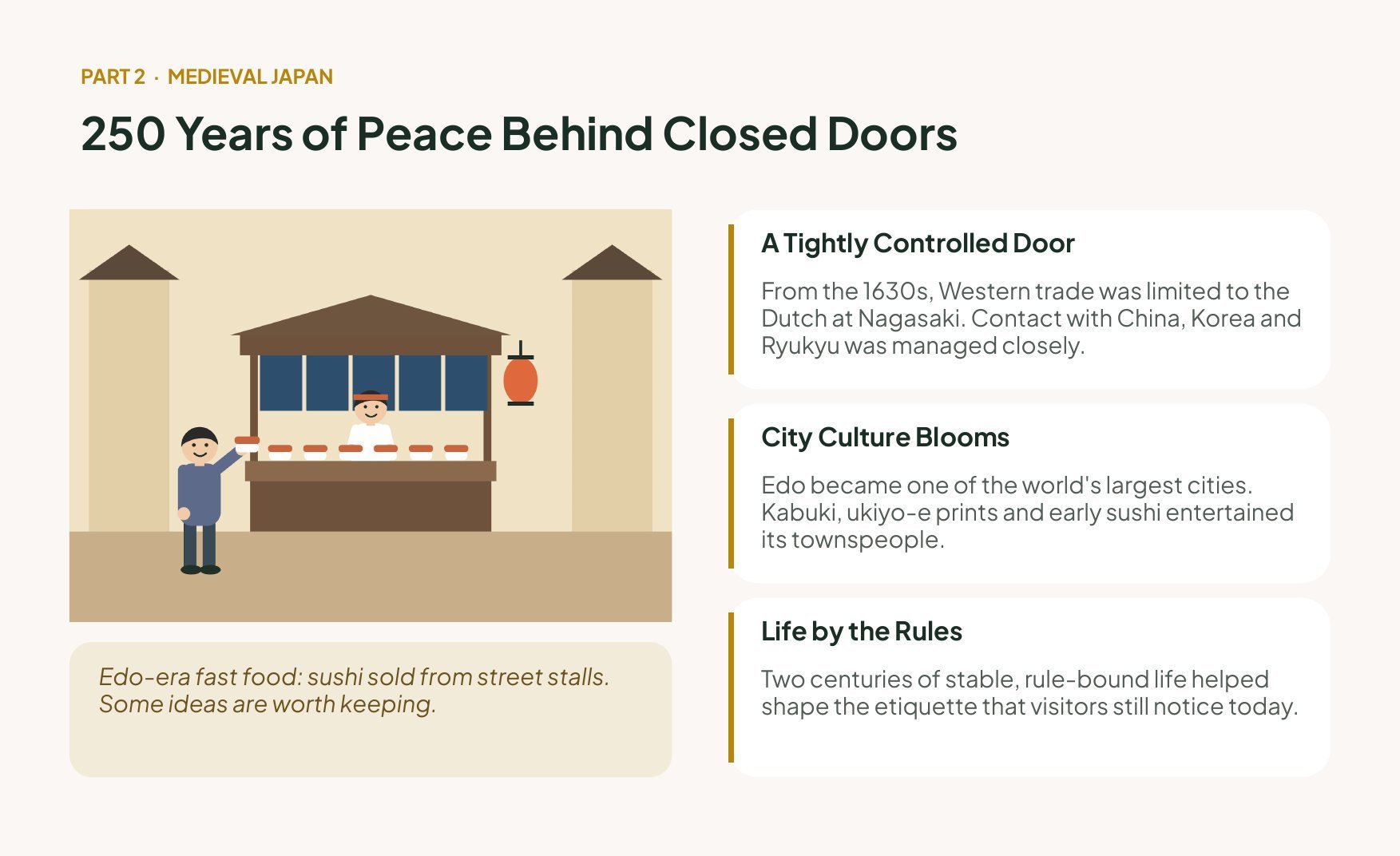
From the 1630s, the Tokugawa shoguns kept Japan’s doors almost shut: Western trade was limited to the Dutch at Nagasaki, and contact with China, Korea and the Ryukyus was carefully managed. Inside, Edo (today’s Tokyo) became one of the largest cities in the world, and its townspeople enjoyed kabuki theater, ukiyo-e woodblock prints and an early form of sushi. Two centuries of stable, rule-bound life helped shape the etiquette visitors still notice today.
Part 3 · Modern Japan
Black Ships and a Crash Course in Modernization
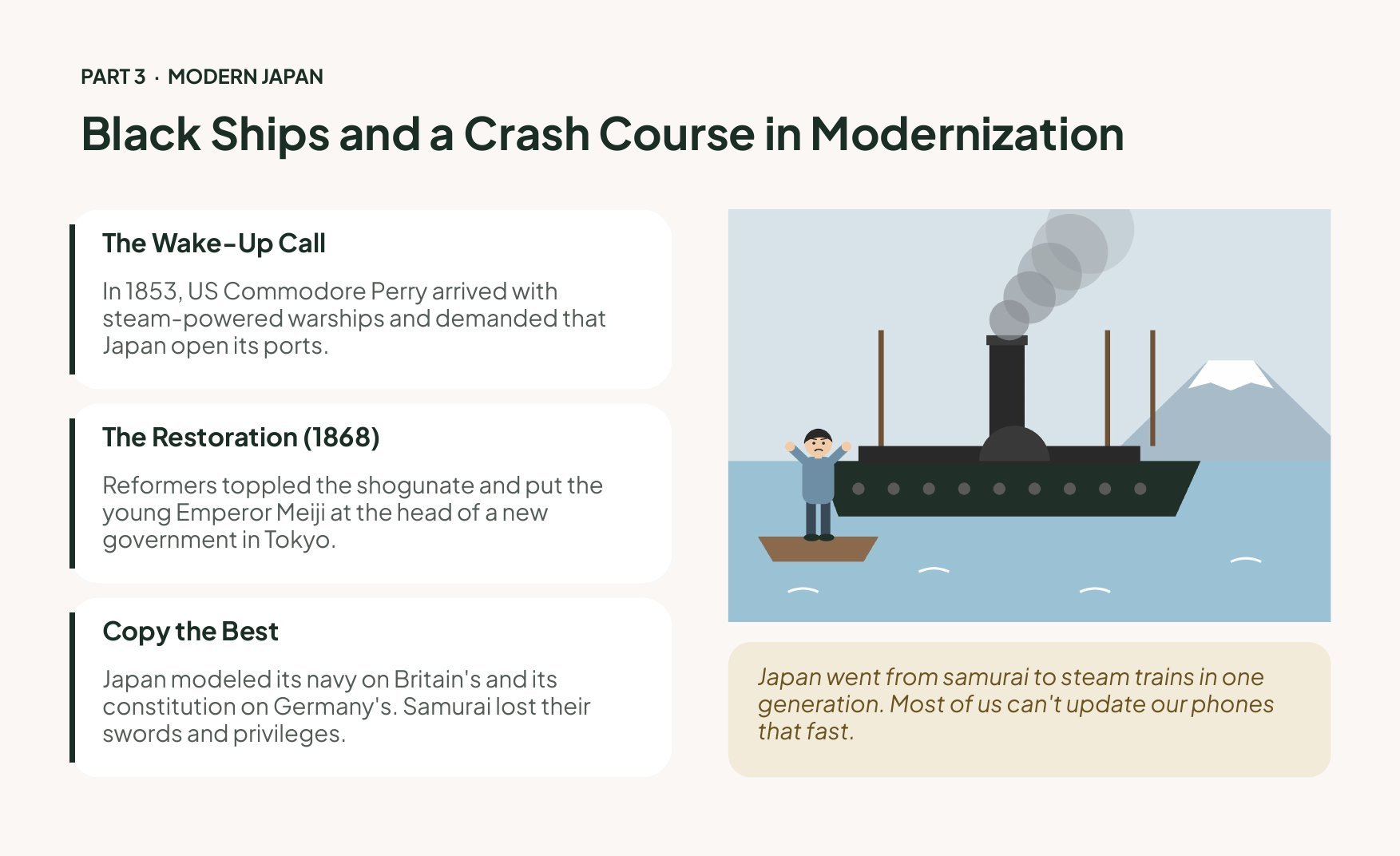
In 1853, US Commodore Matthew Perry sailed into Edo Bay with steam-powered warships and demanded that Japan open its ports. Fifteen years later, reformers toppled the shogunate and placed the young Emperor Meiji at the head of a new government in Tokyo. Japan studied the West and borrowed the best it could find, modeling its navy on Britain’s and its constitution on Germany’s. The samurai lost their swords and their privileges.
Samurai Students in Disguise: The Choshu Five
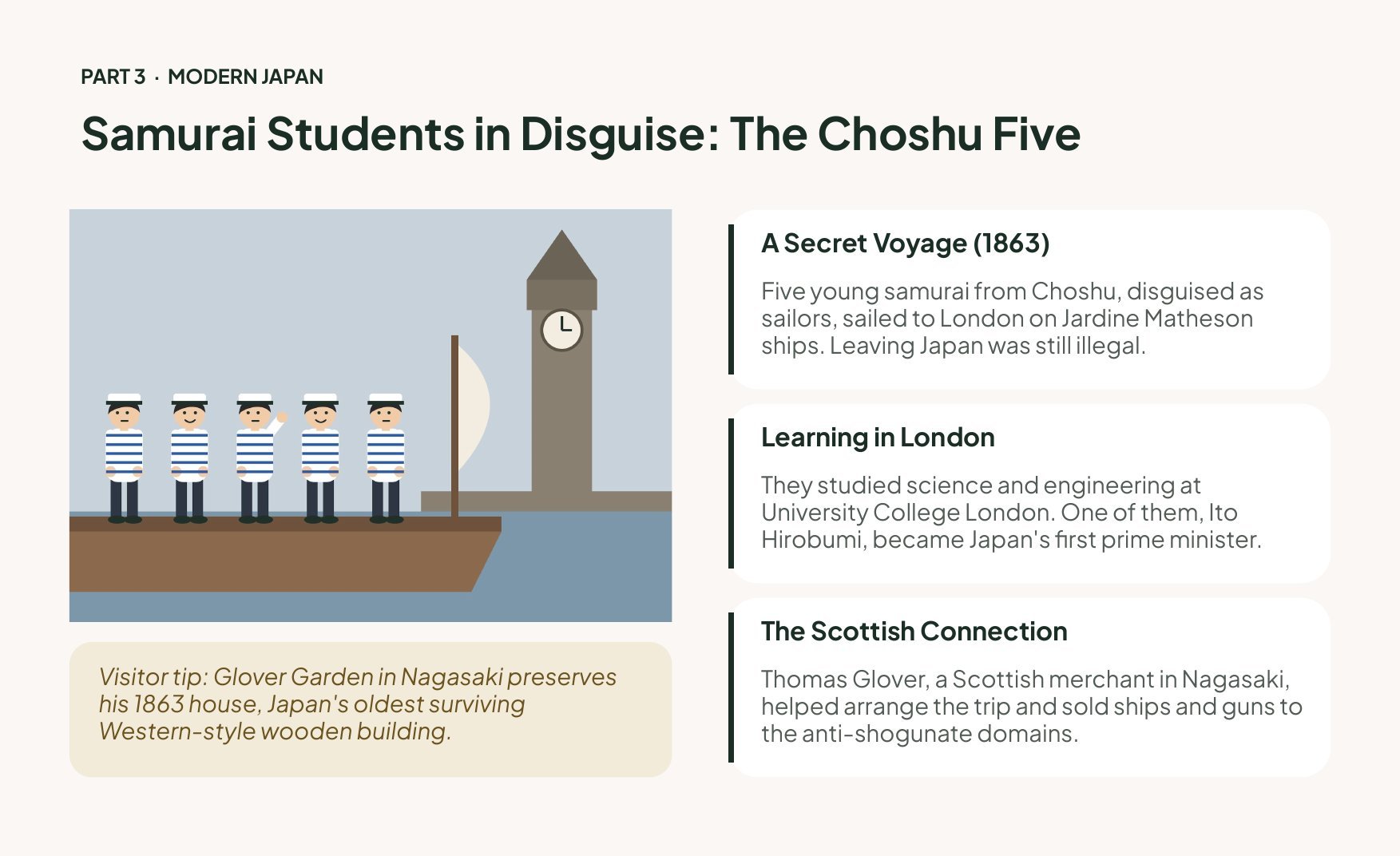
In 1863, when leaving Japan was still illegal, five young samurai from the Choshu domain disguised themselves as sailors and sailed to London on ships of the trading firm Jardine Matheson. They studied science and engineering at University College London. One of them, Ito Hirobumi, later became Japan’s first prime minister. The trip was arranged with the help of Thomas Glover, a Scottish merchant in Nagasaki who also sold ships and guns to the domains that brought down the shogunate.
Empire, War and Defeat (1894–1945)
Wars with China (1894–95) and Russia (1904–05) made Japan a colonial power, ruling Taiwan and later Korea. In the 1930s the military took control of politics, seized Manchuria and launched a full-scale invasion of China. After the attack on Pearl Harbor in December 1941, Japan fought the United States and its allies across Asia and the Pacific, causing immense suffering throughout the region. Atomic bombs destroyed Hiroshima and Nagasaki in August 1945; Japan surrendered, and a US-led occupation began.
Hiroshima’s Peace Memorial Museum is one of the most moving places a visitor can see in Japan.
From Ashes to Bullet Trains
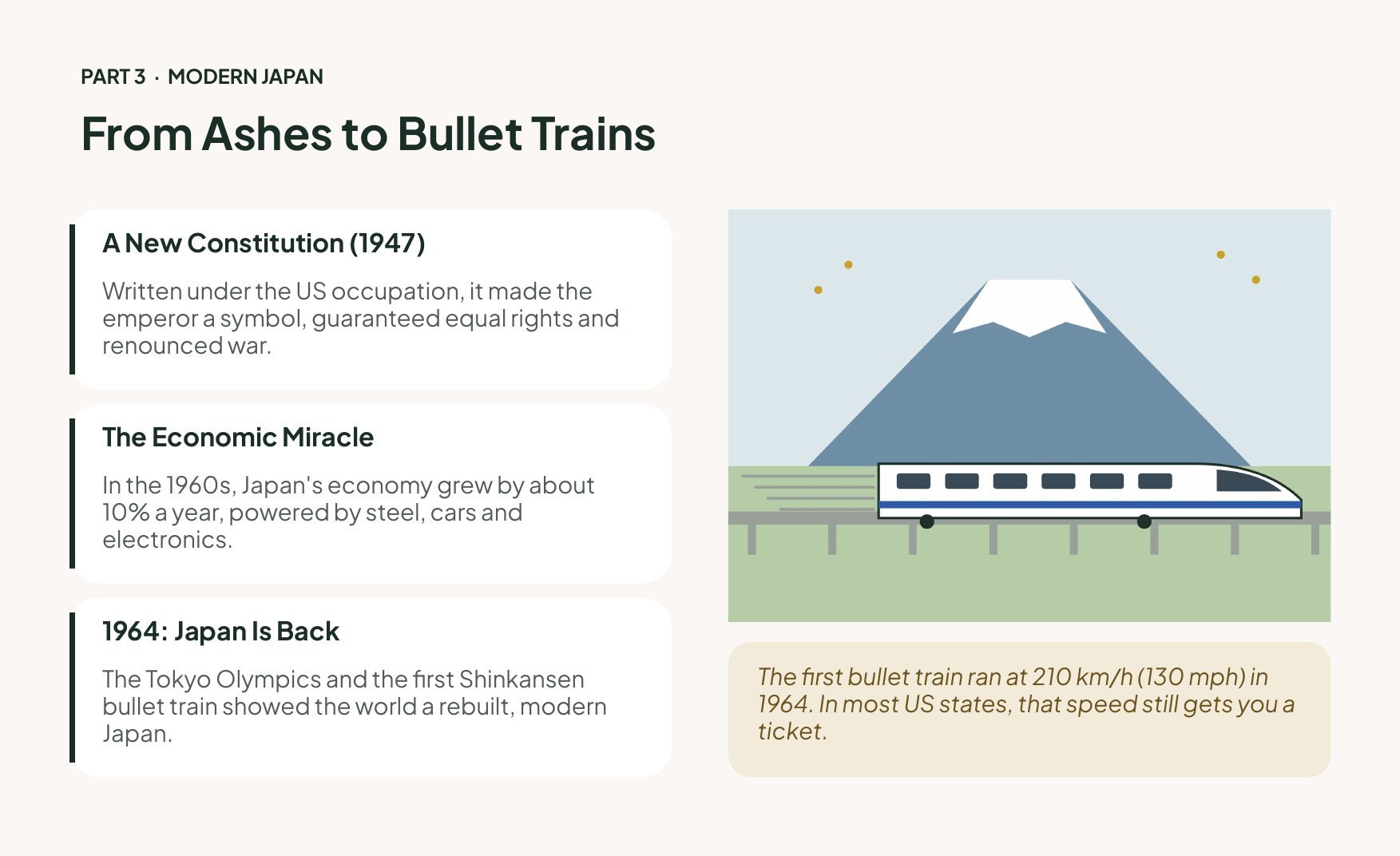
Japan’s 1947 constitution, written under the US occupation, made the emperor a symbol of the nation, guaranteed equal rights and renounced war. In the 1960s, the economy grew by about 10 percent a year, powered by steel, cars and electronics. In 1964, the Tokyo Olympics and the first Shinkansen bullet train showed the world a rebuilt, modern Japan.
Japan Today: An Old Country in a New Era
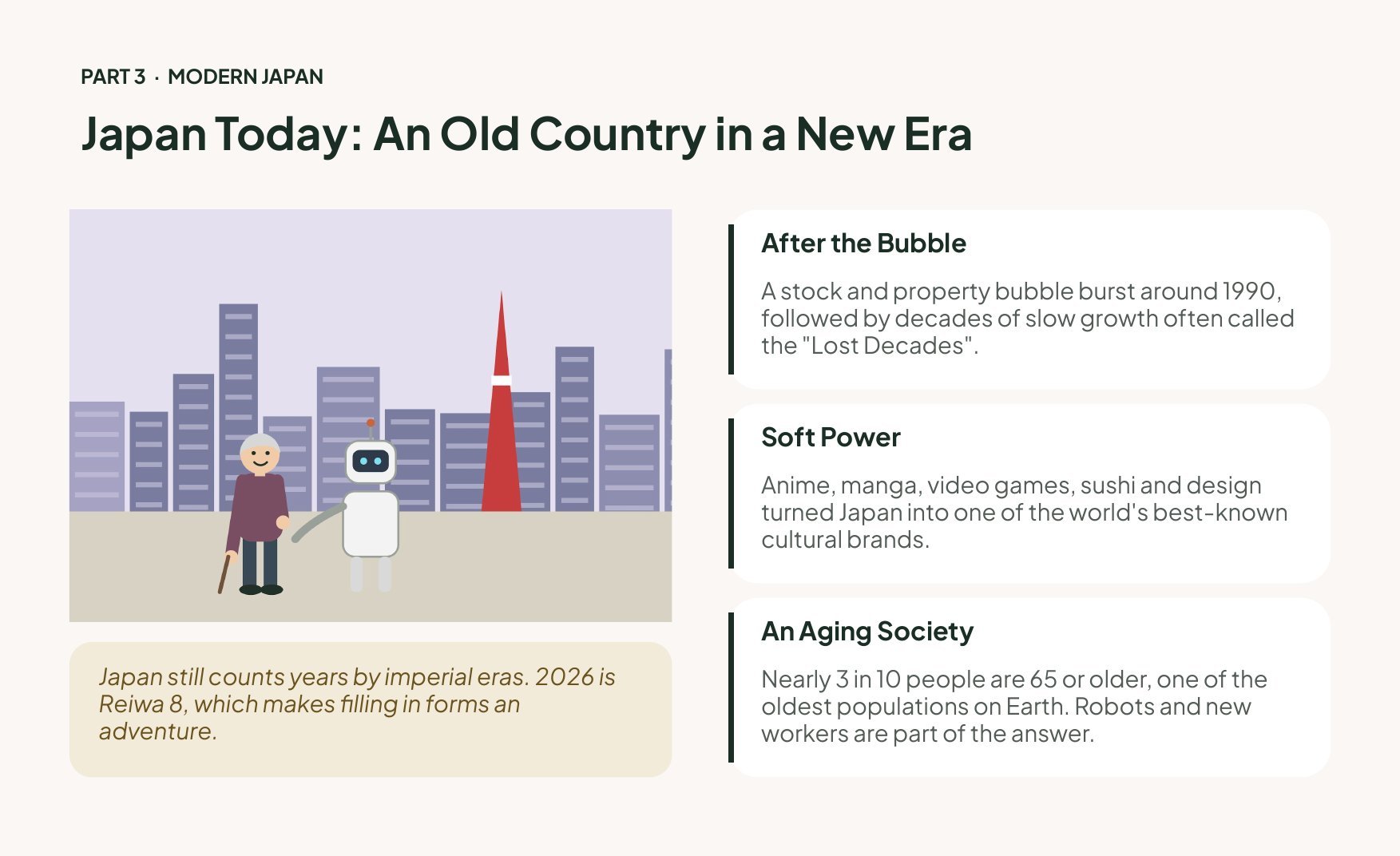
A stock and property bubble burst around 1990, followed by years of slow growth often called the “Lost Decades.” At the same time, anime, manga, video games, sushi and design turned Japan into one of the world’s best-known cultural brands. Today nearly 3 in 10 people are 65 or older, one of the oldest populations on Earth, and robots and new workers are part of the answer.
Why it matters on your trip
What History Explains About What You’ll See
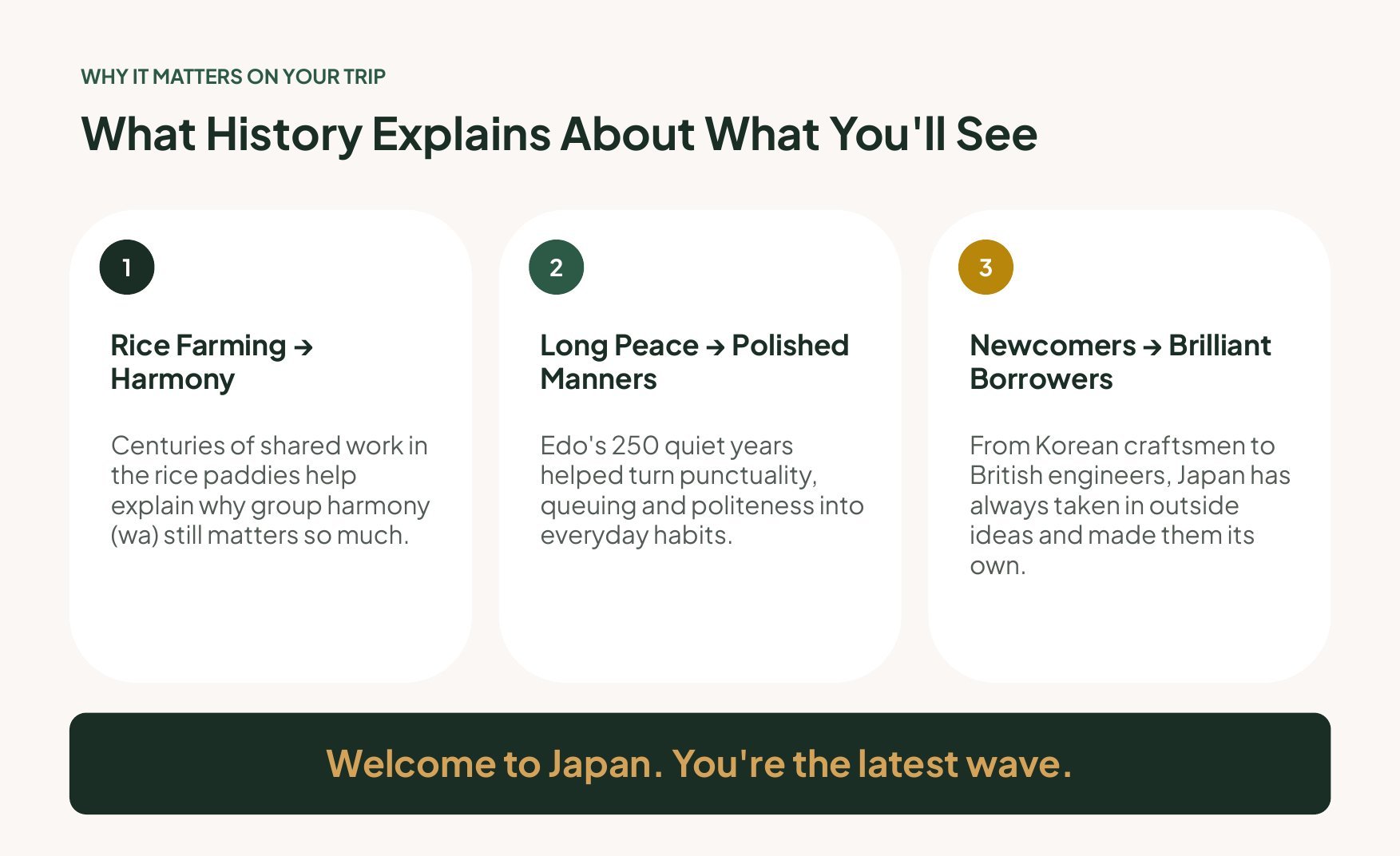
- Rice farming → harmony. Centuries of shared work in the rice paddies help explain why group harmony (wa) still matters so much.
- Long peace → polished manners. Edo’s 250 quiet years helped turn punctuality, queuing and politeness into everyday habits.
- Newcomers → brilliant borrowers. From Korean craftsmen to British engineers, Japan has always taken in outside ideas and made them its own.
Welcome to Japan. You’re the latest wave.
Hear the rest of the story where it happened
Every street in Japan has a story. Your private guide will tailor the history to your interests and your schedule, whether that’s samurai, ancient mysteries or a few hours between flights.
More briefings from our guides: Private Guide Briefings.
Sources: Cooke et al., “Ancient genomics reveals tripartite origins of Japanese populations,” Science Advances, 2021; Japan Tourism Agency multilingual commentary on the Mausoleum of Emperor Kanmu; University College London, “The Chōshū Five.” Illustrations: original artwork by Travel Assist Japan.
