
A Private Guide Briefing from Travel Assist Japan
Everyone has seen Mt. Fuji on a postcard. Far fewer people know its life story: three volcanoes stacked into one, an eruption that created two lakes and a forest, ash falling on the world’s biggest city, a summit that belongs to a shrine, and spring water that fell as snow decades ago. Here is the briefing our private guides share before a day at Fuji: four short acts, in about 15 minutes.
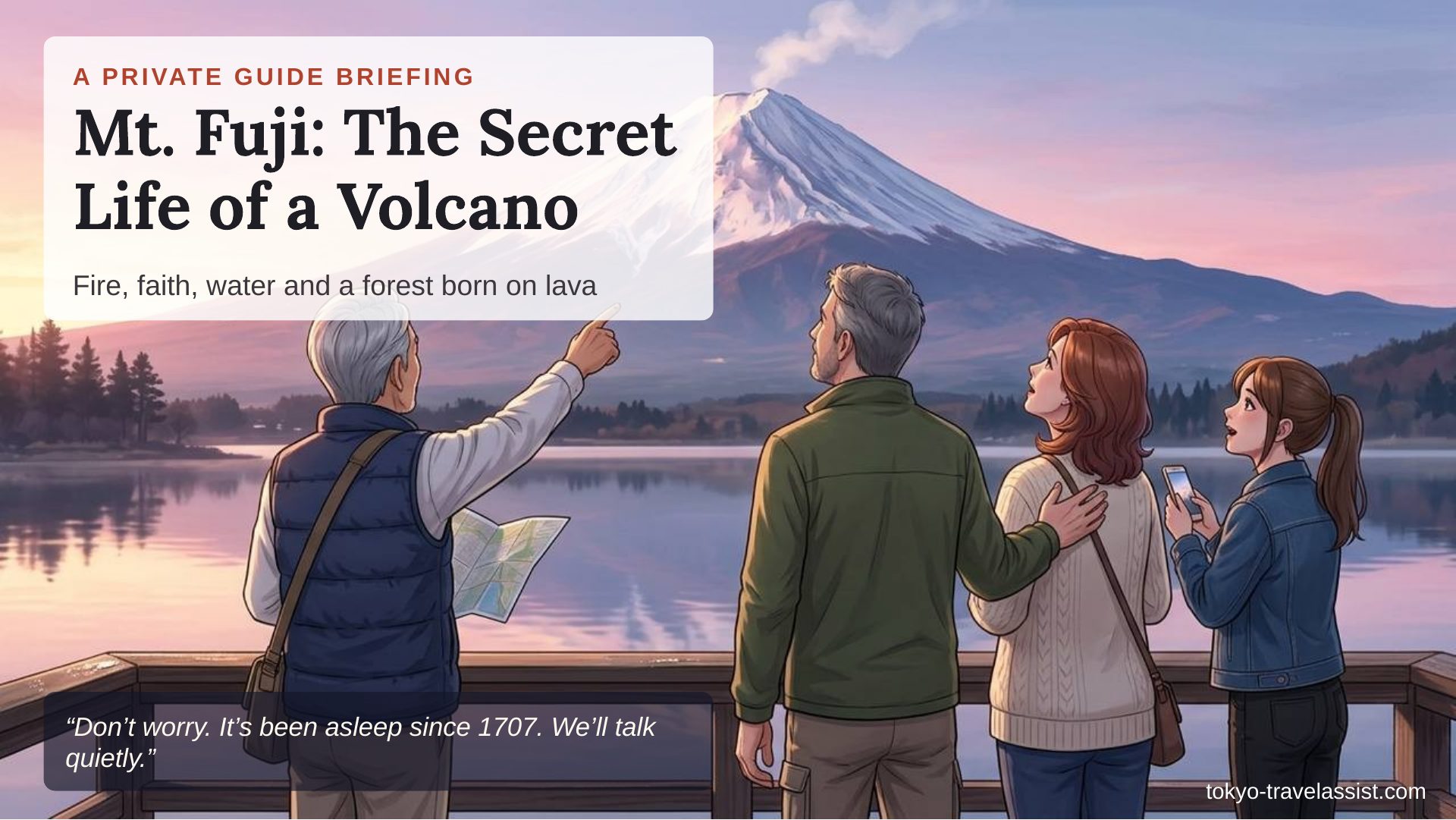
You’ve seen the postcard. Here’s the biography.
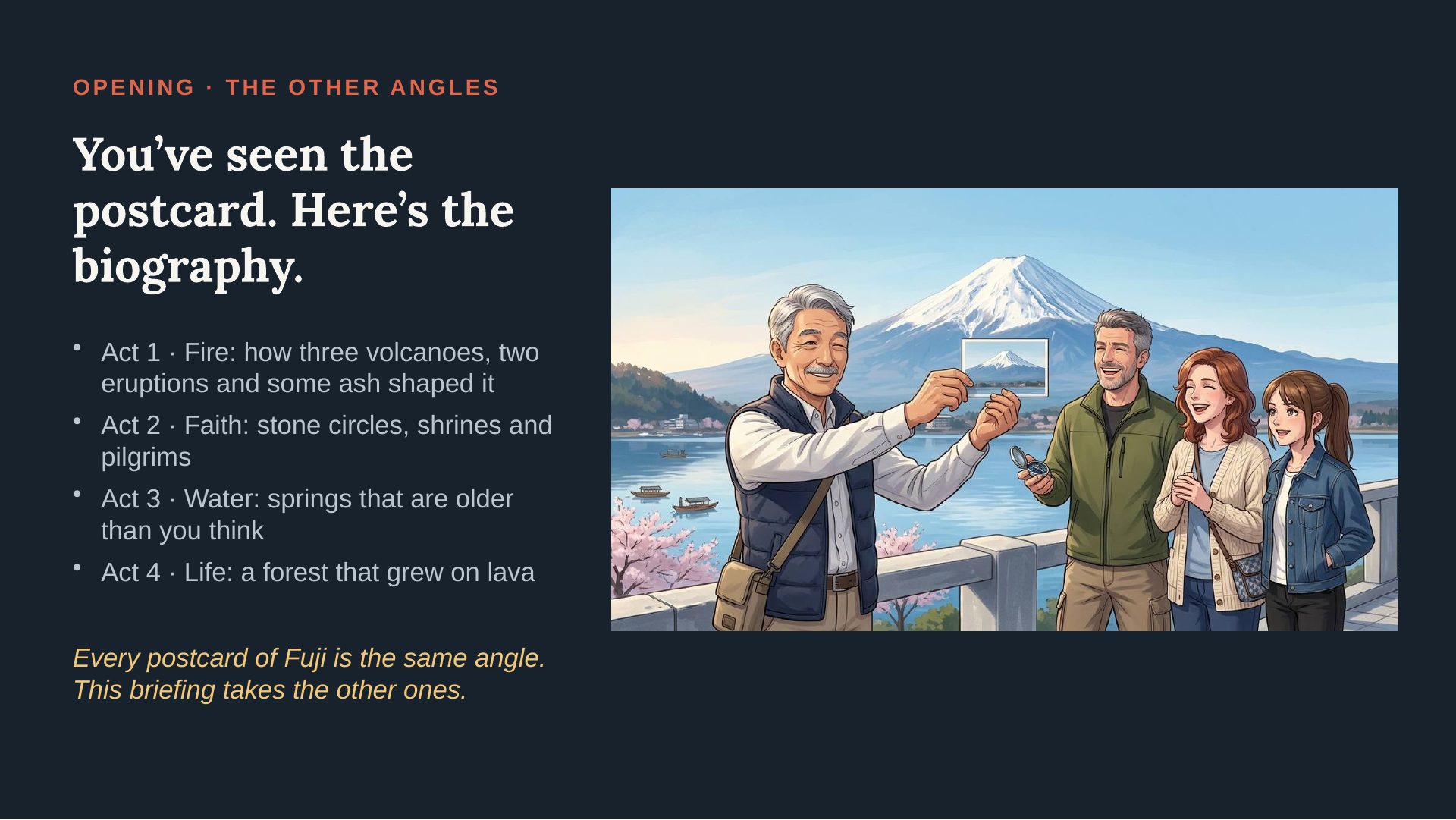
We tell Fuji’s story in four acts. Fire, because without eruptions there is no mountain. Faith, because for thousands of years people have prayed to Fuji, not just admired it. Water, which may be the most surprising chapter. And life: a forest that grew on bare lava.
Act 1 · Fire
Not one volcano. Three.
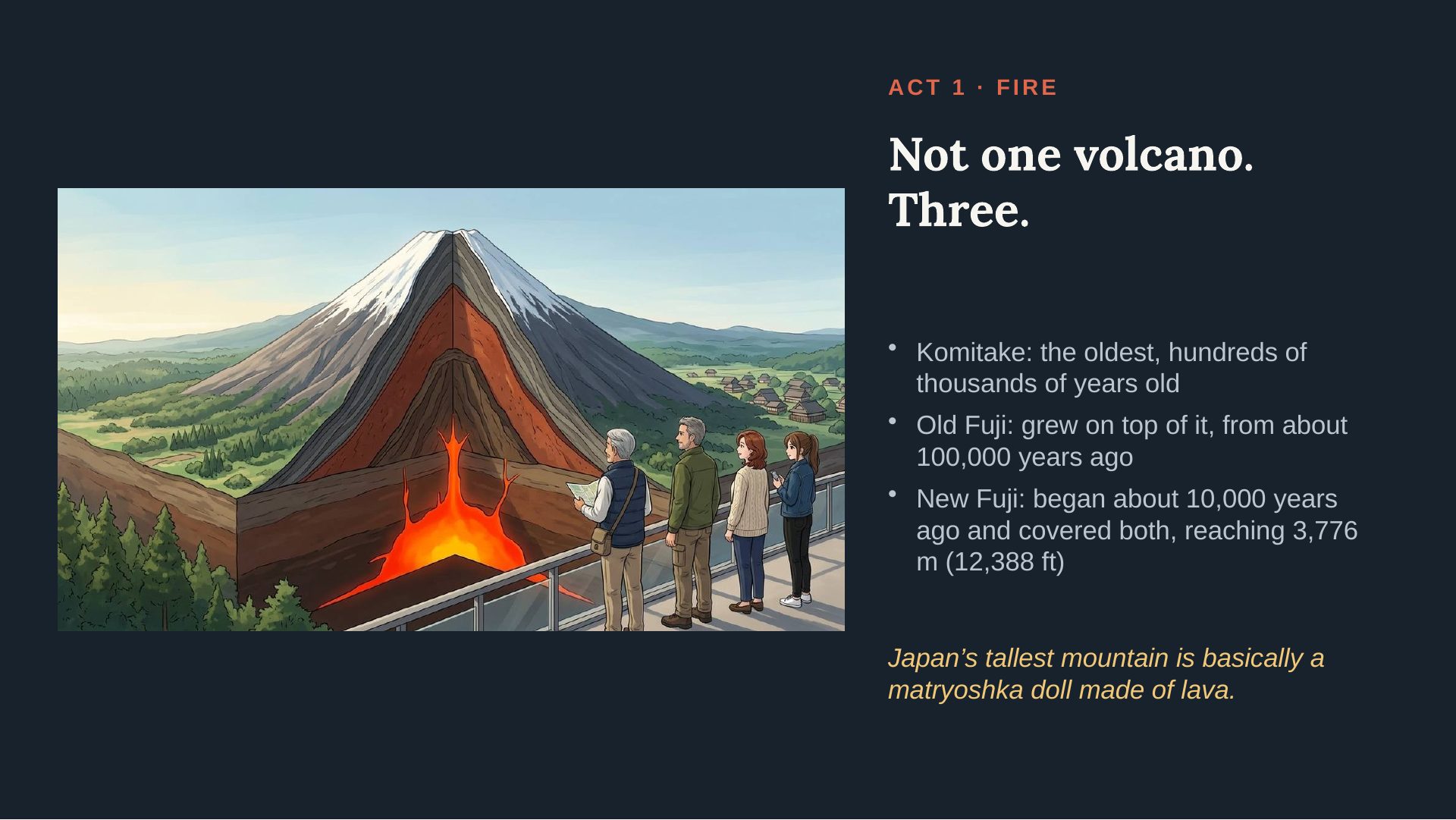
The mountain you see is the youngest of three volcanoes stacked on top of each other. Komitake is the oldest, hundreds of thousands of years old; part of it still pokes out near the Fifth Station on the Yoshida side. Old Fuji grew over it from about 100,000 years ago. Then, about 10,000 years ago, New Fuji began erupting from almost the same spot, covering both with basalt lava and rising to 3,776 meters (12,388 feet). Geologists have even found signs of an older volcano buried beneath them all.
864: the eruption that planted a forest
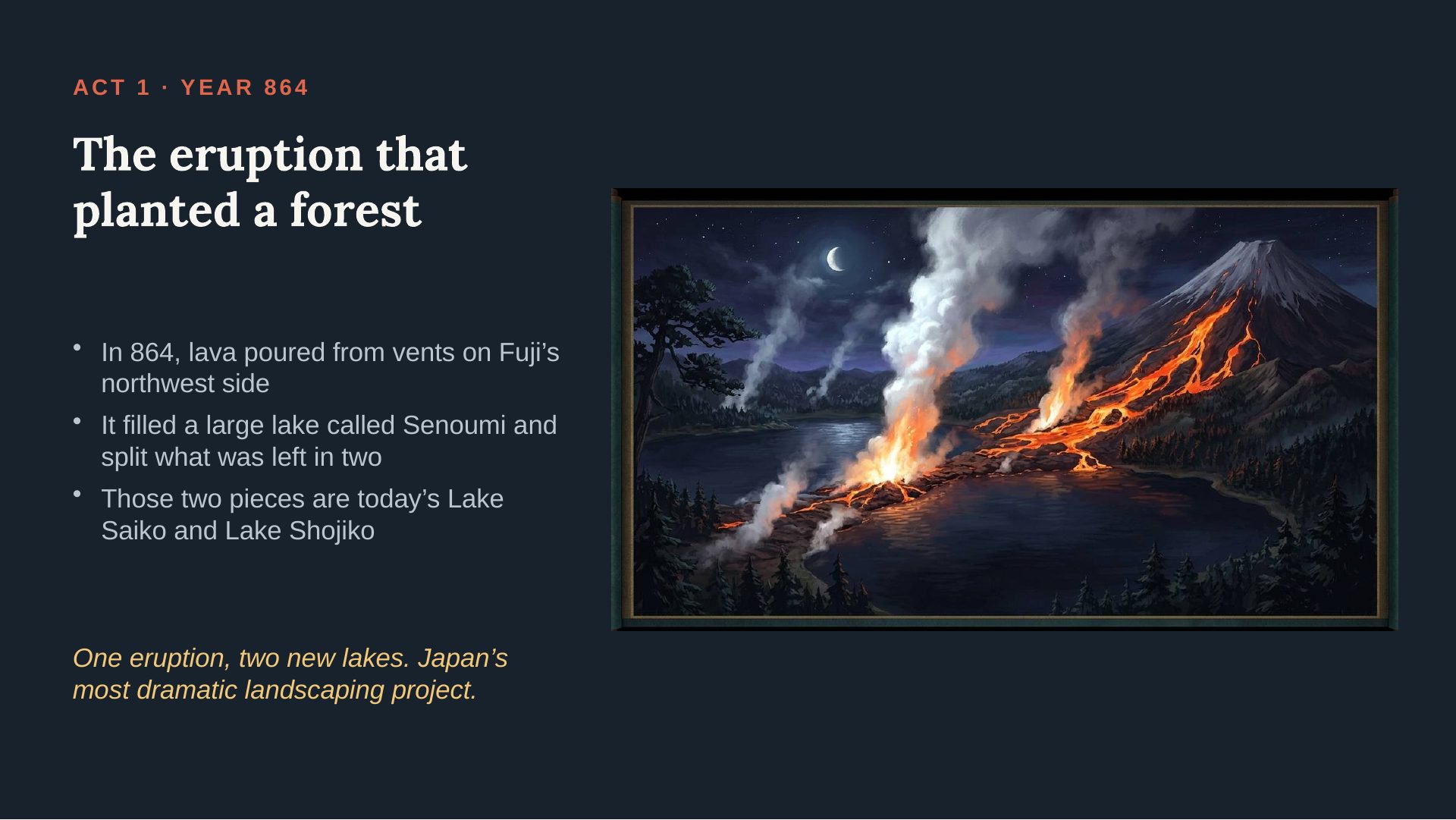
The Jogan eruption of 864 to 866 was the largest lava eruption in Fuji’s recorded history. Lava poured from vents on the northwest flank into a large lake called Senoumi, burying most of it. The two leftover pieces became today’s Lake Saiko and Lake Shojiko. The same lava field, about 30 square kilometers, is where the Aokigahara forest grows today. Keep it in mind for Act 4.
1707: the day it snowed ash on Edo
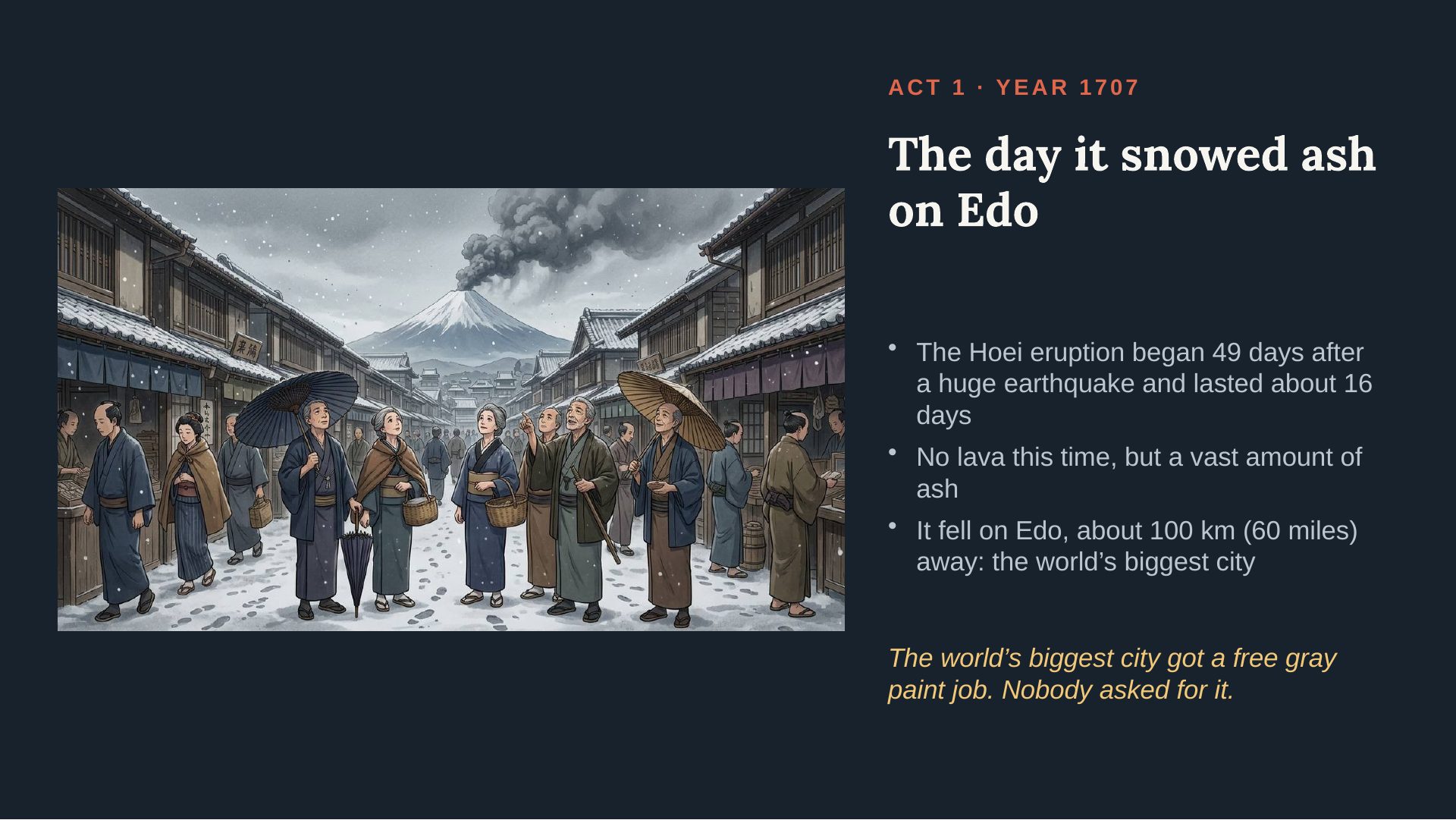
In late 1707, just 49 days after the great Hoei earthquake, Fuji erupted from a new crater on its southeast side. It lasted about 16 days. This time there was no lava, but an enormous amount of ash, around 800 million cubic meters, and the wind carried it to Edo, about 100 kilometers (60 miles) away. The world’s biggest city was dusted in a few centimeters of it, and writers of the time compared it to snow. You can still see the Hoei crater from the Gotemba side. This is Fuji’s most recent eruption.
Today: asleep, but not ignored
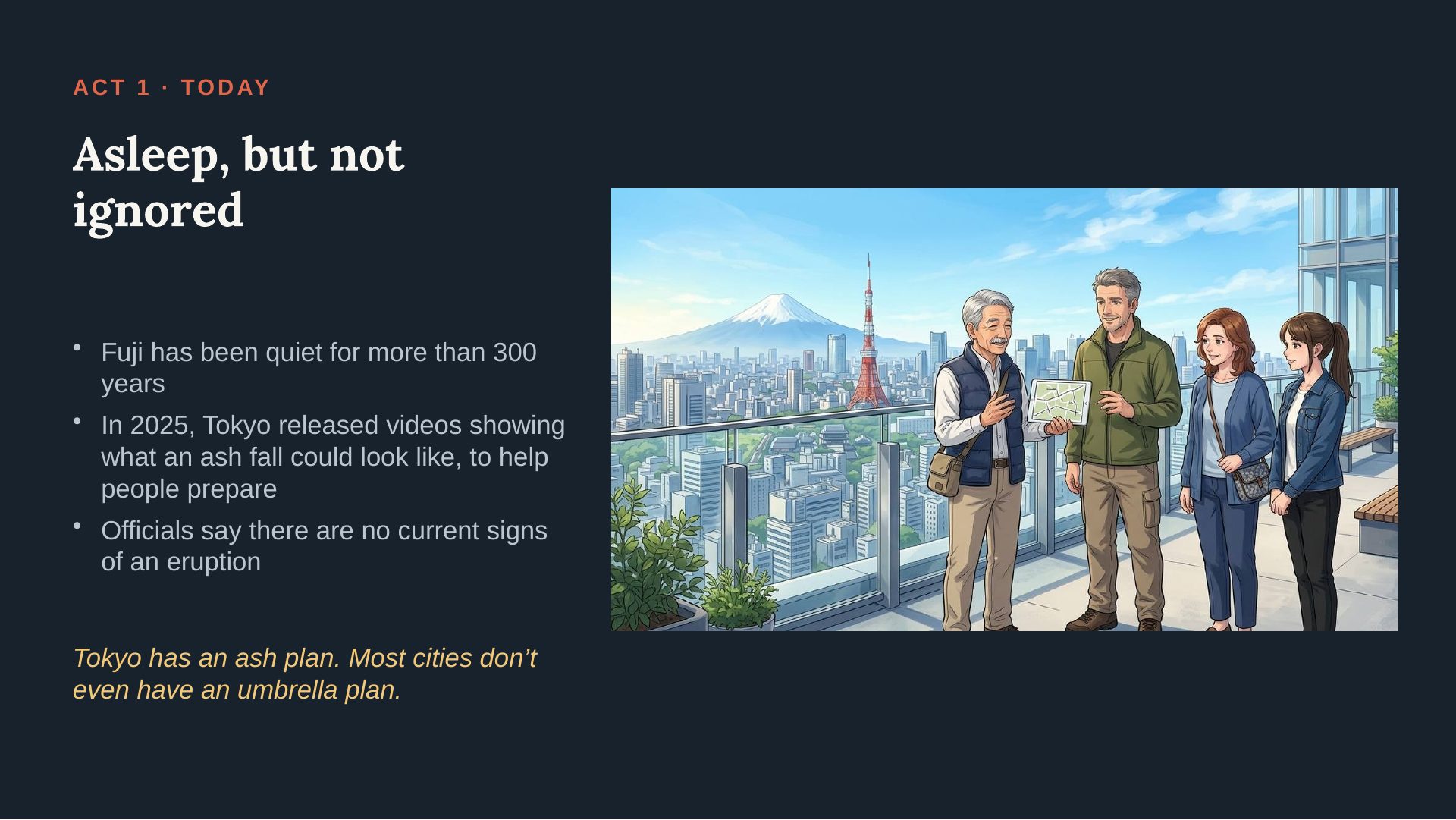
Fuji has been quiet for more than 300 years, and scientists watch it closely. In 2025, the Tokyo government released videos showing what an ash fall could look like, so residents know how to prepare. It’s preparation, not prediction: officials stress there are no current signs of an eruption. For visitors, Fuji is simply one of the most beautiful mountains on Earth.
Act 2 · Faith
4,000 years ago, someone was watching Fuji
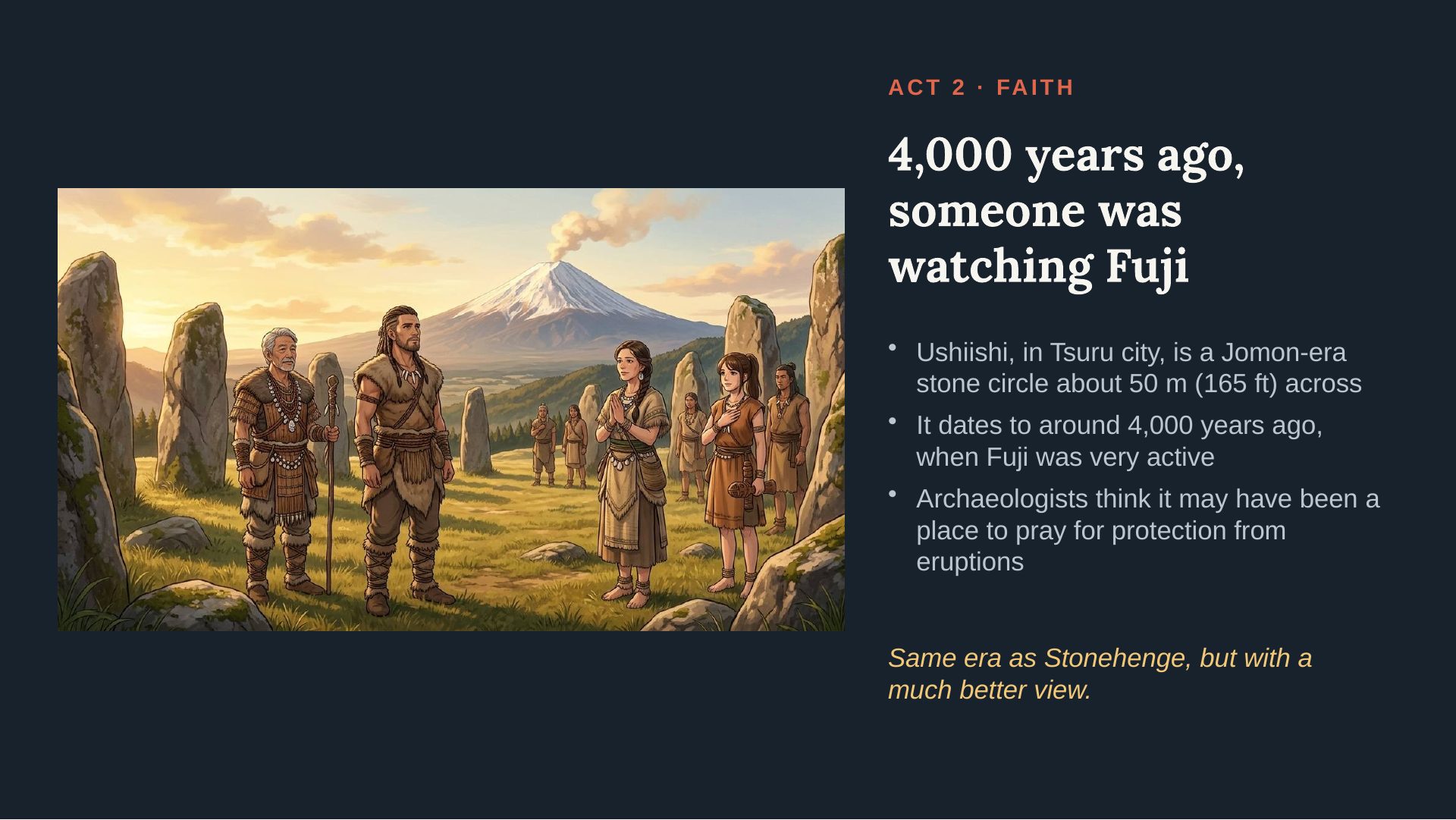
The Jomon were the hunter-gatherers who made some of the world’s oldest pottery. At Ushiishi, in Tsuru city, they built a stone circle about 50 meters (165 feet) across, one of the largest in eastern Japan, around 4,000 years ago, when Fuji was very active. Mt. Fuji lines up with stone arrangements on the site, and archaeologists think it may have been a place to pray for protection from eruptions. It’s roughly the same era as Stonehenge.
The mountain is the kami
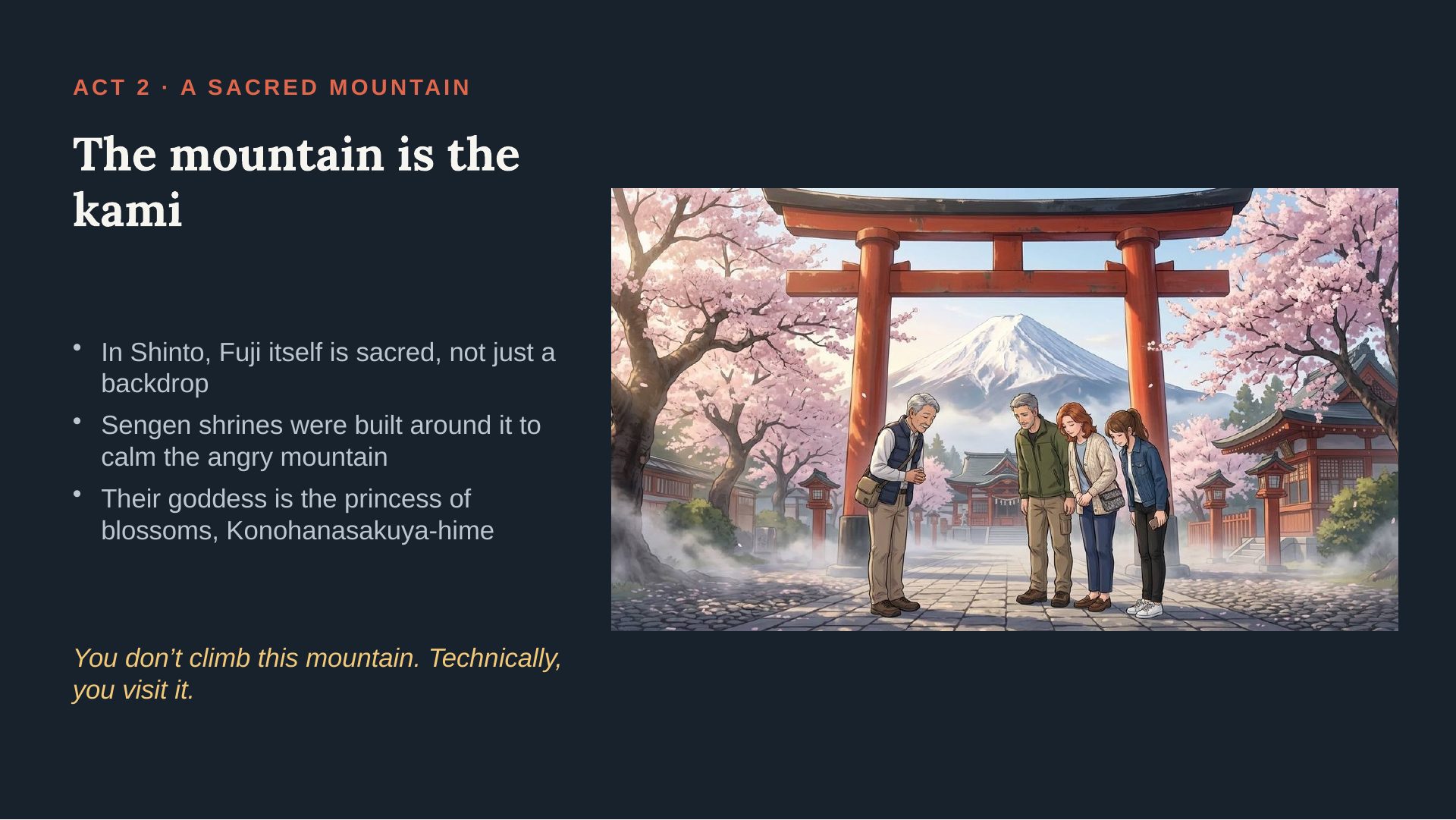
In Shinto, a mountain can itself be sacred (see our briefing Not Quite “God”: Meet the Kami). Fuji is the great example. Sengen shrines were built around its foot to calm the angry mountain, and their goddess, Konohanasakuya-hime, is the princess of blossoms. That’s one reason you so often see cherry blossoms and Fuji together. A small bow at the torii gate, as our family does here, is a nice gesture.
The summit is shrine property
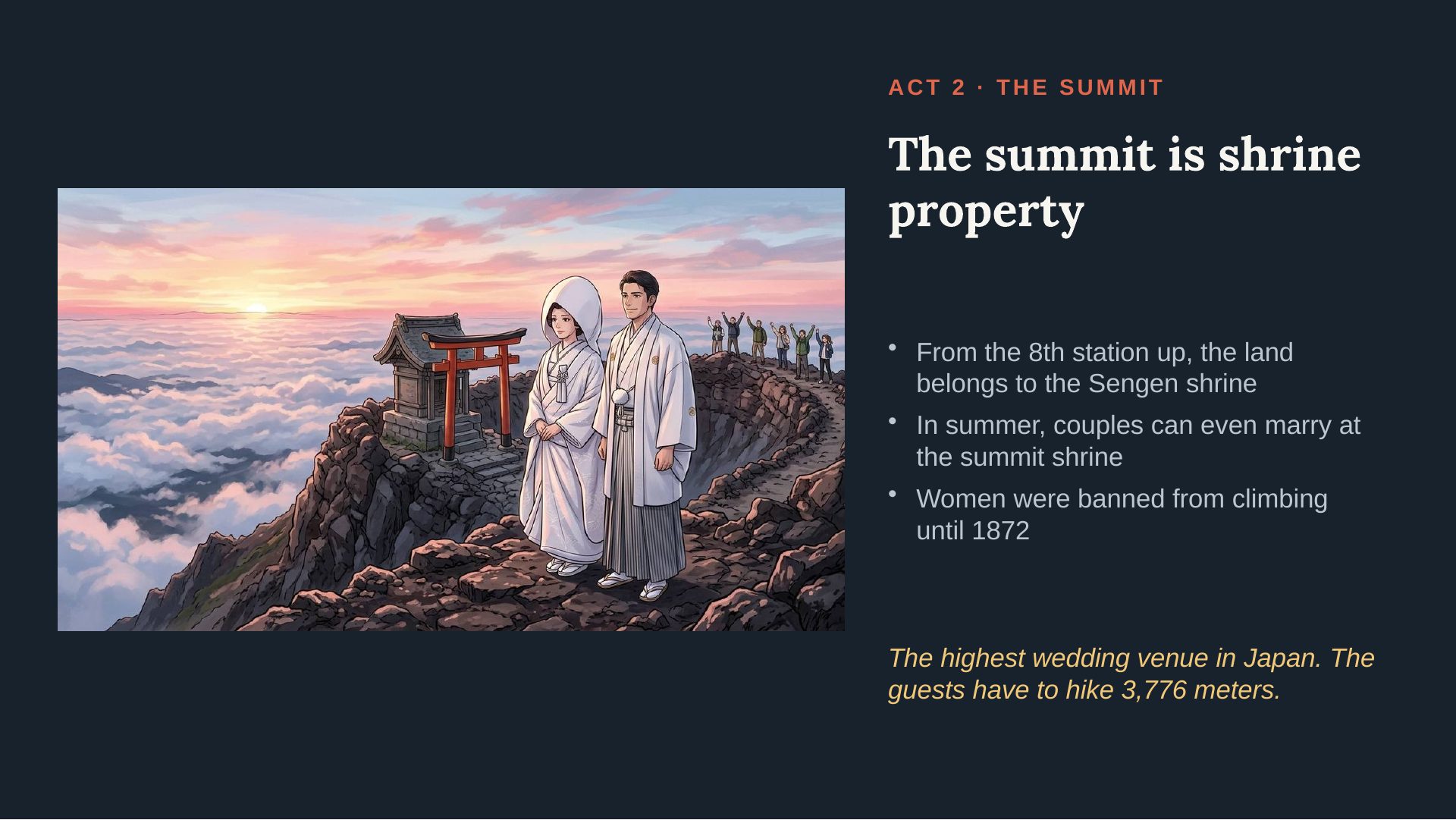
Here’s something few visitors know: from the 8th station up, crater included, the top of Japan’s most famous mountain is the inner precinct of Fujisan Hongu Sengen Taisha shrine. The national government formally handed the land back in 2004. The summit shrine opens in the climbing season, and yes, couples marry there. For centuries women were not allowed to climb; that ban was lifted in 1872.
Can’t climb Fuji? Climb a mini Fuji.
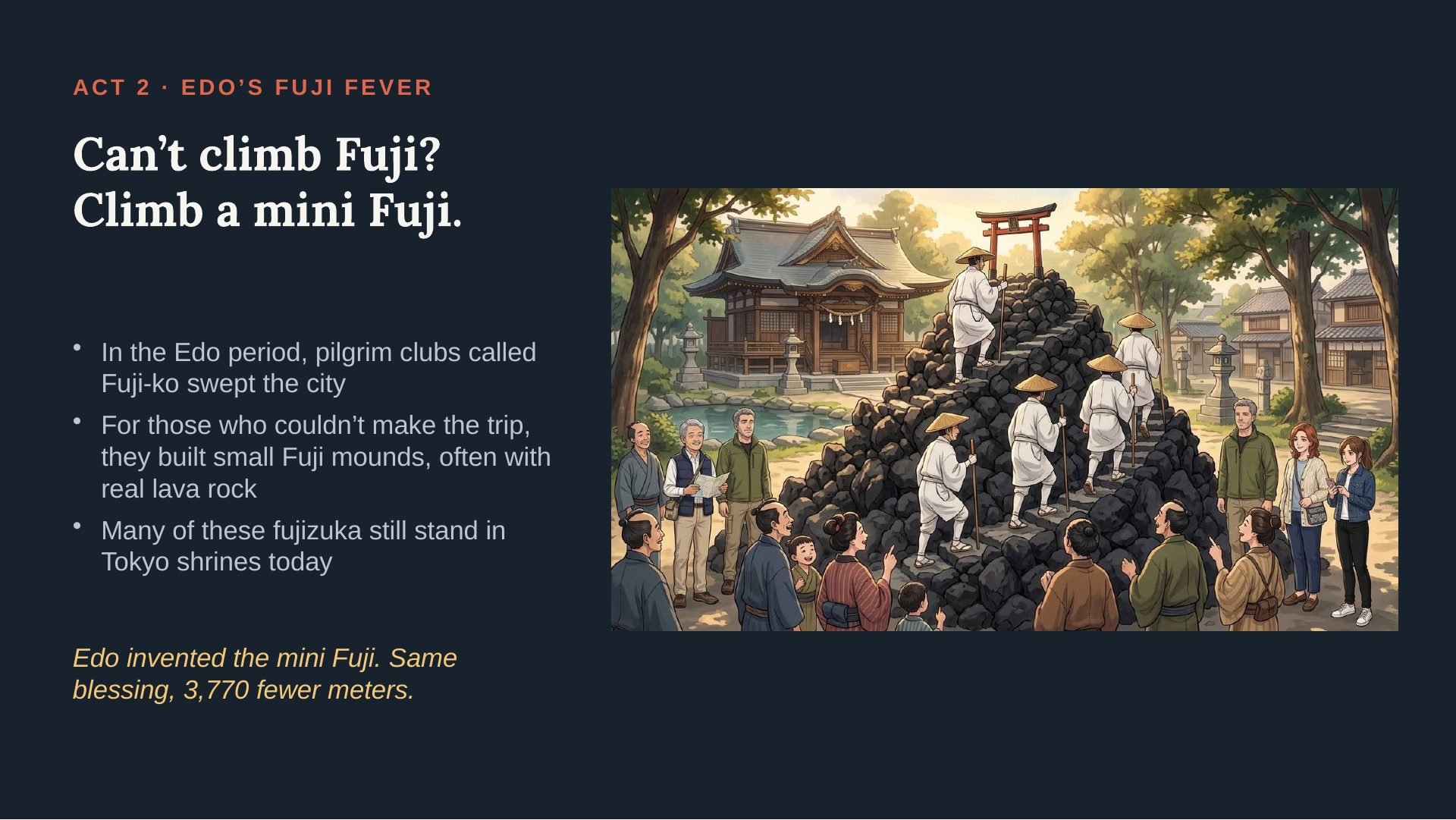
In the Edo period, pilgrim clubs called Fuji-ko swept the city. Neighbors saved up together so members could make the pilgrimage. For those who couldn’t go, they built small Fuji mounds called fujizuka at local shrines, often using real lava rock carried from the mountain. Climbing one was said to bring the same blessing. You can still find them in Tokyo, for example at Shinagawa Shrine or Hatonomori Hachiman in Sendagaya.
Act 3 · Water
Quick quiz: how old is this water?
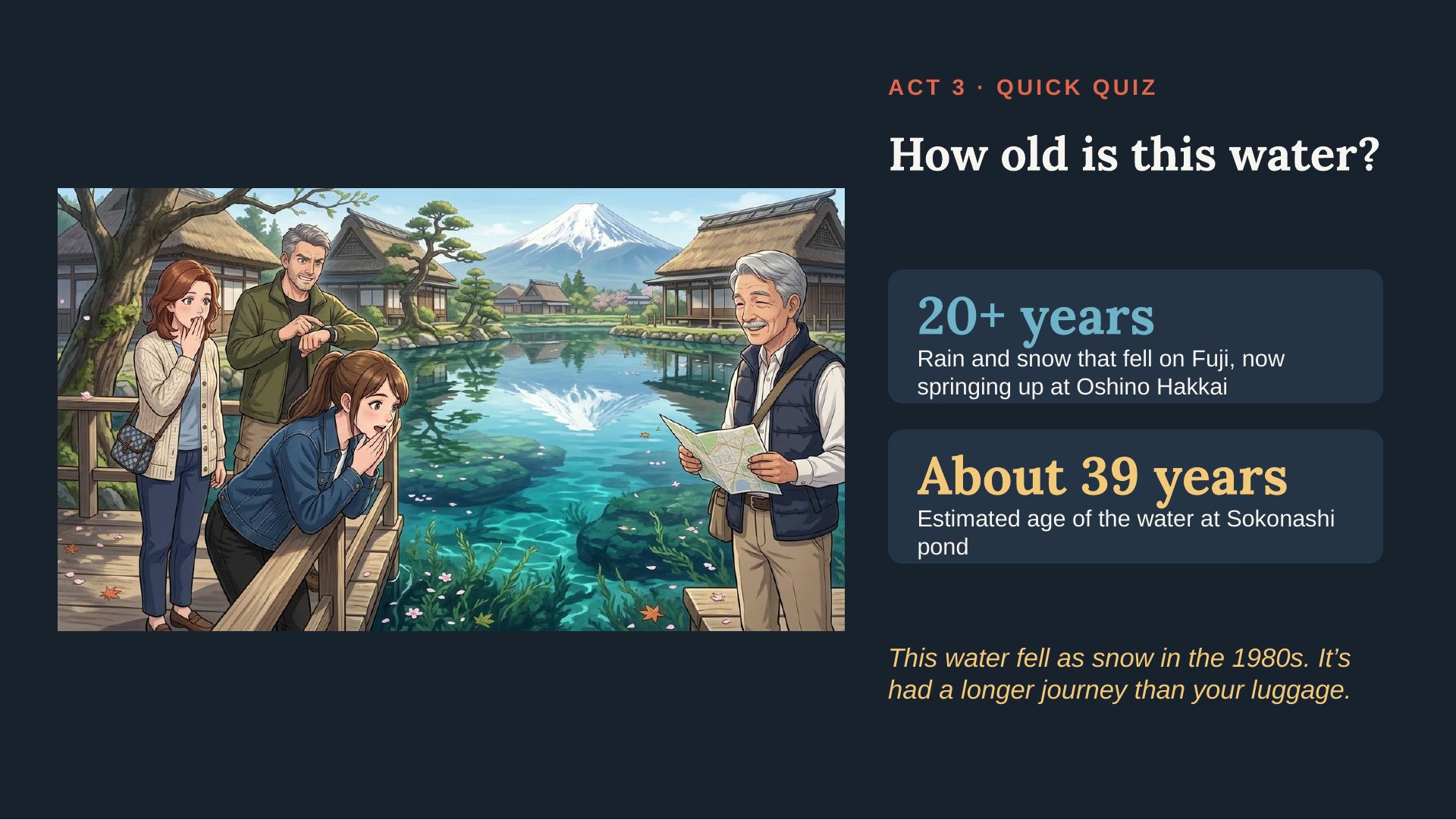
Take a guess before you read on. Fuji’s lava is full of tiny holes, so rain and snowmelt soak in and travel slowly underground, filtered by the rock. At Oshino Hakkai it rises again in eight crystal-clear ponds. Studies show the water is more than 20 years old, and at one pond, Sokonashi, it’s estimated at about 39 years. So ask yourself: what were you doing when this water fell as snow?
Wash before you climb
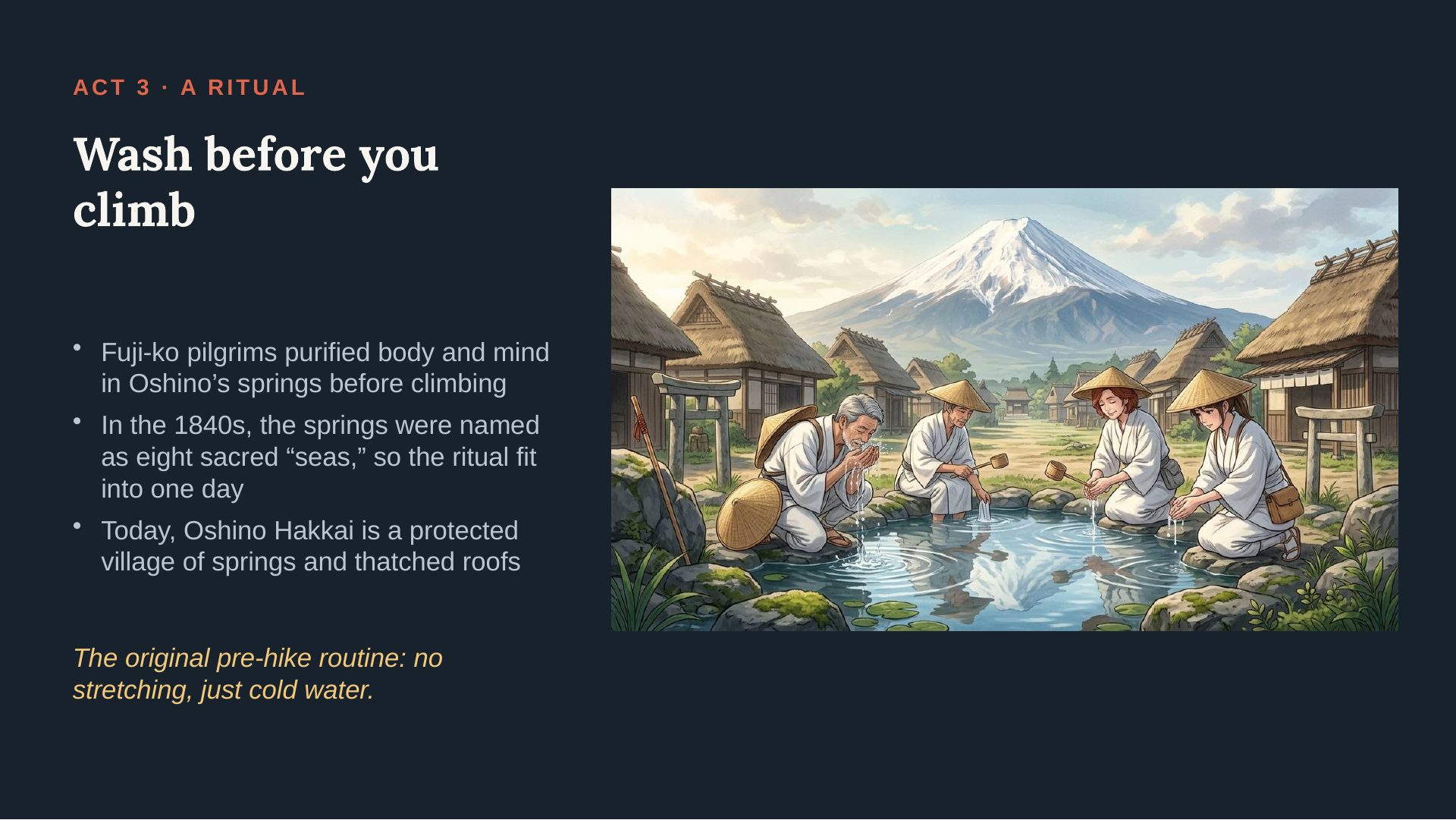
Fuji-ko pilgrims purified body and mind in Oshino’s springs before setting off up the mountain. They once spent days visiting lakes around Fuji for this; in the 1840s the eight springs of Oshino were named as eight sacred “seas,” so the ritual could be done in a single day. Today Oshino Hakkai is part of the Fuji World Heritage site, a small village of springs and thatched roofs.
Act 4 · Life
From fire to forest in 1,200 years
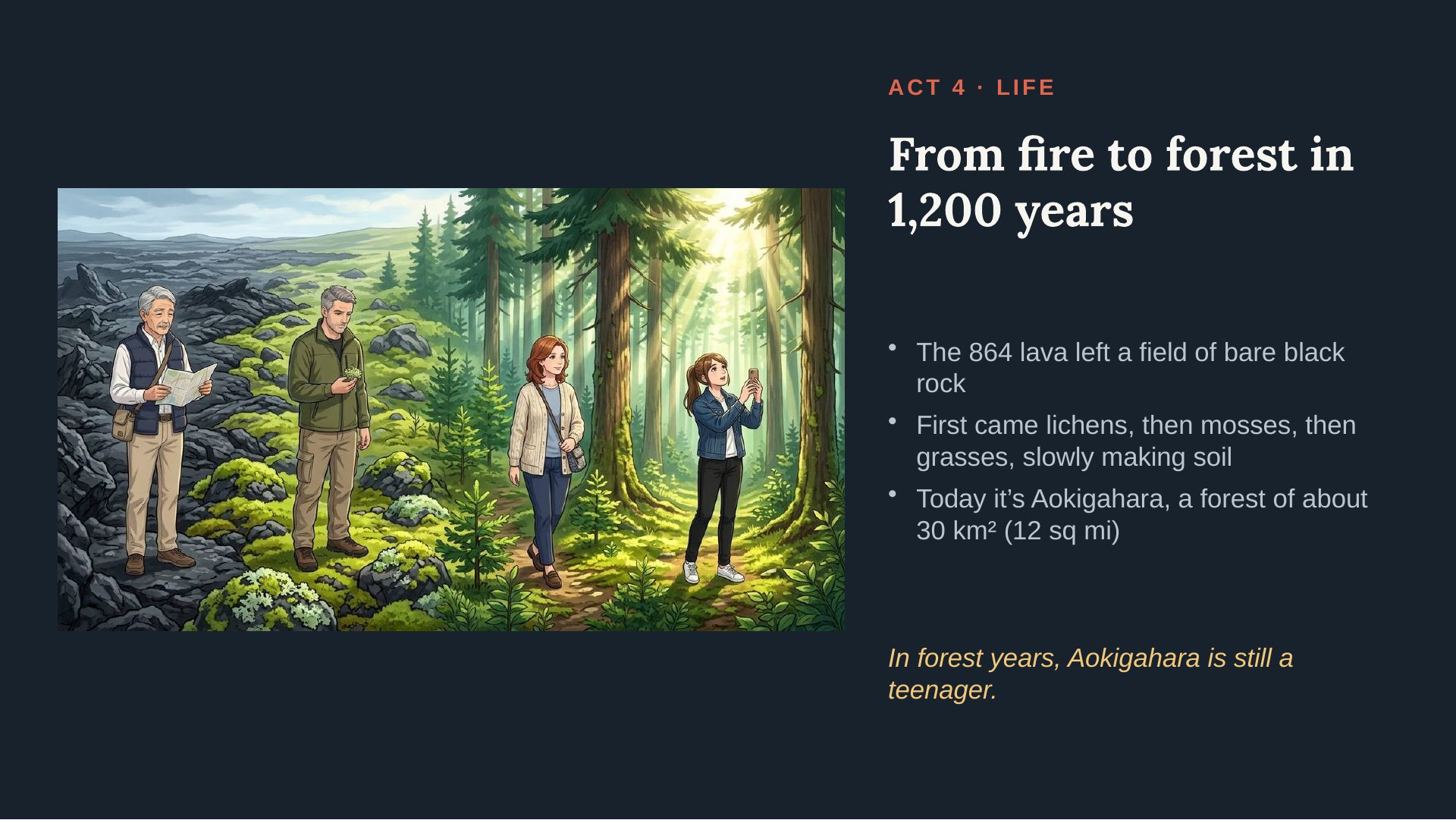
You may have heard a different story about this forest online. Here’s the one our guides tell. After 864, nothing lived on the cooled lava. Lichens arrived first, then mosses, then grasses, each adding a little soil, and trees followed. Today it’s Aokigahara, a forest of about 30 square kilometers (12 square miles). For a forest, 1,200 years is very young: Aokigahara is a living lesson in how life reclaims volcanic land.
10 cm of soil. A whole forest.
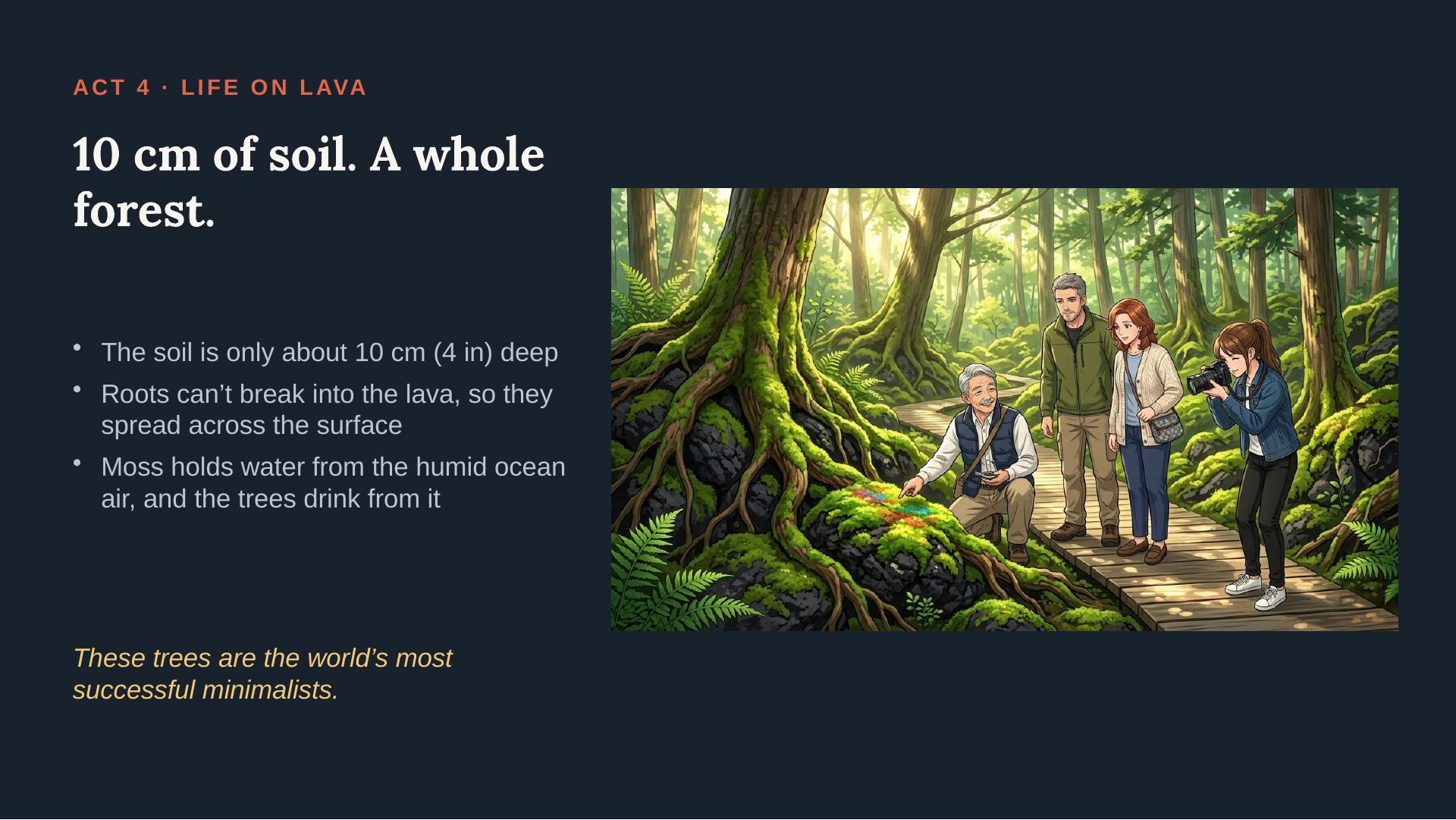
The soil here is only about 10 centimeters (4 inches) deep. Roots can’t break into the hard lava, so they spread across the surface, wrapping over rocks and each other. The secret is moisture: humid air from the Pacific keeps the thick moss soaked, and the moss feeds the trees, mostly Japanese hemlock and hinoki cypress. The forest is a protected natural monument, so please stay on the trails.
Ice caves and the compass myth
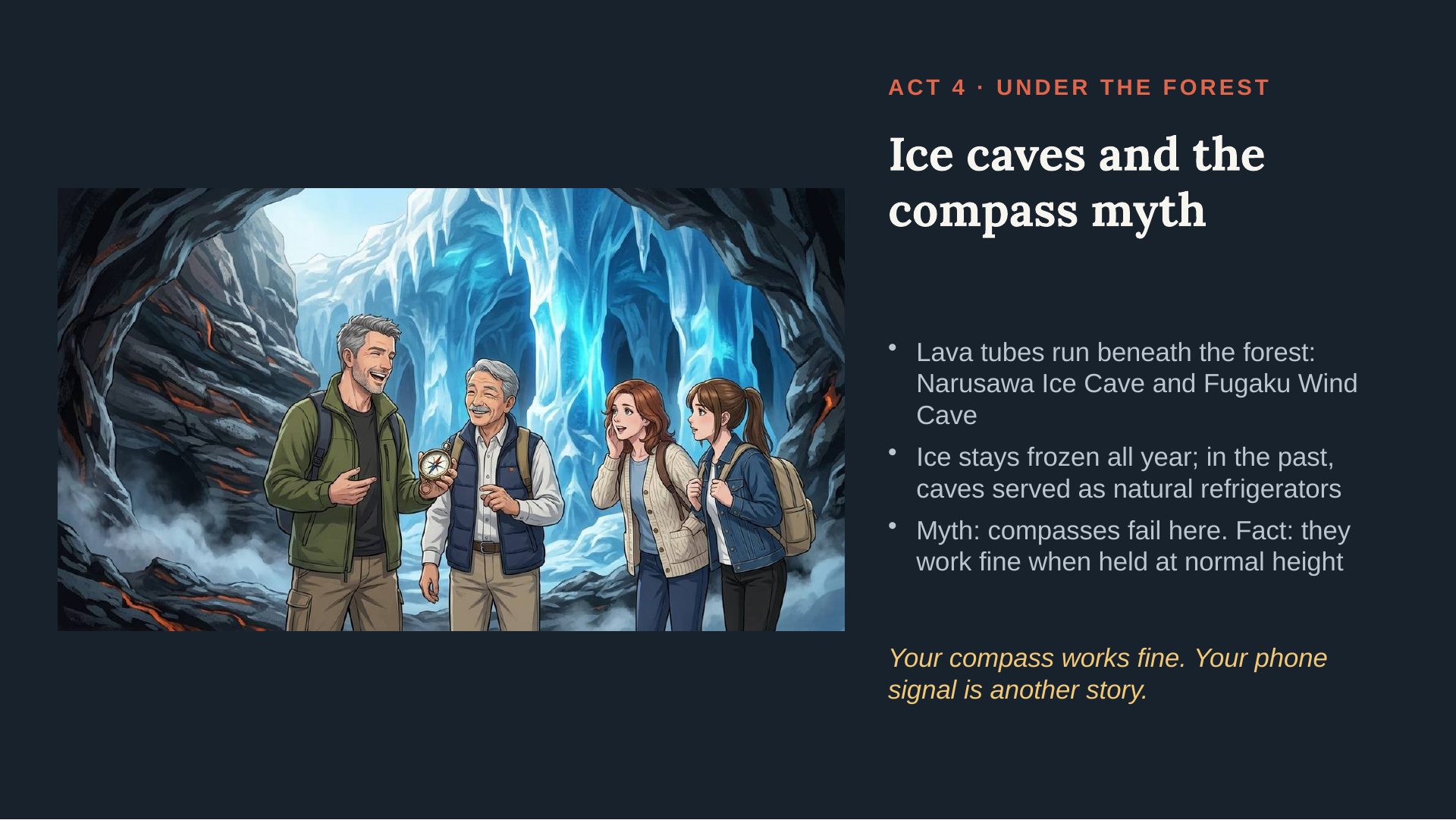
When the lava cooled, its surface hardened while molten rock kept flowing underneath, leaving tunnels. Narusawa Ice Cave stays below freezing all year, and its ice was once presented to the shogun. Fugaku Wind Cave served as a natural refrigerator for silkworm eggs, and Saiko Bat Cave is named for its residents. And the famous compass story? Only if you set a compass directly on the magnetic lava rock will the needle wander. Held at normal height, it works just fine.
Fire · Faith · Water · Life
Fire made it. Water feeds it. Life moved in.
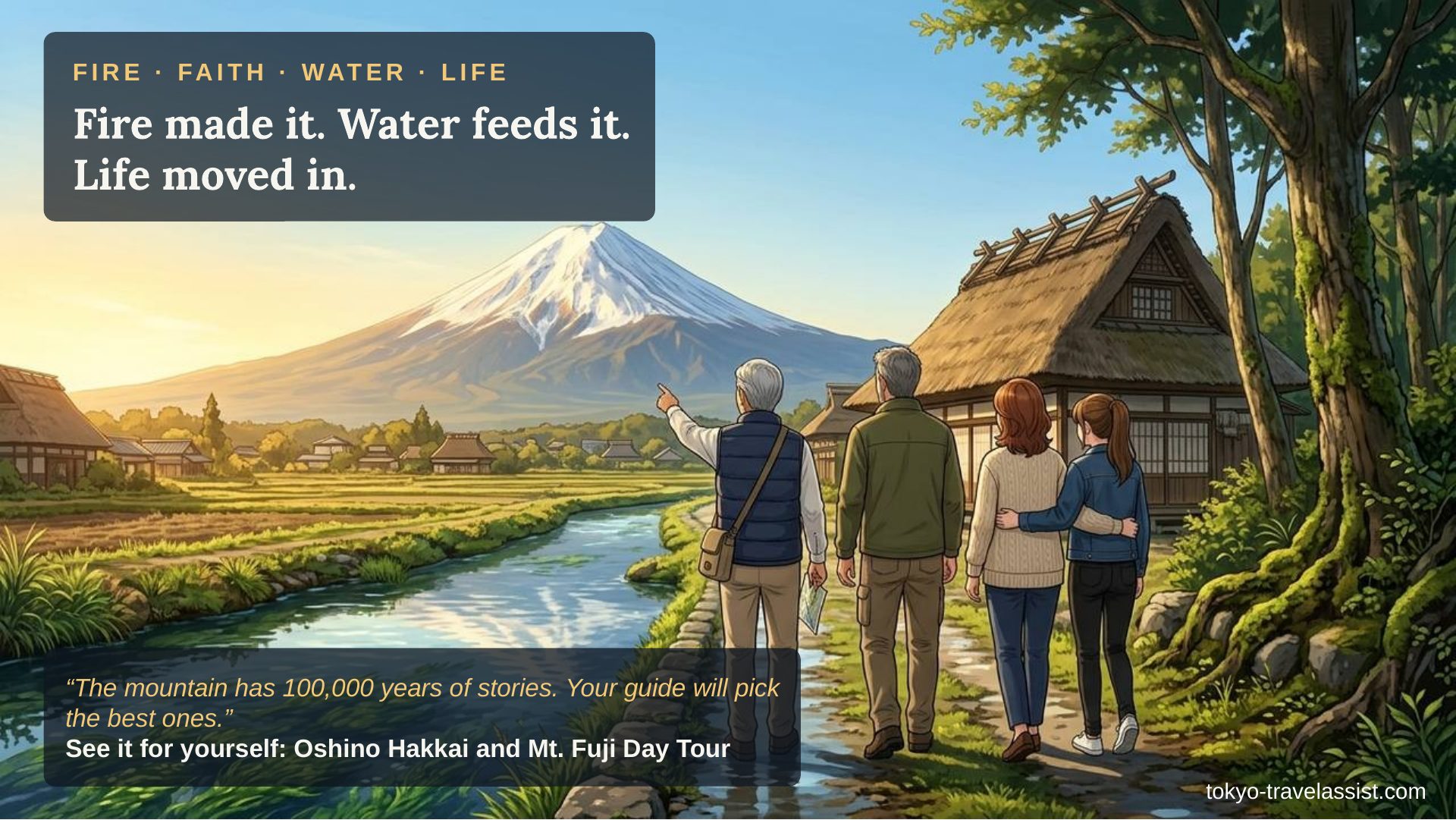
- Oshino Hakkai: decades-old snowmelt in eight sacred ponds, a thatched-roof village and the Chureito Pagoda at a Sengen shrine. Oshino Hakkai and Mt. Fuji Day Tour →
- Aokigahara and Lake Saiko: the forest on the 864 lava and one of the lakes it created. Aokigahara Jukai and Mt. Fuji Day Tour →
- Fuji and Hakone together: Oshino Hakkai plus Lake Ashi and Hakone Shrine. Mt. Fuji and Hakone Tour →
See Fuji’s secret life with your own private guide
Tell us your dates and which chapter of this briefing caught your eye. We’ll plan a day around you, by email, one conversation at a time.
Plan a private tour See all toursMore from our guides: Private Guide Briefings. Ages of volcanoes and spring water are scientific estimates and vary by study. Mt. Fuji shows no current signs of eruption; check official guidance from the Japan Meteorological Agency before any summit climb.

