A Private Guide Briefing from Travel Assist Japan
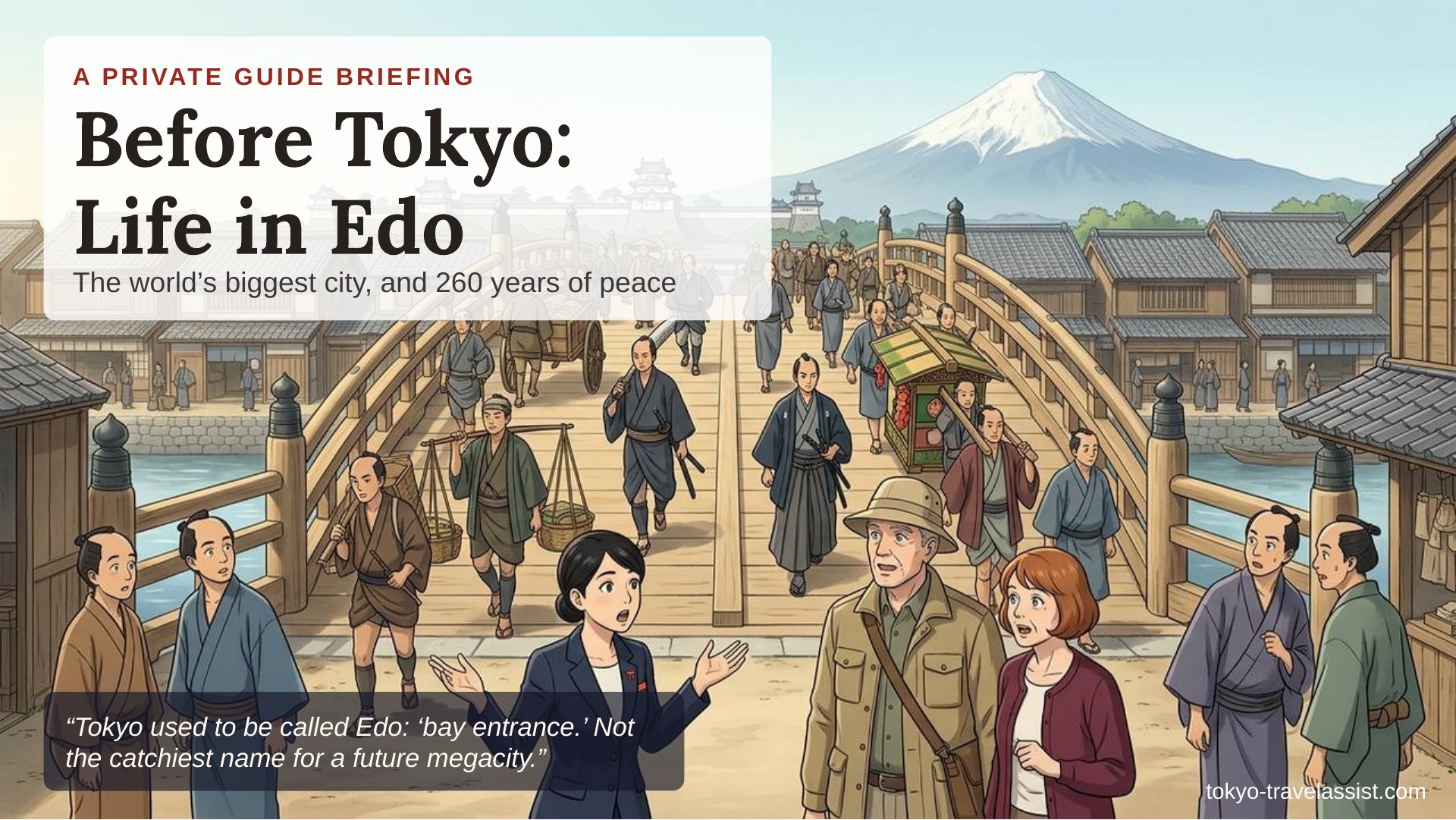
Before it was Tokyo, this city was Edo, and around 1720 it was probably the biggest city on Earth. For about 260 years it lived in peace, packed half a million townspeople into a sliver of land, invented fast food and turned actors into rock stars. Our private guides love telling this story, because so much of it is still hiding in plain sight. Here is the briefing we share before a Tokyo tour: four short acts and a cliffhanger, in about 15 minutes.
In this briefing
Act 1 · From battlefield to boomtown
Your hotel may be standing in the sea
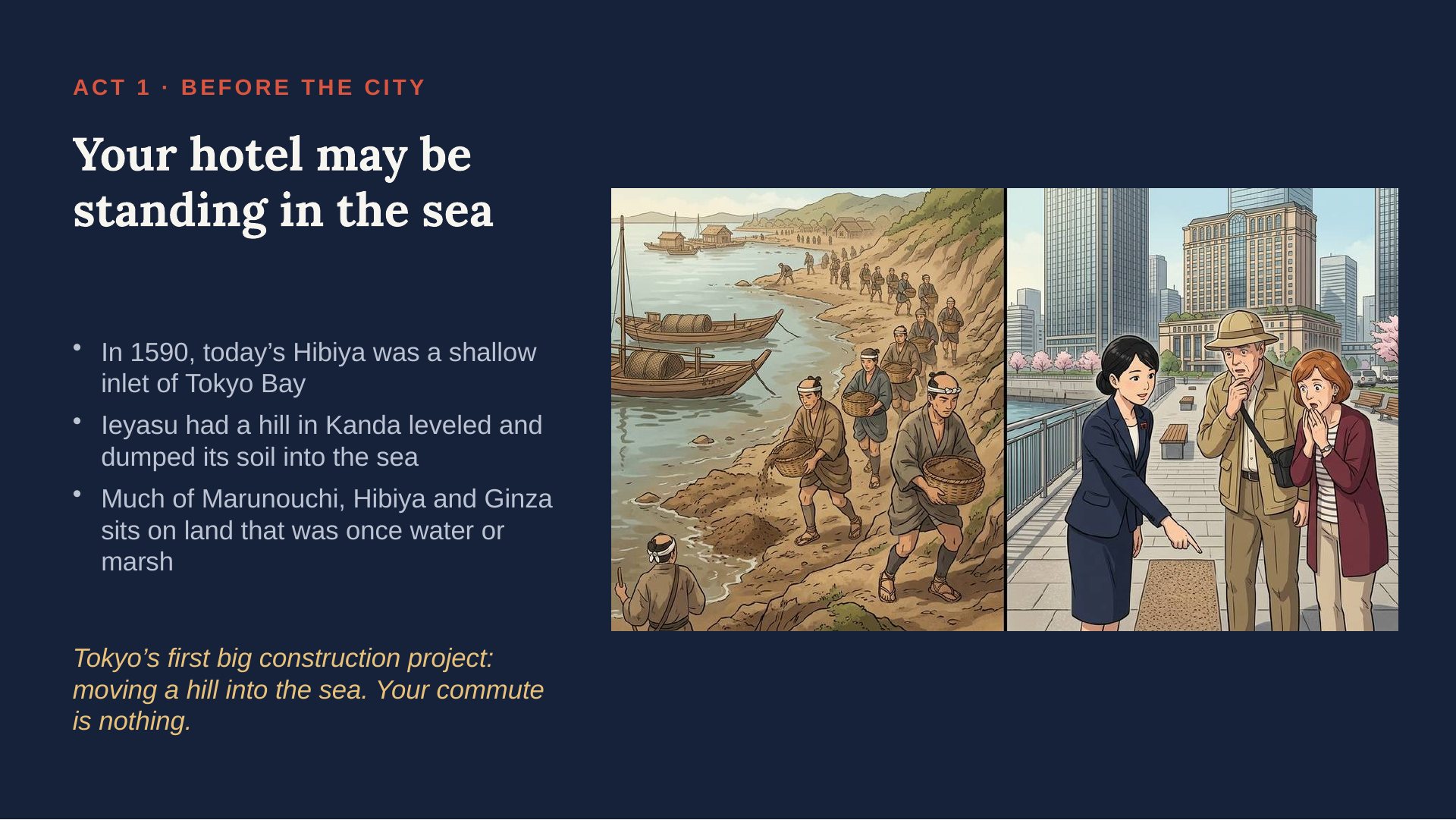
When Tokugawa Ieyasu arrived in 1590, Edo was a modest castle town on marshy ground, and today’s Hibiya was a shallow inlet of Tokyo Bay. His engineers leveled a hill in Kanda and dumped its soil into the sea to create new land. If you’re staying near the Imperial Palace, Hibiya or Ginza, there’s a good chance you’re sleeping on ground that was once water or marsh. Tokyo has been reclaiming land from the bay ever since.
150 years of war come to an end
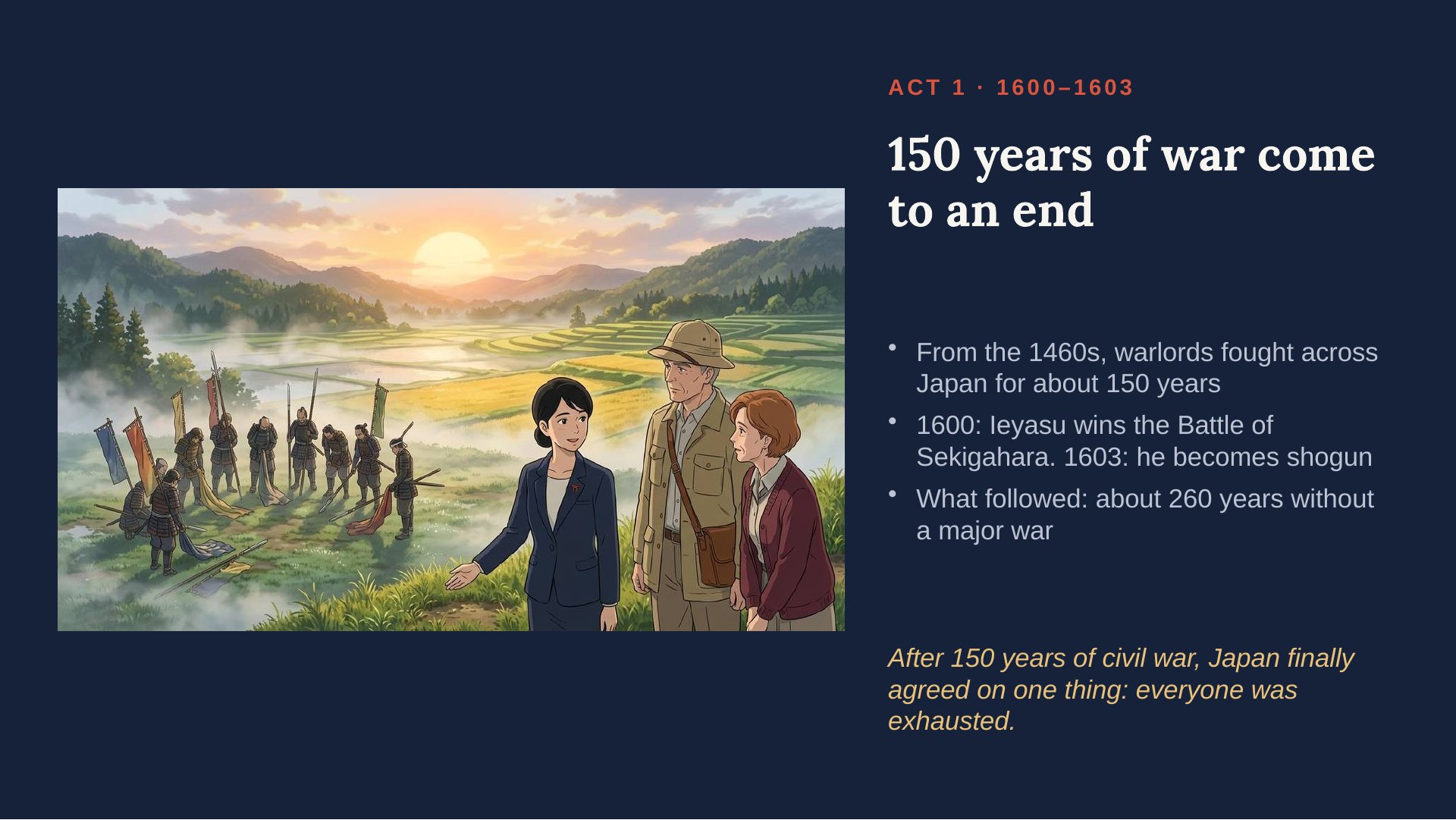
From the 1460s, rival warlords fought across Japan for about a century and a half. In 1600 Ieyasu won the Battle of Sekigahara, and in 1603 he was appointed shogun. Crucially, he ruled from Edo, not the old imperial capital of Kyoto. What followed was about 260 years without a major war. The question was how to keep it that way.
Act 2 · How to keep the peace for 260 years
Peace policy #1: one castle per domain
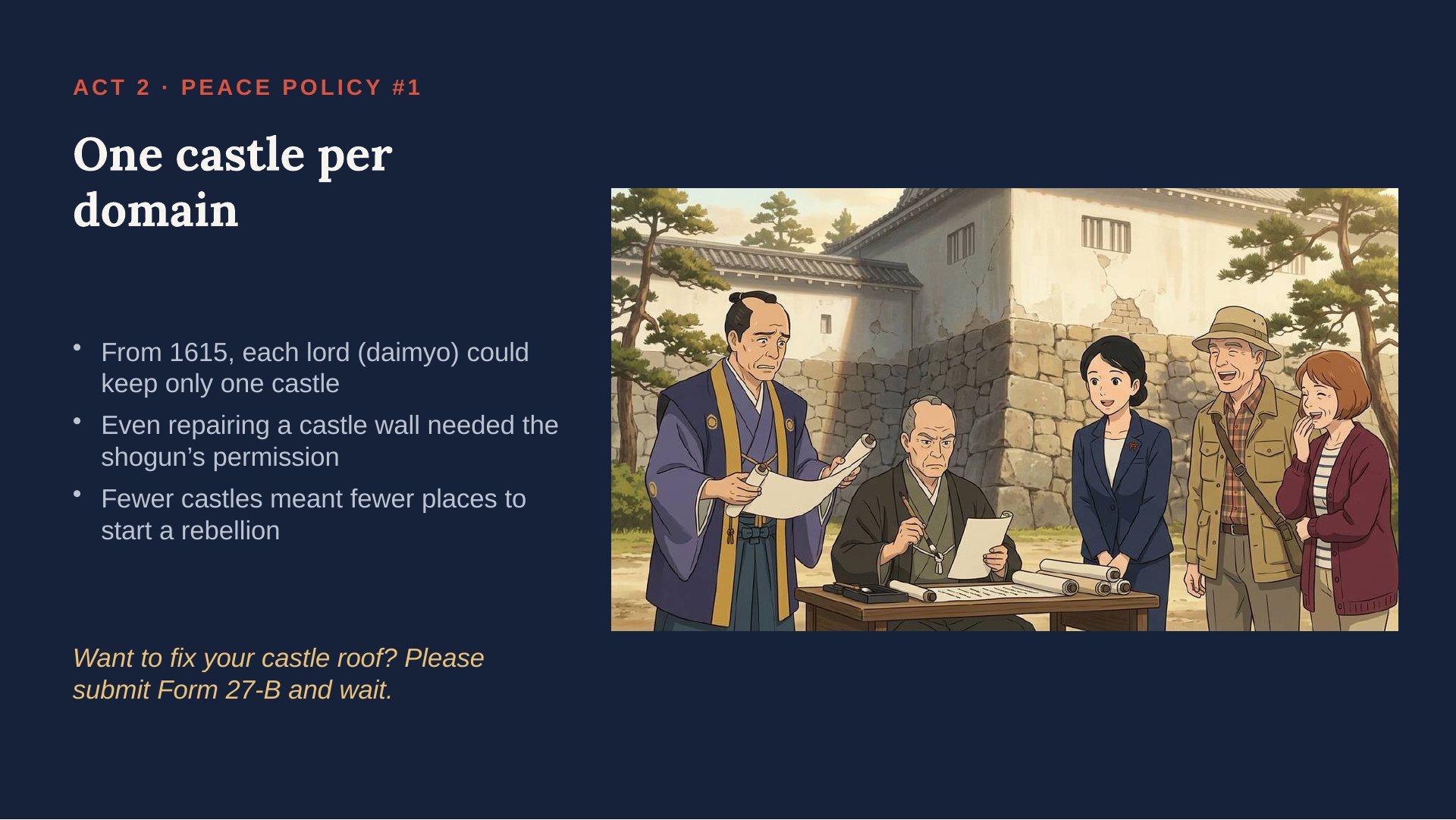
In 1615 the shogunate ordered each lord (daimyo) to keep just one castle, and issued strict rules for the warrior houses. Hundreds of castles were torn down. Even repairing a wall, building a new fortification or arranging a marriage between lord families needed the shogun’s approval. Fewer castles meant fewer places to start a rebellion.
Peace policy #2: the world’s most expensive commute
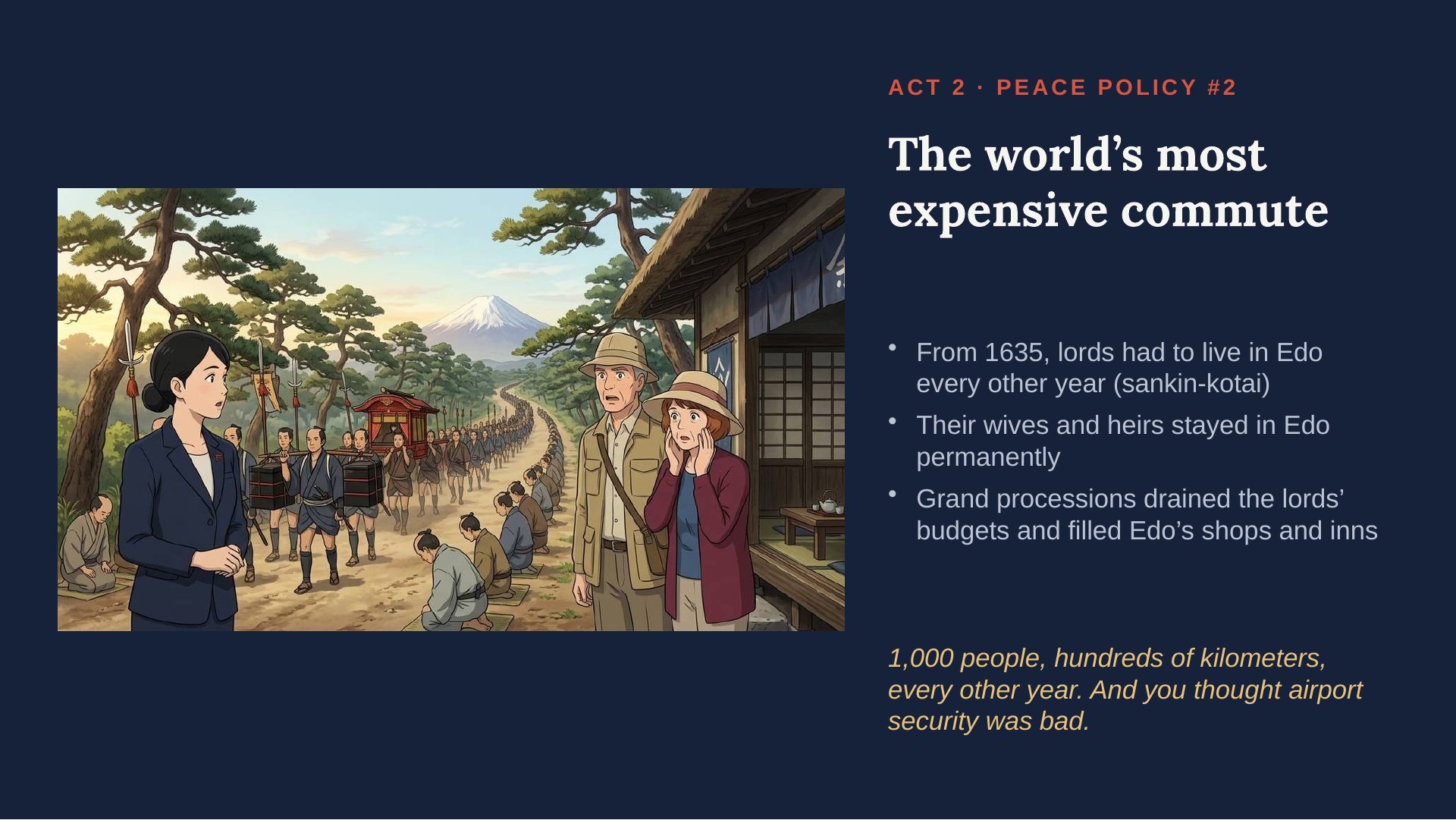
Under sankin-kotai (“alternate attendance,” from 1635), lords had to live in Edo every other year, and their wives and heirs stayed in Edo permanently, a polite form of hostage. Their grand processions, sometimes a thousand people strong, drained their budgets, leaving little money for war. All that spending built Japan’s highways, its post towns full of inns, and Edo’s booming economy.
Peace policy #3: a closed country, with one small window
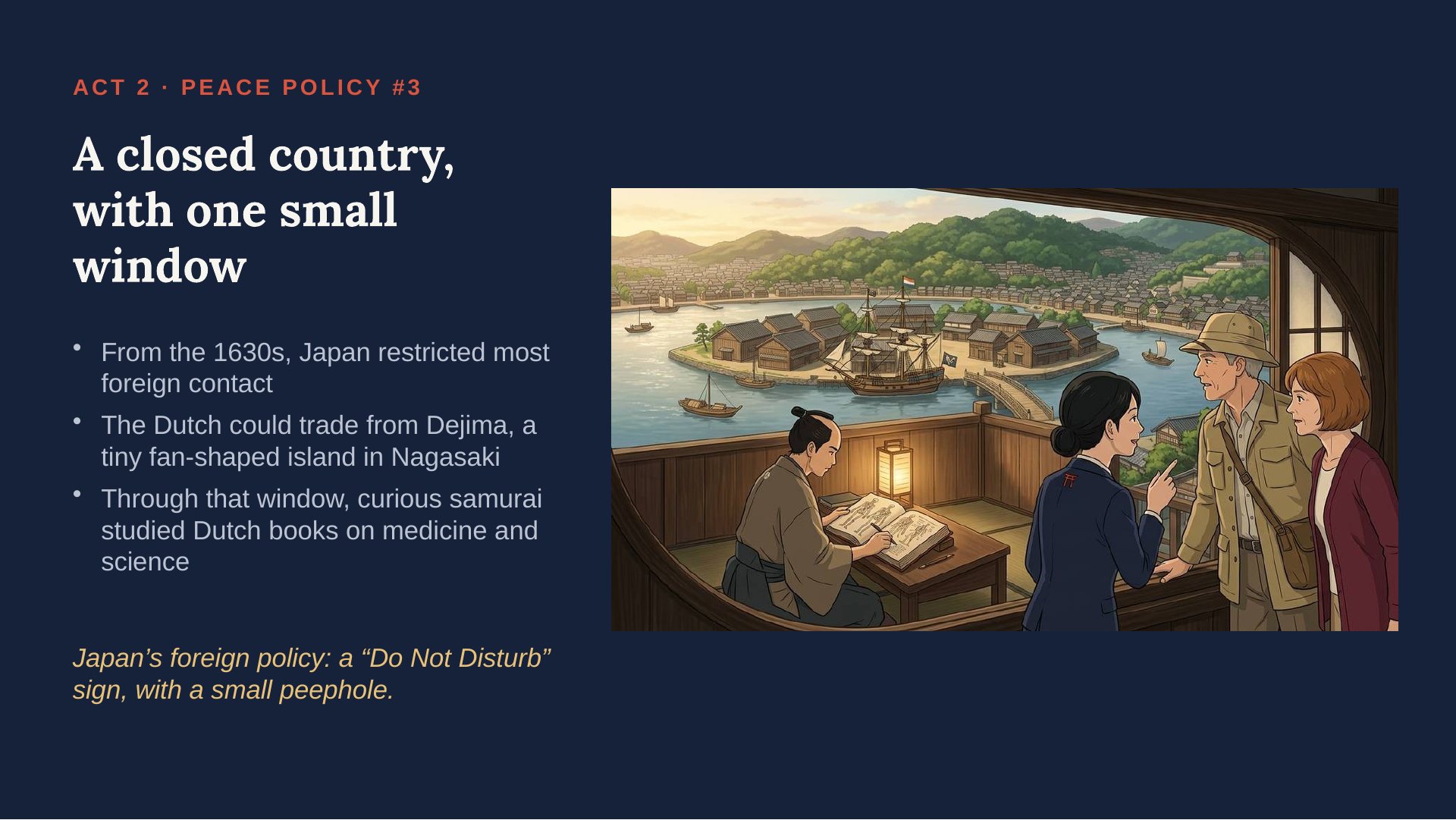
From the 1630s, fearing foreign influence and especially Christianity, the shogunate restricted most contact with the outside world. One small window stayed open: the Dutch were allowed to trade from Dejima, a tiny fan-shaped artificial island in Nagasaki harbor. Through that window, curious scholars translated Dutch books on anatomy, astronomy and science. Remember that window. It matters in our next briefing.
Peace policy #4: warriors become bureaucrats
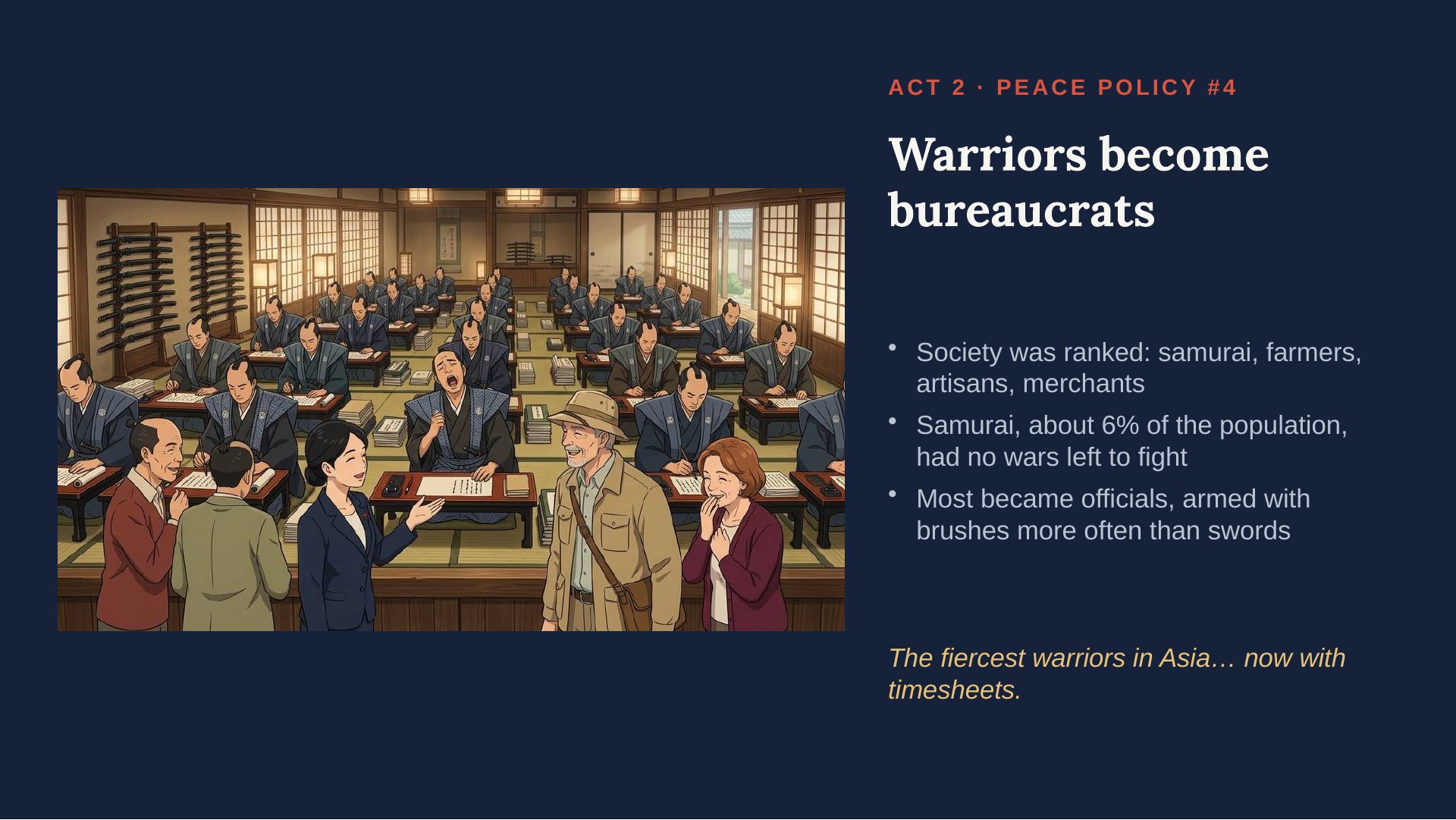
Society was ranked into samurai, farmers, artisans and merchants. The samurai, about 6% of the population, suddenly had no wars to fight, so most became the country’s administrators: tax officials, judges, police and clerks. They still wore two swords as a mark of rank, but many never drew them in anger. Meanwhile, merchants at the “bottom” of the ladder often grew richer than the samurai above them.
Act 3 · Edo vs. Tokyo today
The biggest city in the world
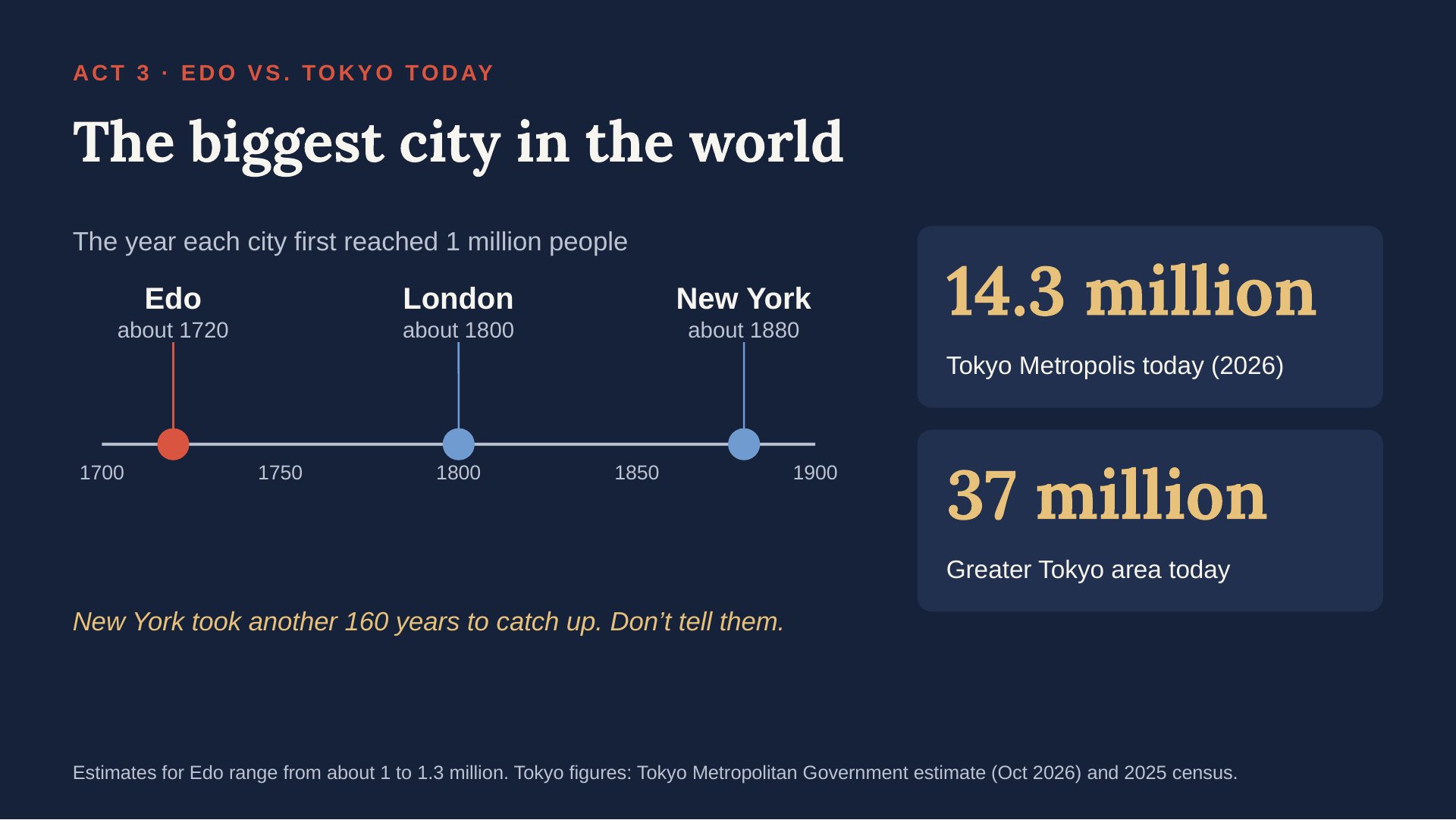
| City | First reached 1 million |
|---|---|
| Edo | About 1720 (estimates range from 1 to 1.3 million) |
| London | About 1800 |
| New York | About 1880 |
| Tokyo today | About 14.3 million in the Tokyo Metropolis; about 37 million in Greater Tokyo |
Edo probably passed a million people around 1720, when London had perhaps 600,000. Today the Tokyo Metropolis is home to about 14.3 million people, and Greater Tokyo to about 37 million, almost as many as all of Canada.
Who lived where
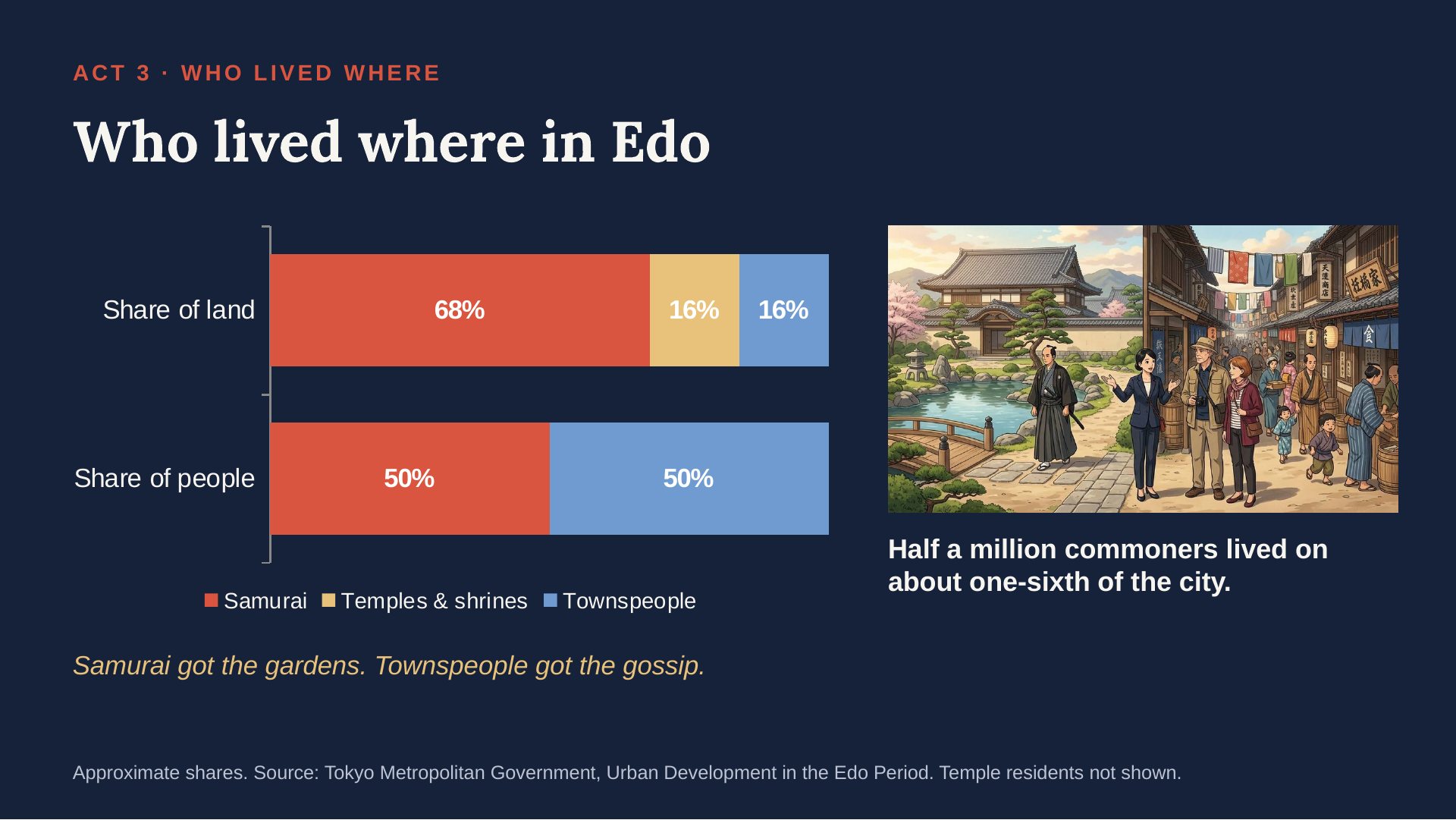
This is the part that surprises our guests most. Samurai estates covered about 68% of Edo, temples and shrines about 16%, and the townspeople’s districts only about 16%. Yet samurai and townspeople were roughly equal in number. So about half a million merchants and artisans were packed into one-sixth of the city, one of the densest urban neighborhoods in the world at the time.
Your shopping mall was a samurai lord’s backyard
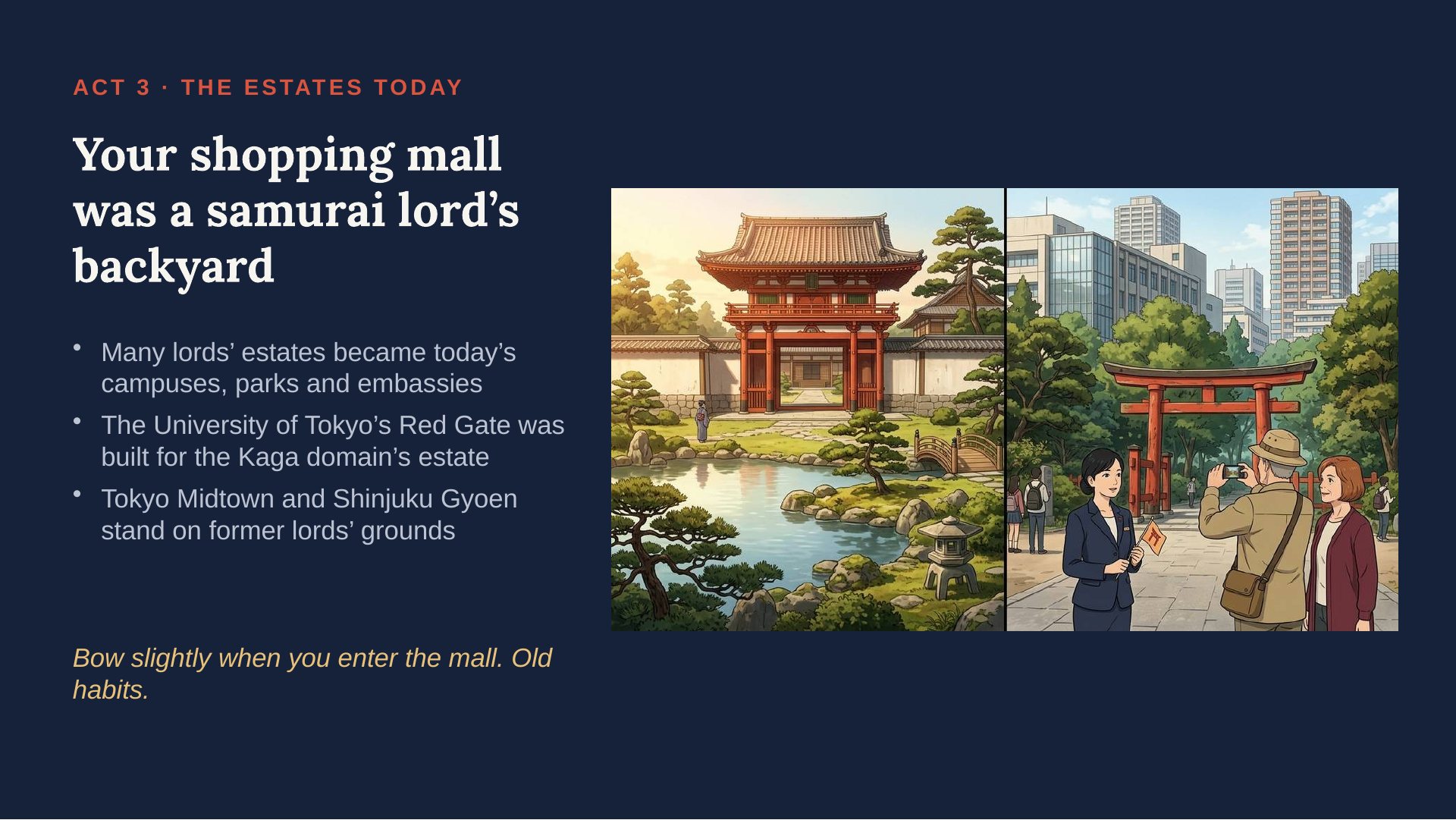
When the shogunate fell, the huge lords’ estates were the obvious places to put universities, ministries, parks and embassies. That’s why central Tokyo has so many large green spaces. The University of Tokyo’s Red Gate (Akamon) was built in 1827 for the Kaga domain’s estate. Tokyo Midtown stands on the Mori family’s former grounds, and Shinjuku Gyoen garden on the Naito family’s.
Tiny apartments: invented in Edo
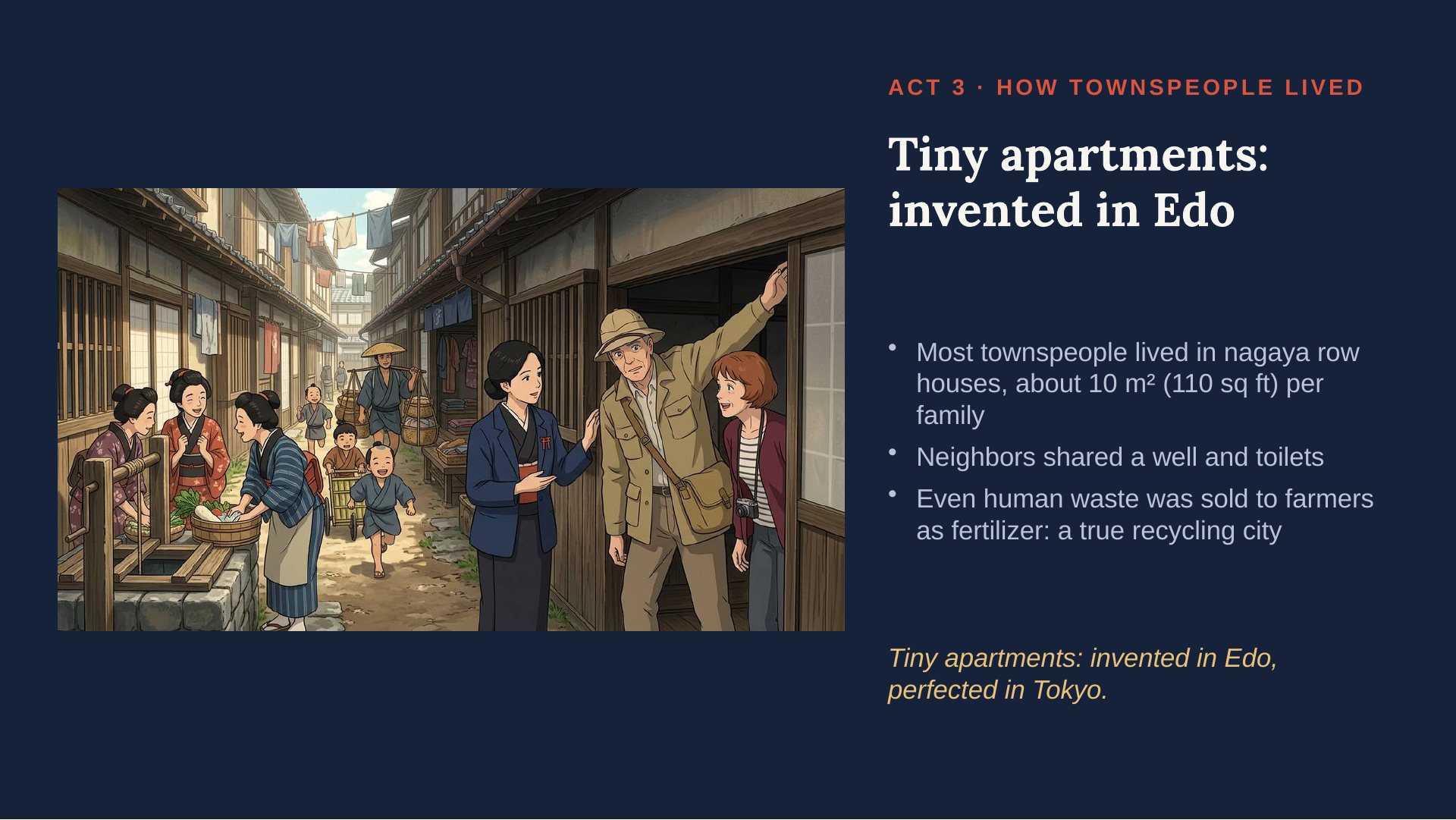
Most townspeople lived in nagaya row houses: one unit was about 10 square meters (110 square feet), a small earthen kitchen plus a single room for the whole family. Neighbors shared a well and toilets, and life spilled out into the alley. Almost nothing was wasted. Used paper, broken pottery, ashes and even human waste were collected and resold; the last went to farmers as fertilizer. Visitors often remark on how clean Tokyo feels. The habit is old.
Edo invented fast food
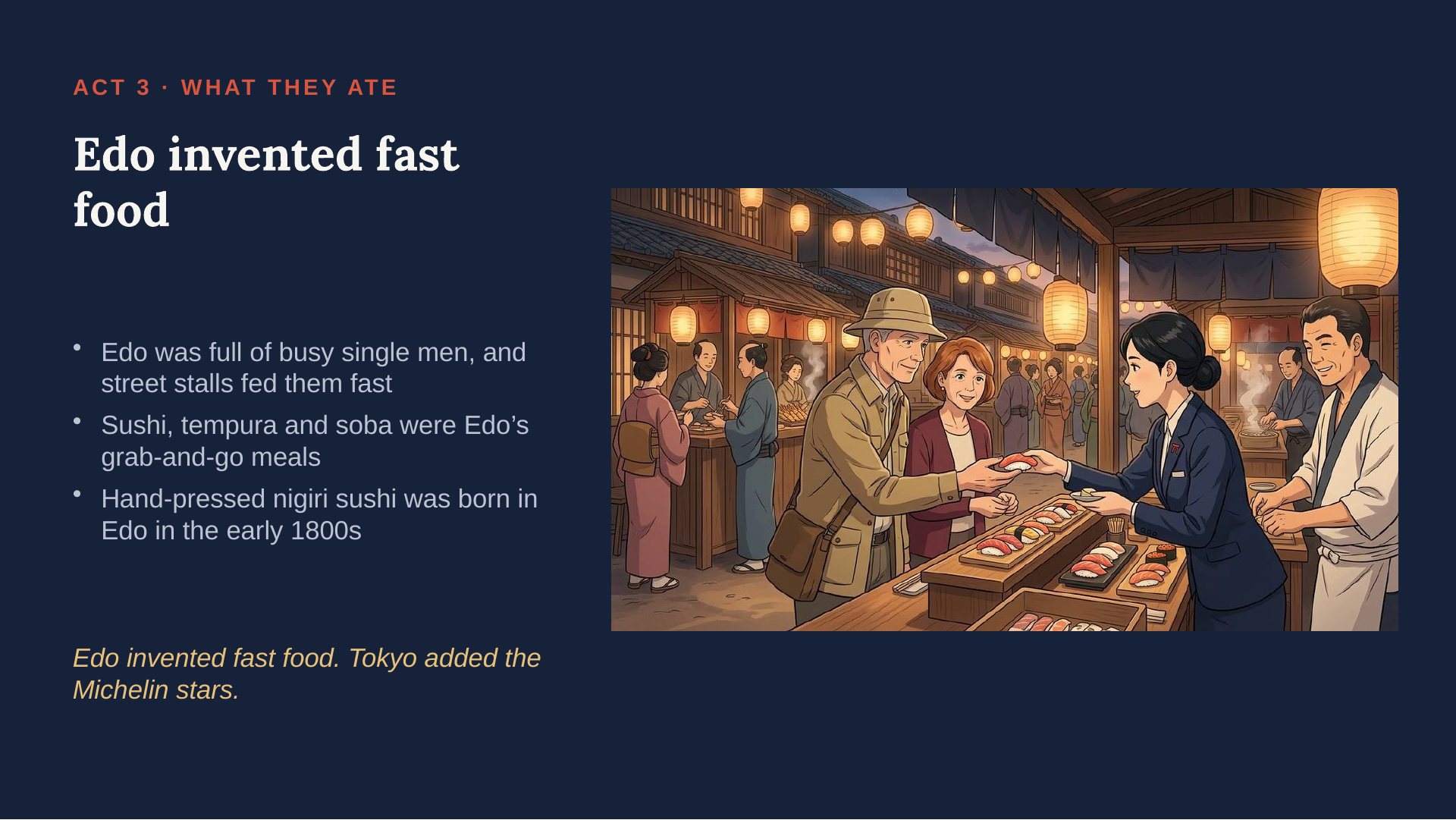
Edo had far more men than women: samurai posted from the provinces, laborers and apprentices, many of them single and busy. Street stalls fed them fast. Sushi, tempura and soba were Edo’s grab-and-go meals, eaten standing up. Hand-pressed nigiri sushi, made in seconds instead of being fermented for days, became Edo’s signature snack in the early 1800s. Tempura was fried at outdoor stalls, partly to keep the fire risk out of crowded homes.
Act 4 · Pop culture of a peaceful city
Kabuki: Edo’s rock stars
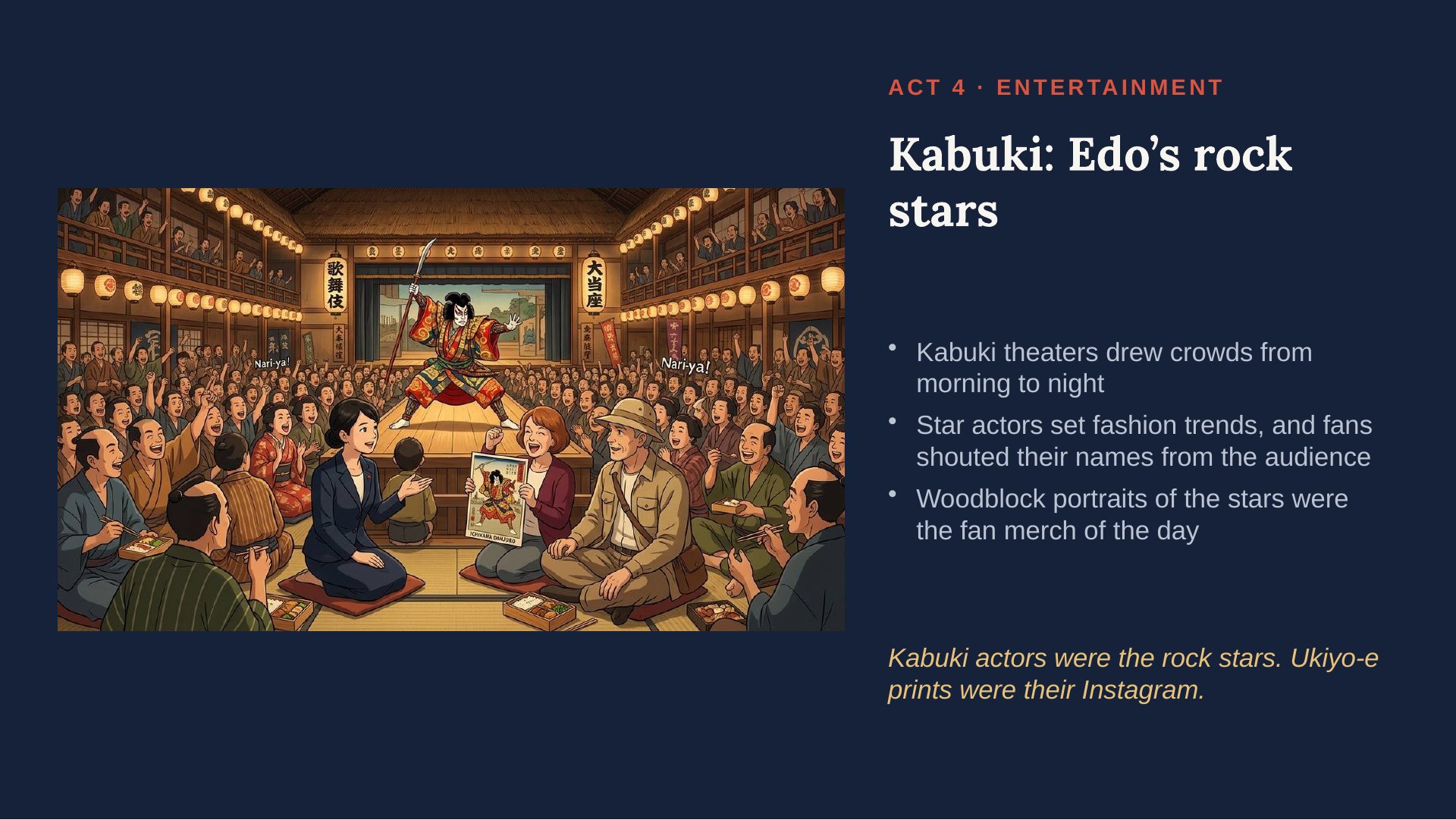
A day at the kabuki was a full day out, with bento boxes, snacks and plenty of shouting. Star actors set fashion trends, and fans called out the actor’s stage-family name at the big moments, a tradition you can still hear today at the Kabuki-za theater in Ginza. Woodblock portraits of the stars were the fan merchandise of the day. If you’re curious, a single-act ticket is an easy way to try it.
A print that changed Western art
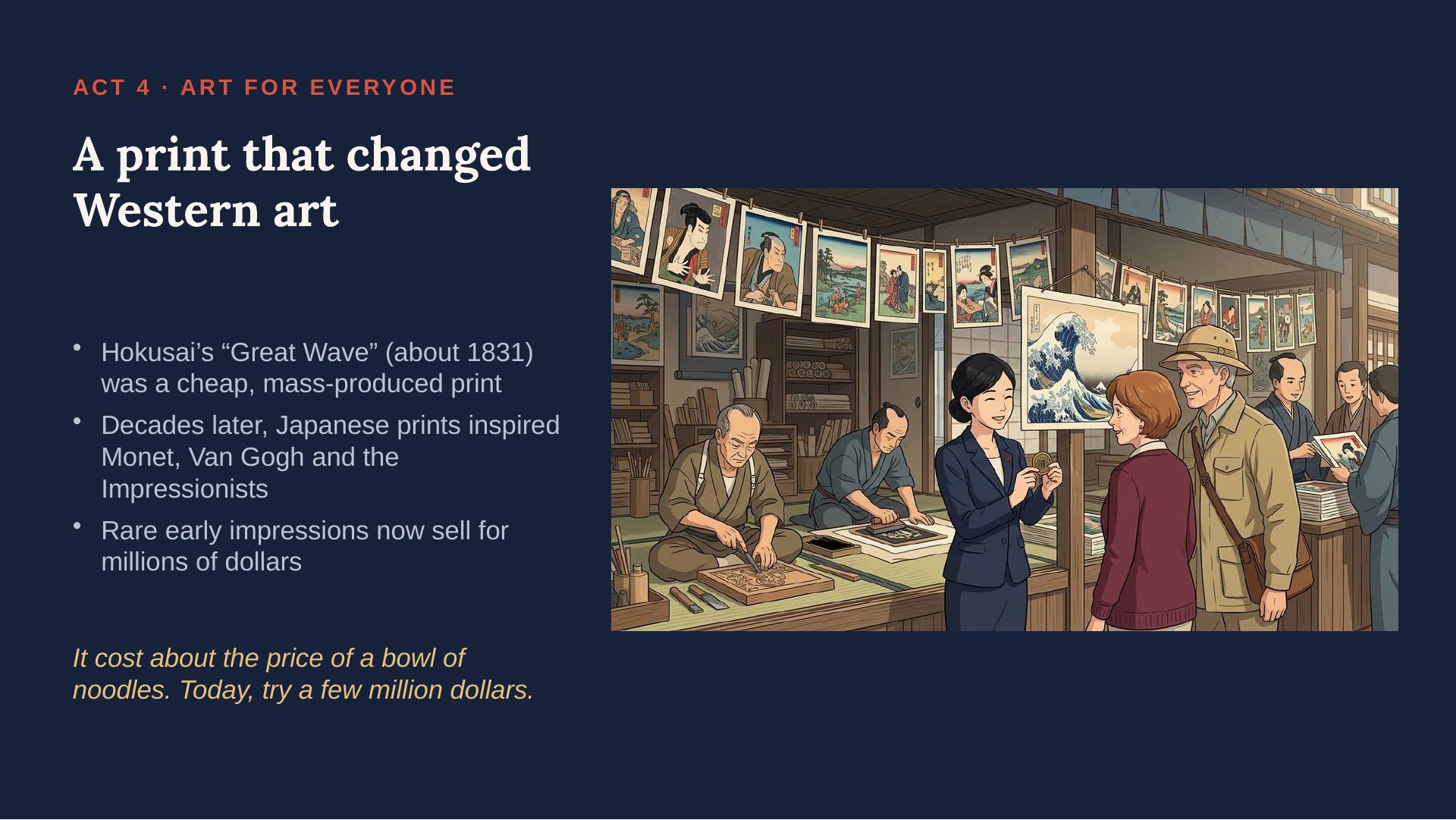
Woodblock prints were made by teams: a designer, a carver and a printer, coordinated by a publisher. A print sold for roughly the price of a bowl of soba. Hokusai’s “Great Wave” (about 1831) was one of these cheap, mass-produced prints. Once Japan opened up, prints poured into Europe and sparked the craze called Japonisme; Monet filled his house at Giverny with them, and Van Gogh copied them. Rare early impressions of the Great Wave now sell for millions of dollars.
Cherry blossoms, fireworks and sumo
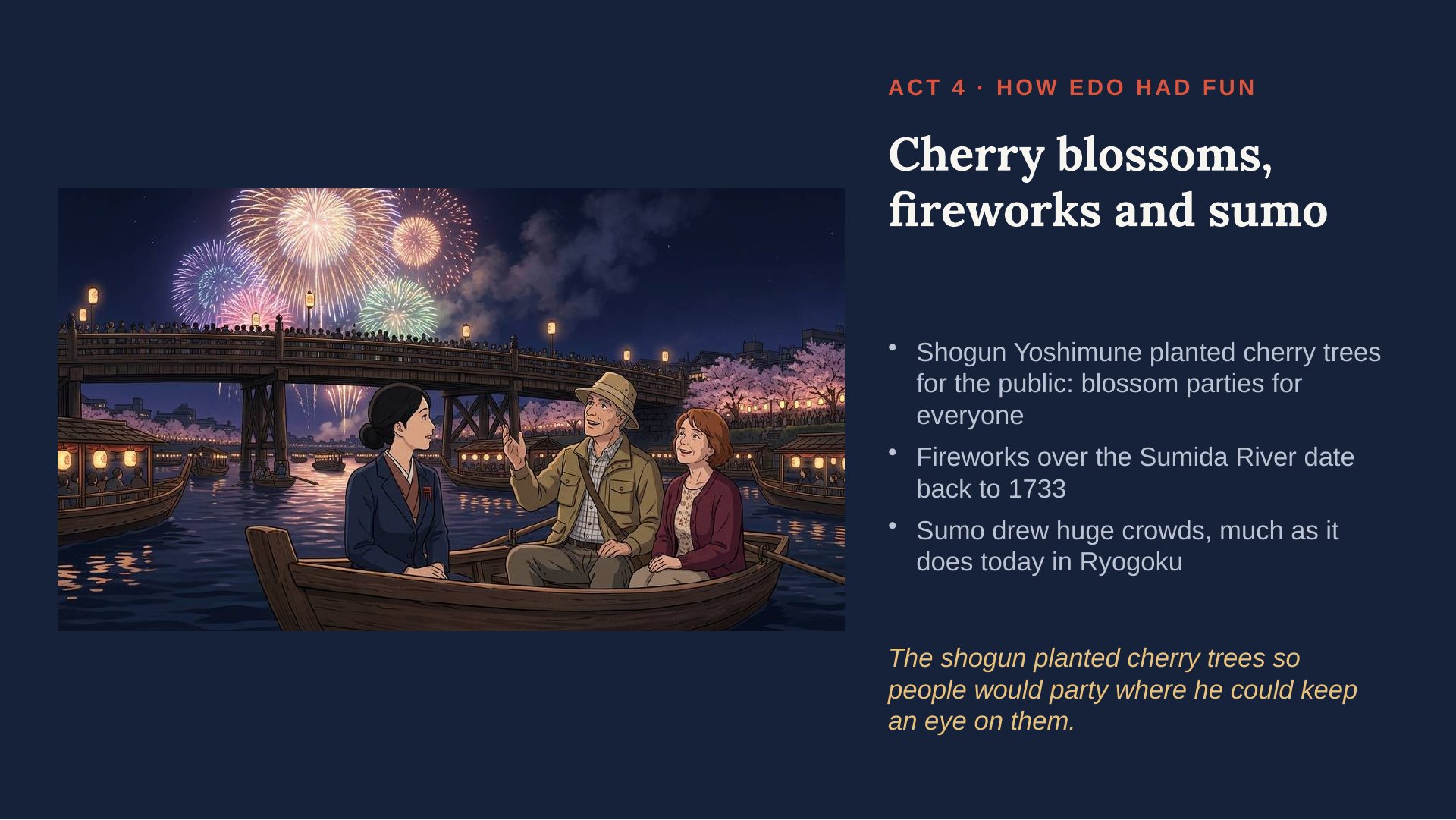
In the 1720s, Shogun Yoshimune planted cherry trees at places like Asukayama so ordinary people had somewhere to celebrate, and blossom-viewing parties became everyone’s spring ritual. The Sumida River fireworks date back to 1733. Sumo drew huge crowds too, and the national sumo stadium is still in Ryogoku, beside the same river.
A city of readers
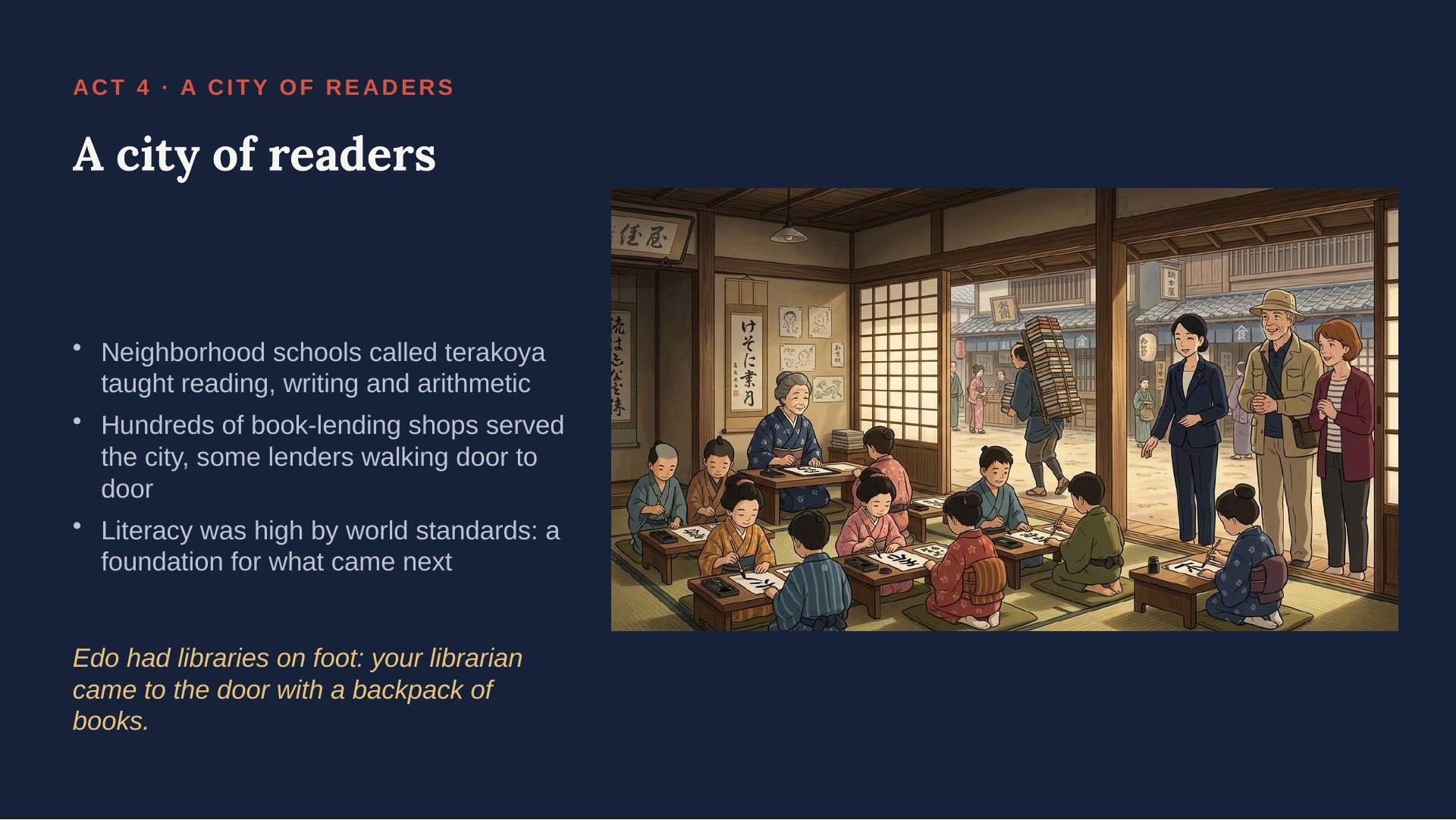
Many children of merchants and artisans learned reading, writing and arithmetic at neighborhood schools called terakoya. Hundreds of book-lending shops served the city, and some lenders walked from door to door with stacks of novels, guidebooks and comic stories on their backs. Literacy was high by the standards of the time, a foundation for how quickly Japan would modernize in the decades that followed.
Find Edo in today’s Tokyo
Edo is still here, if you know where to look
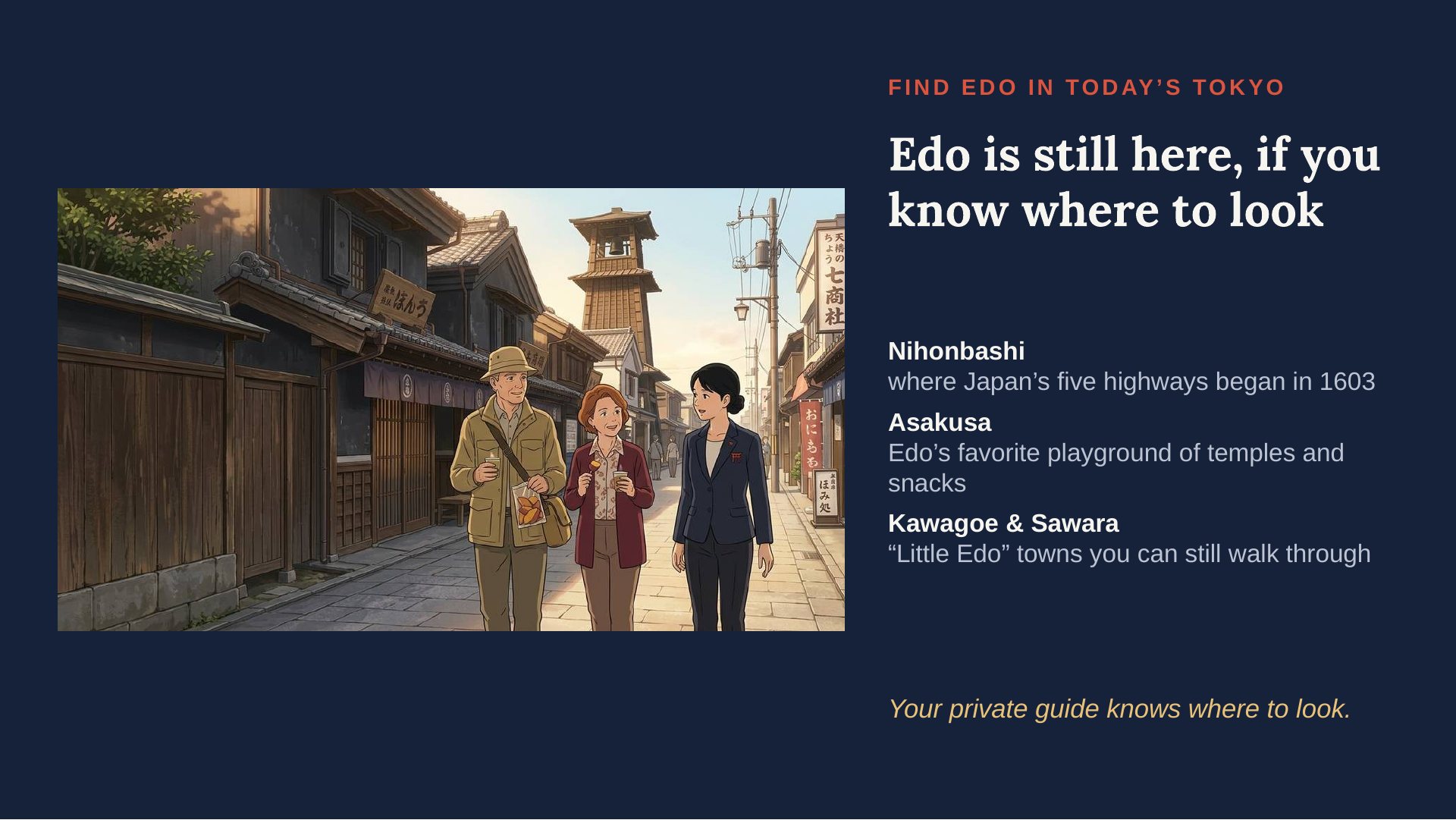
- Nihonbashi: the 1603 bridge where Japan’s five great highways began. Road distances are still measured from here.
- Asakusa: Edo’s favorite playground of temples, theaters and snacks. Essentials of Tokyo Tour →
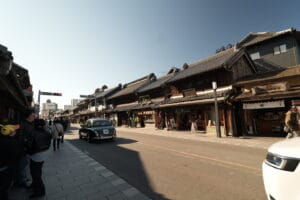
- Kawagoe: Kurazukuri Street’s clay-walled merchant houses, the Toki no Kane bell tower and Kashiya Yokocho candy alley. Kawagoe “Little Edo” Tour →
- Sawara: Edo-period merchant houses and warehouses along the Ono River canal. Sawara Little Edo Tour →
To be continued…
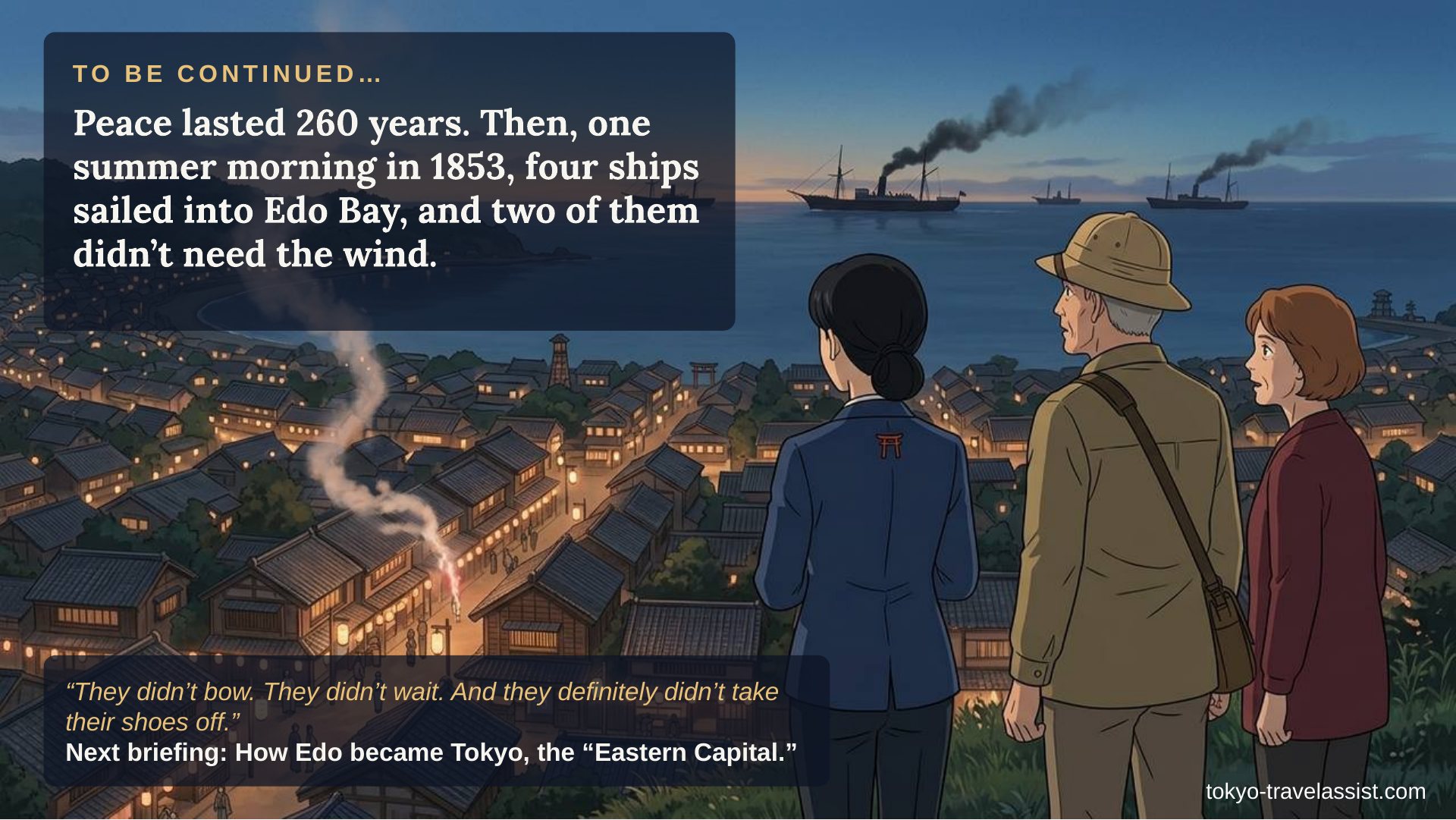
Peace lasted 260 years. Then, one summer morning in 1853, four American warships sailed into the mouth of Edo Bay, and two of them didn’t need the wind. Remember the little Dutch window and the city of readers? Both matter enormously in what happens next.
Step into Edo with your own private guide
Tell us your dates and what caught your eye in this briefing. We’ll plan a day around you, by email, one conversation at a time.
Next briefing: how Edo became Tokyo, the “Eastern Capital.” More from our guides: Private Guide Briefings. Population figures for Edo are estimates and vary by source; Tokyo figures are from the Tokyo Metropolitan Government (2026) and the 2025 census.