A Private Guide Briefing from Travel Assist Japan
Japan has eight million gods, and not one of them is quite what a Western visitor means by “God.” They live in trees and waterfalls. Nobody among them created the world. And some of them were ordinary people not so long ago. Our private guides get questions about this at almost every shrine, so here is the briefing we share before the tour: four short acts, a few surprises and one or two jokes, in about 12 minutes.
Act 1 · What do you mean by “God”?
Start with the picture in your head

Close your eyes and picture “God.” Most of our guests from North America see some version of the same thing: one all-powerful Creator, somewhere above the world, who made everything and keeps an eye on how we behave. That picture comes from Judaism, Christianity and Islam, and it is a perfectly good picture. It just isn’t the one you’ll need at a Japanese shrine.
Most of humanity’s early gods came in crowds
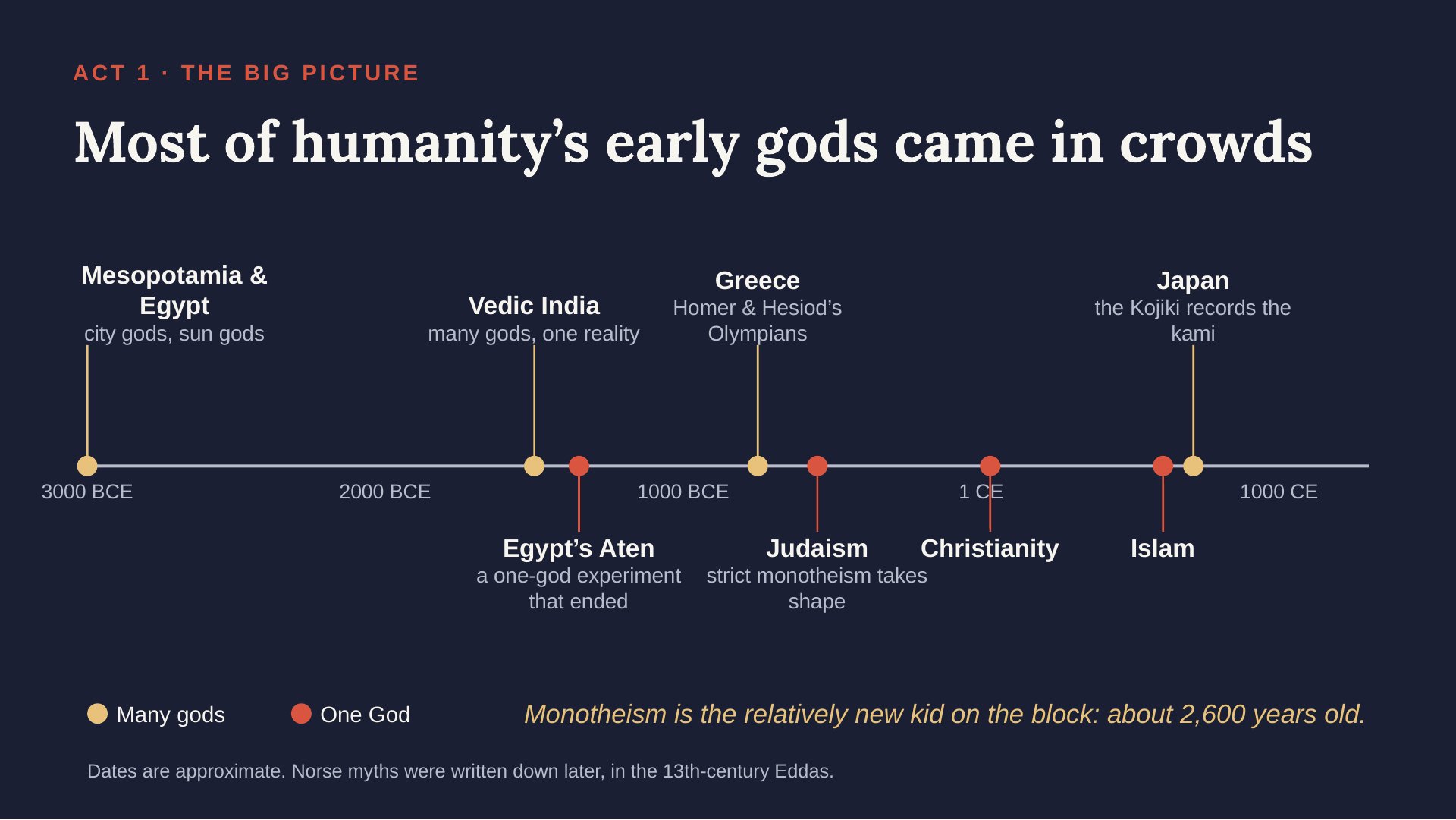
For most of recorded history, people lived with many gods: the city gods of Mesopotamia and Egypt, the many gods of Vedic India, the Olympians of Greece. Pharaoh Akhenaten tried a one-god religion around 1350 BCE, but it ended with him. Strict monotheism took shape in Judaism around the 6th century BCE and later spread through Christianity and Islam. Japan’s oldest chronicle, the Kojiki, was compiled in 712 CE, and it describes a world crowded with kami.
Three ways people have imagined the divine
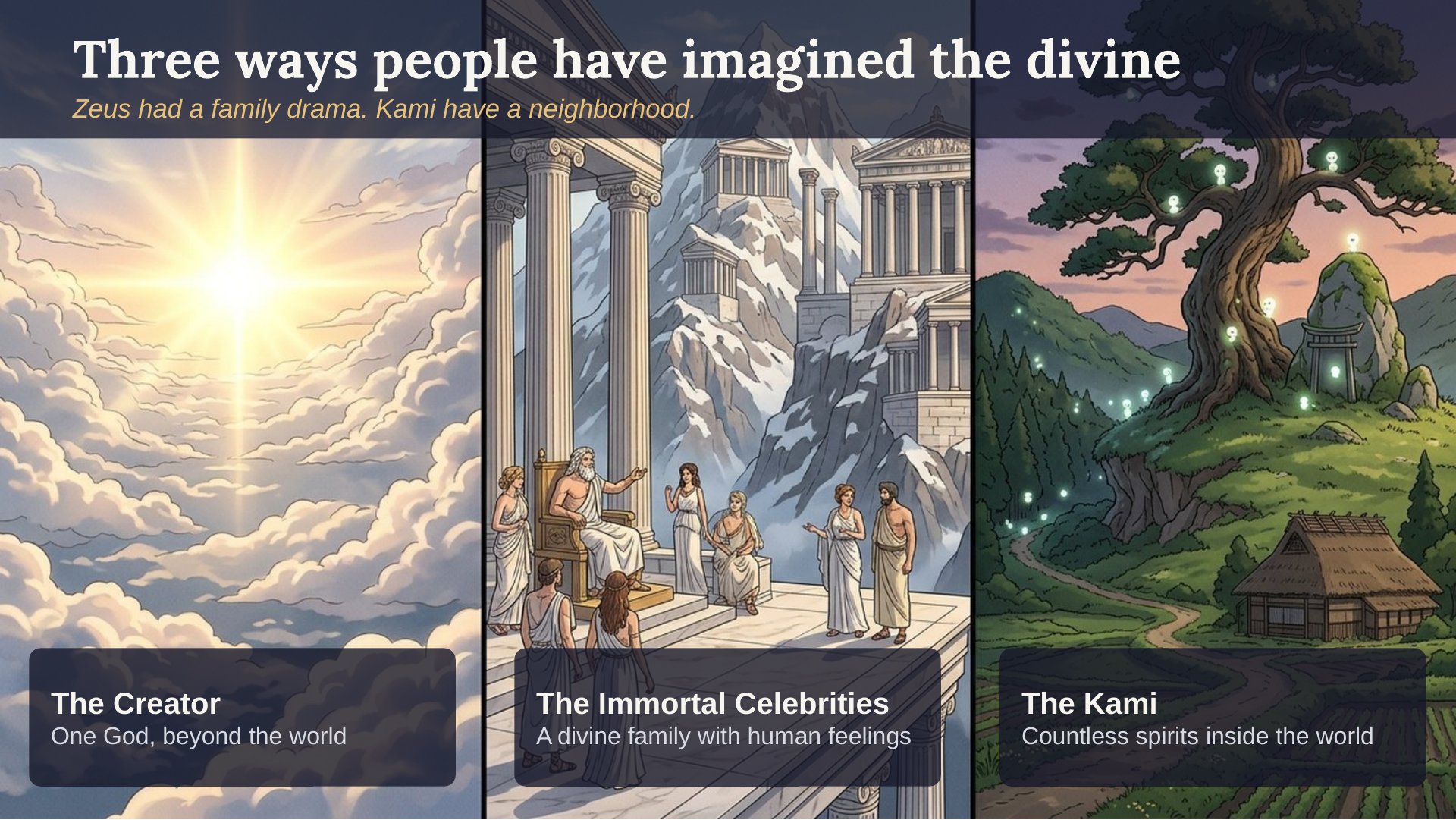
It helps to think in three models. The Creator: one God, outside the world he made. The Immortal Celebrities: the Greek and Norse gods, a divine family with very human feelings and plenty of drama. And the kami: countless spirits that live inside the world, in mountains, rivers, trees and, as you’ll see, people. Japan sits firmly in the third group.
Act 2 · Meet the kami
Kami are sacred presences, not a supreme being
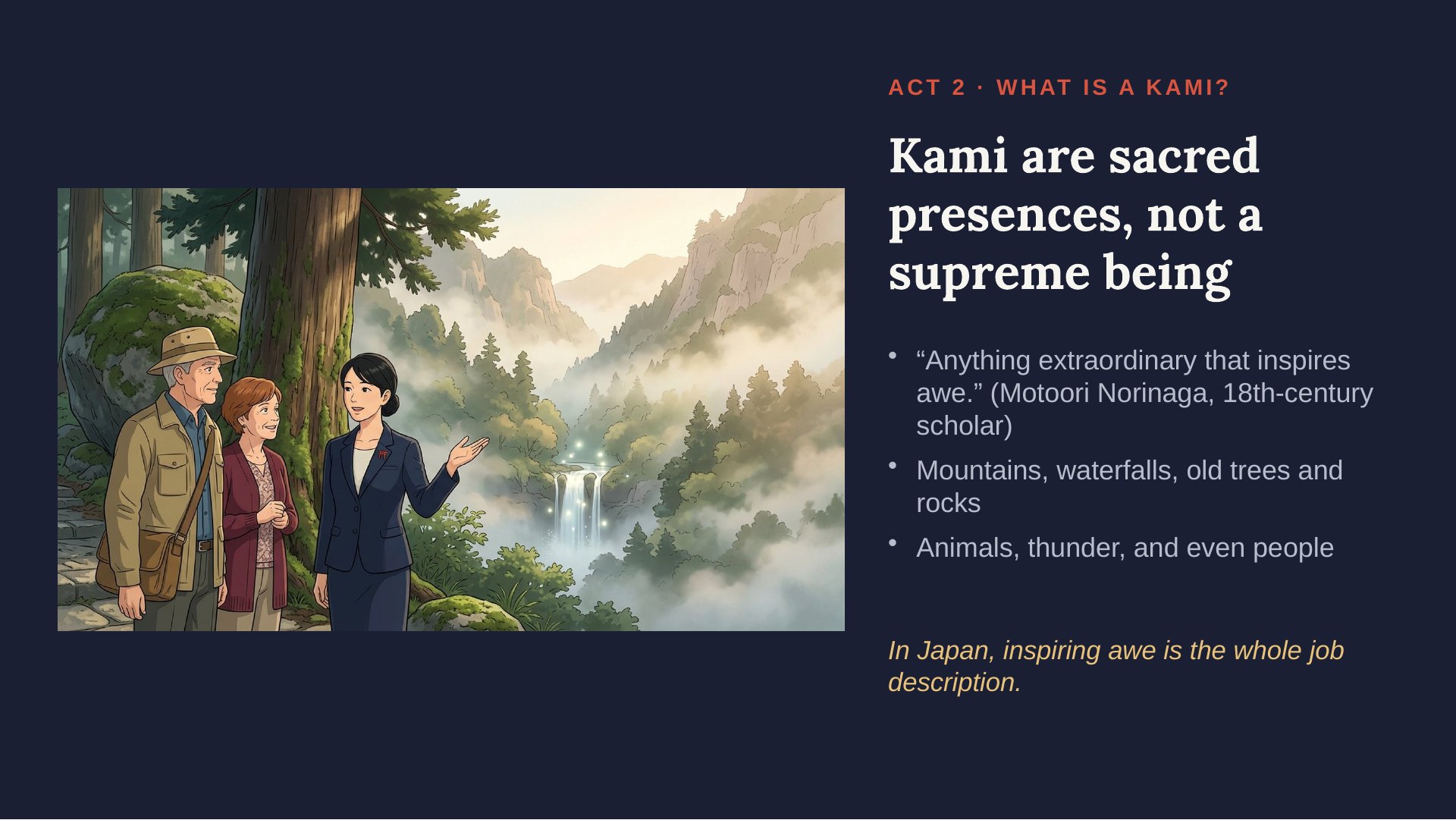
The 18th-century scholar Motoori Norinaga gave the most famous definition: a kami is anything extraordinary that fills us with awe. Notice what is missing. A kami doesn’t have to be all-powerful, all-good or the maker of anything. Mountains, waterfalls, ancient trees, unusual rocks, animals, thunder and even people can all be kami. “Sacred presence” is a better English translation than “god.”
A rope around a tree means a kami lives here
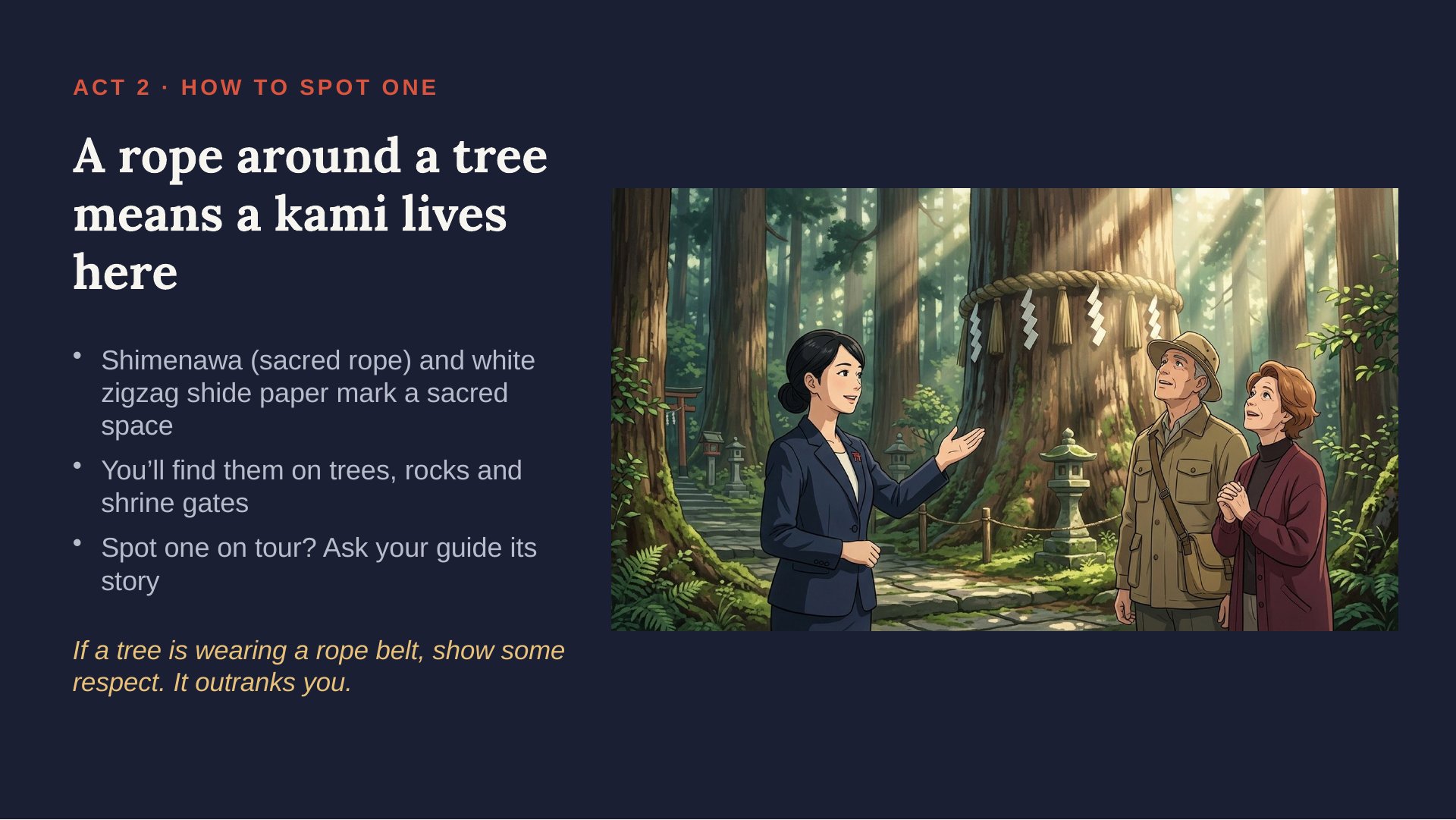
How do you know a kami is present? Look for a shimenawa, a thick rope of rice straw, often hung with white zigzag paper strips called shide. You’ll find them around giant trees, on boulders, across shrine gates and even around waterfalls. Some sacred trees are over a thousand years old. Admire them from outside the fence, and please don’t touch or climb them.
Japan’s myths have no creator who made everything
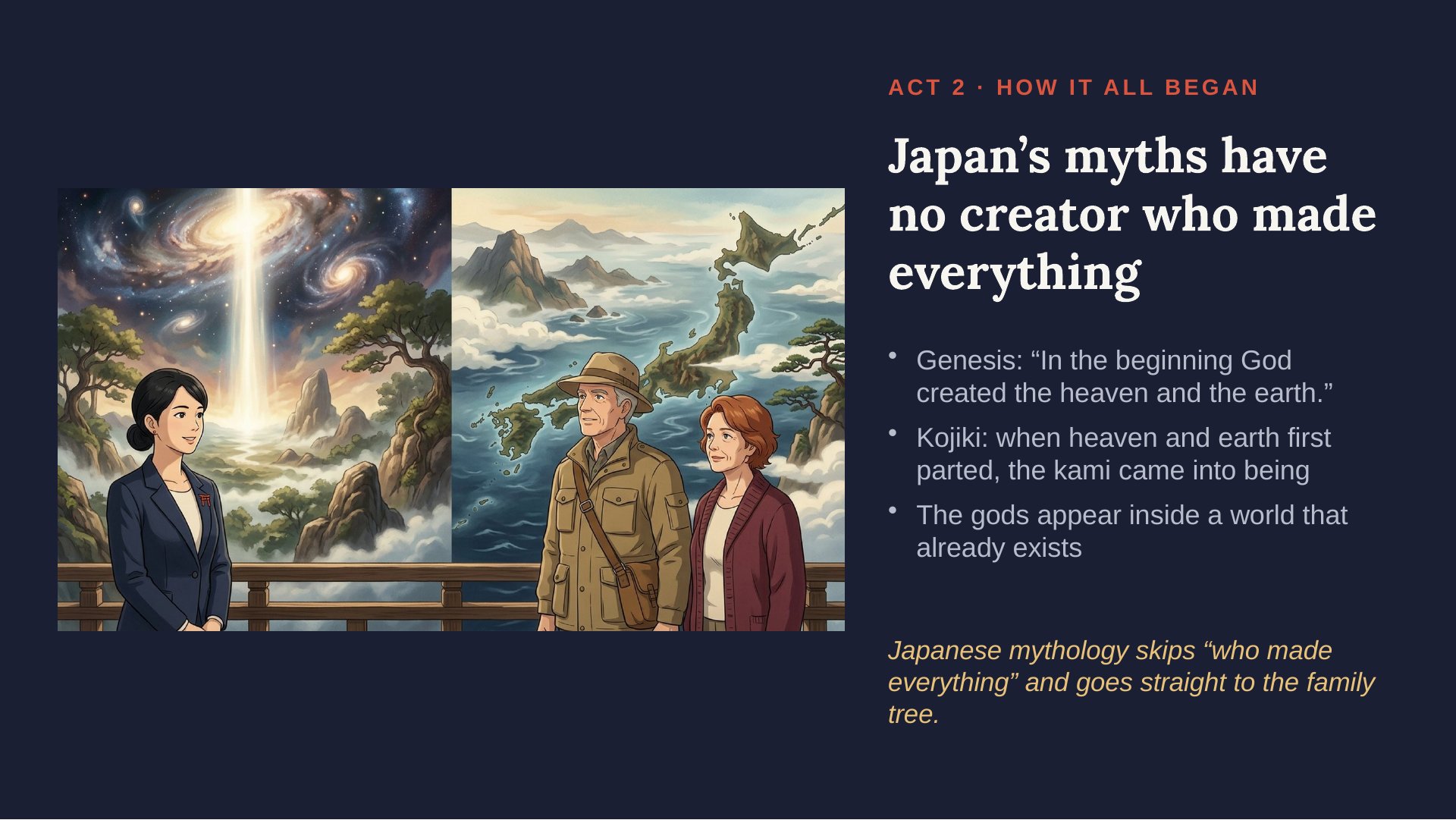
Compare the opening lines. Genesis begins, “In the beginning God created the heaven and the earth.” The Kojiki begins with heaven and earth already parting, and the first kami simply come into being. Even the famous divine couple Izanagi and Izanami give birth to the islands of Japan; they don’t create the universe from nothing. The gods appear inside a world that was already there.
Every kami has a wild side and a gentle side
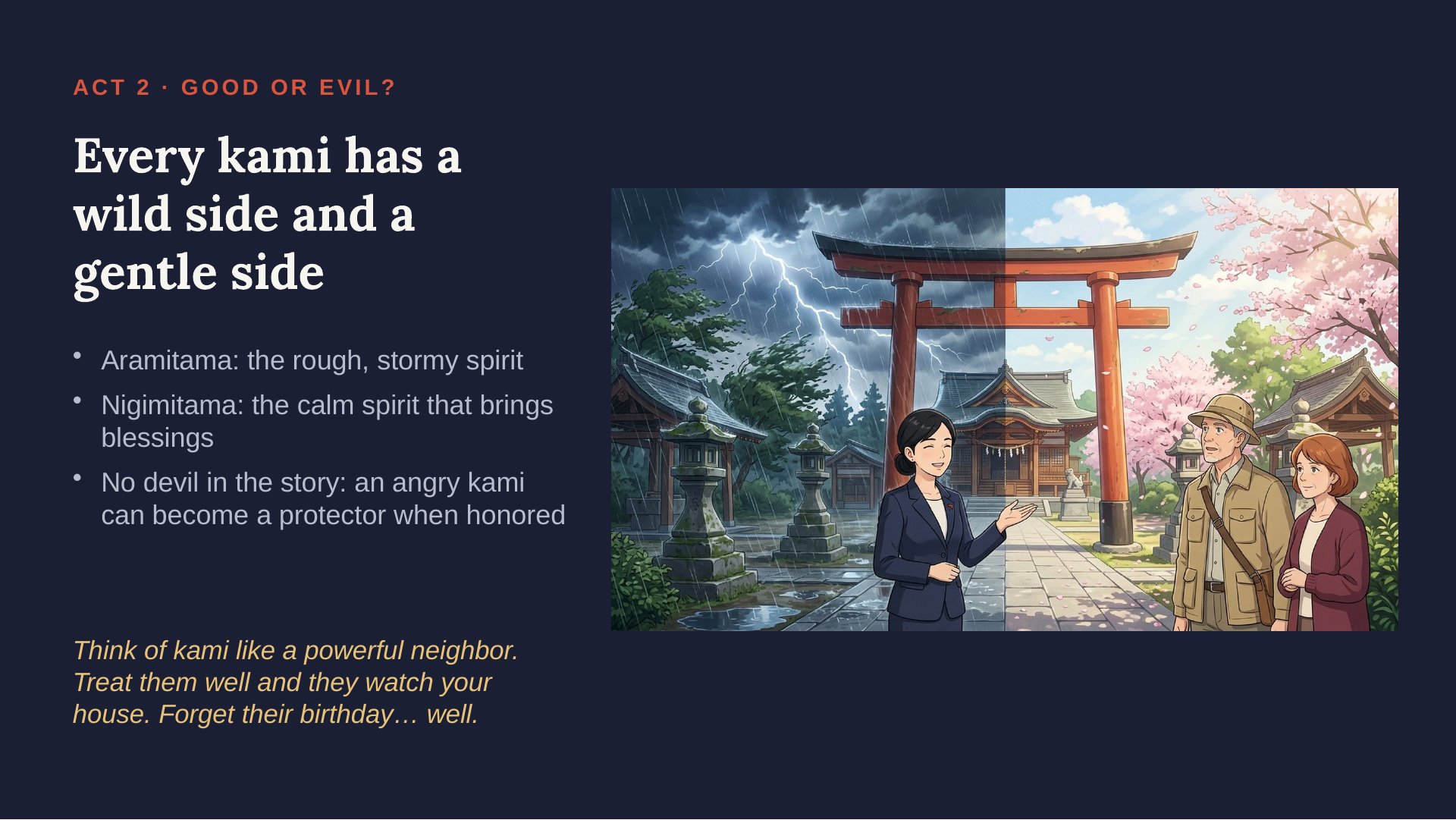
There is no cosmic battle between good and evil here, and no devil. Shinto describes a rough, stormy spirit (aramitama) and a calm spirit that brings blessings (nigimitama), and the same kami can show either one. Festivals, prayers and offerings are about keeping the relationship on good terms, so that an angry kami becomes a protector.
At a shrine, purity matters more than sin
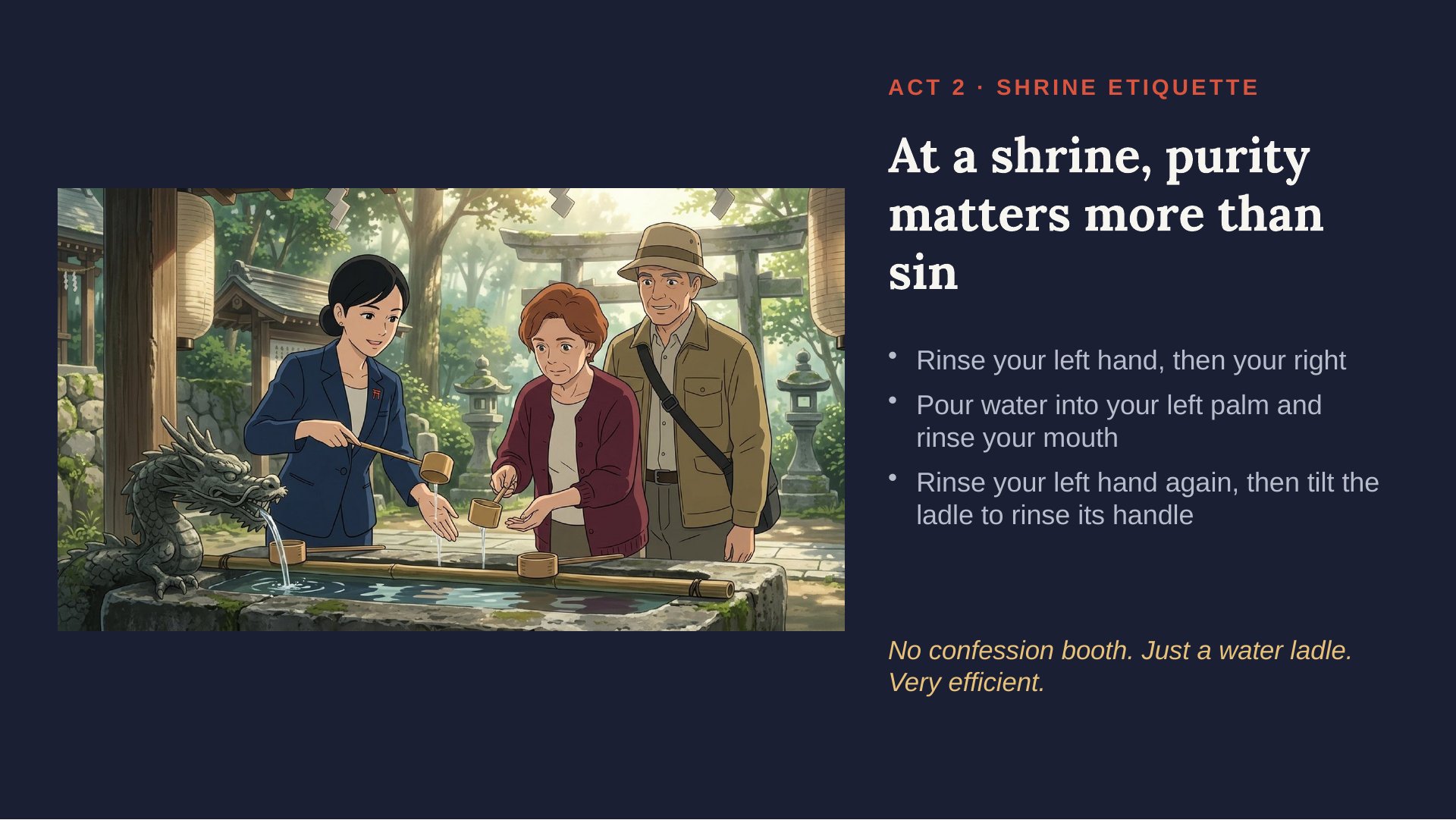
Shinto worries less about moral sin and more about kegare, a kind of spiritual dust we all pick up. The stone water basin at the shrine entrance (temizuya) is where you shed it:
- Rinse your left hand, then your right.
- Pour a little water into your left palm and rinse your mouth. Never drink straight from the ladle.
- Rinse your left hand again, then tilt the ladle upright so the last water runs down the handle.
Act 3 · Humans who became kami
In Japan, a person can become a kami
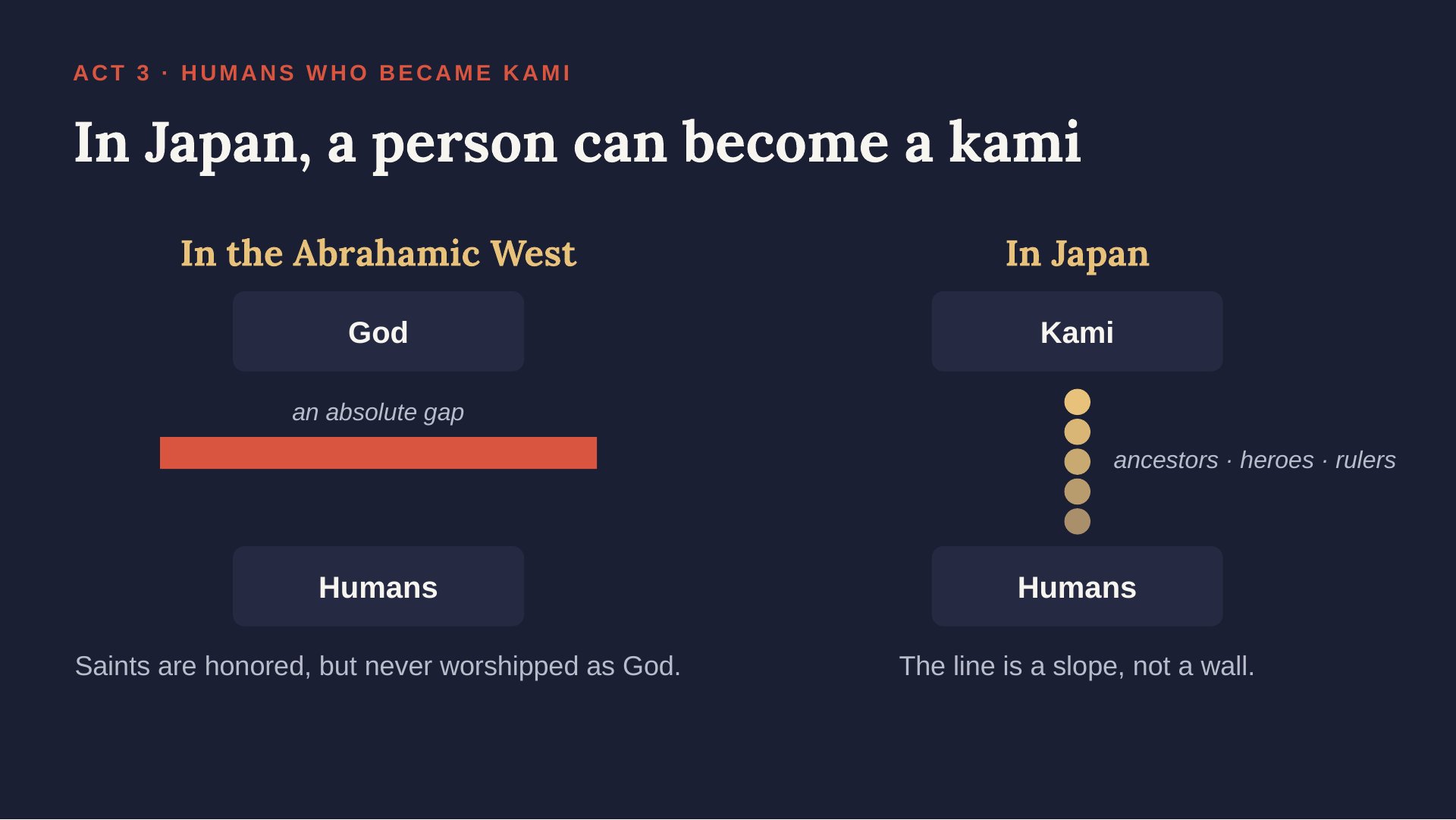
This is the biggest difference of all. In Judaism, Christianity and Islam, the gap between the Creator and his creatures can’t be crossed. Catholic theology even separates the honor given to saints from the worship owed to God alone. In Japan there is no wall. Death, extraordinary achievement, or simply being remembered and honored can carry a person into the world of kami.
A disgraced scholar became Japan’s god of exams
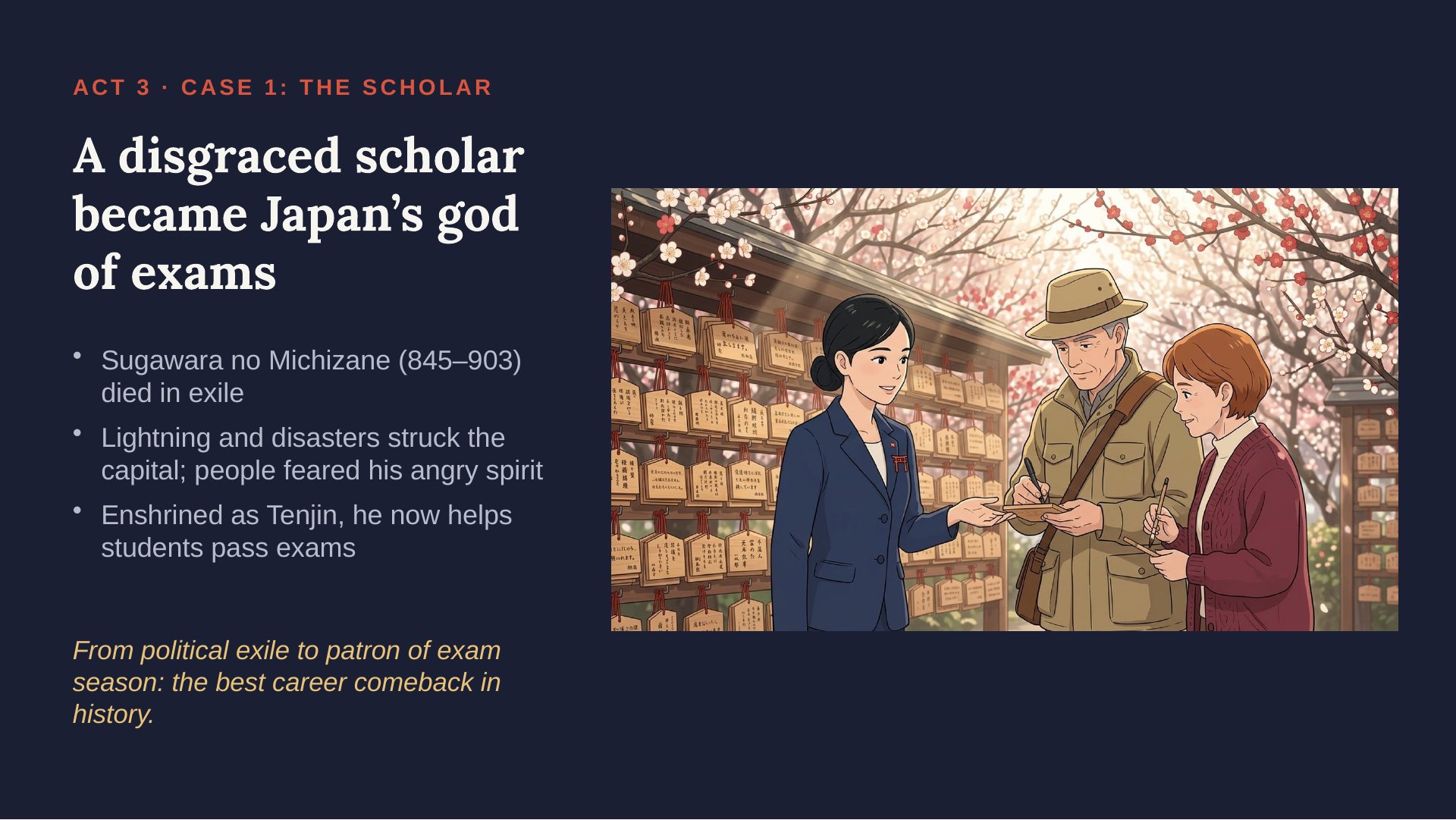
Sugawara no Michizane (845–903) was a brilliant scholar and statesman who was falsely accused and sent into exile, where he died. Soon after, lightning, fires and plague struck the capital, and people became convinced that his angry spirit was behind it. To calm him, they enshrined him as Tenjin. Today, his shrines are covered in wooden ema plaques from students praying to pass their exams.
A shogun was enshrined as a kami 400 years ago
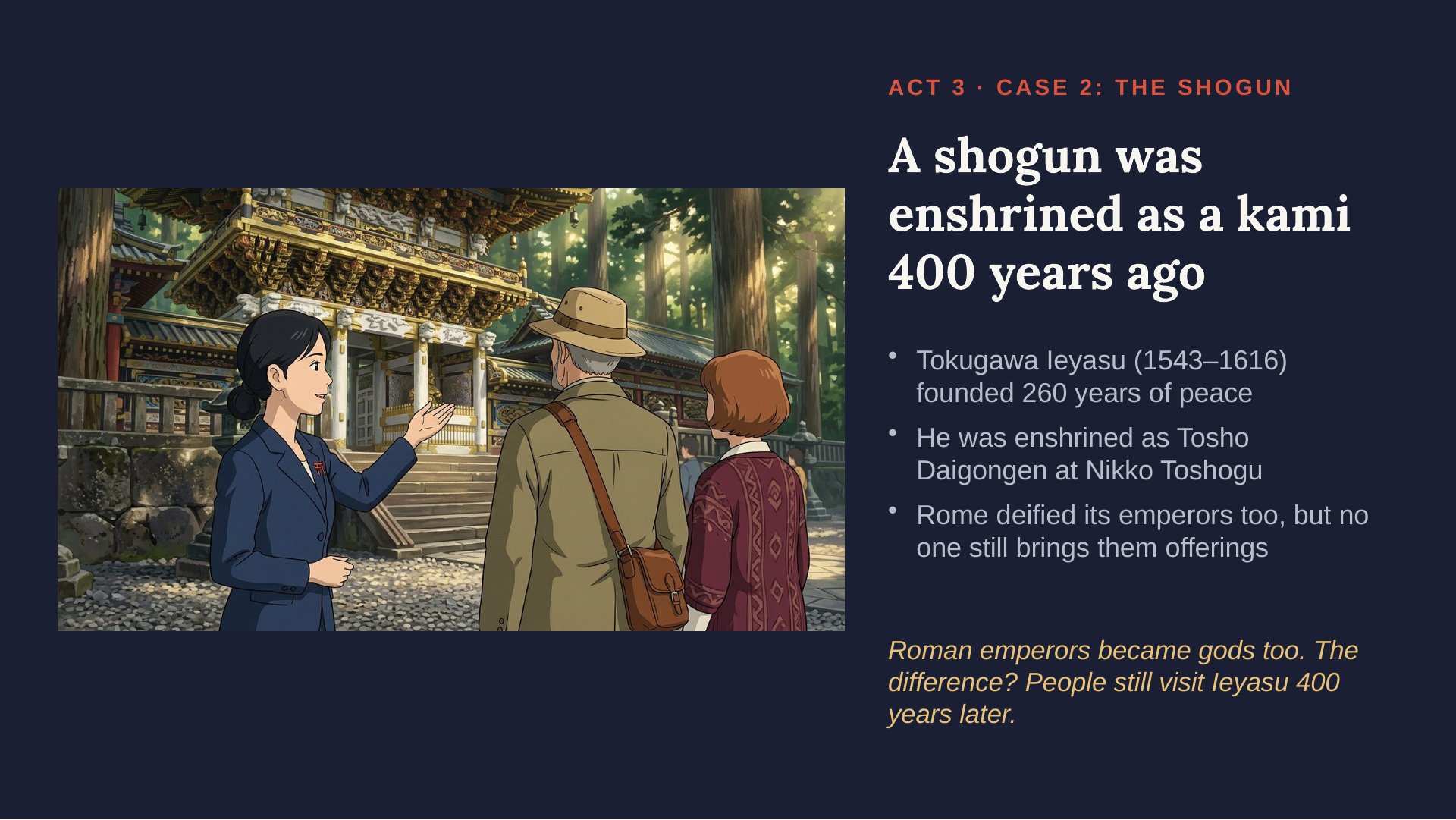
Tokugawa Ieyasu (1543–1616) unified Japan and founded a shogunate that kept the peace for about 260 years. After his death he was enshrined as the kami Tosho Daigongen, and his grandson rebuilt his shrine at Nikko into one of the most lavish buildings in Japan. Rome deified its emperors too, but nobody brings Augustus offerings anymore.
Your ancestors can become kami, too
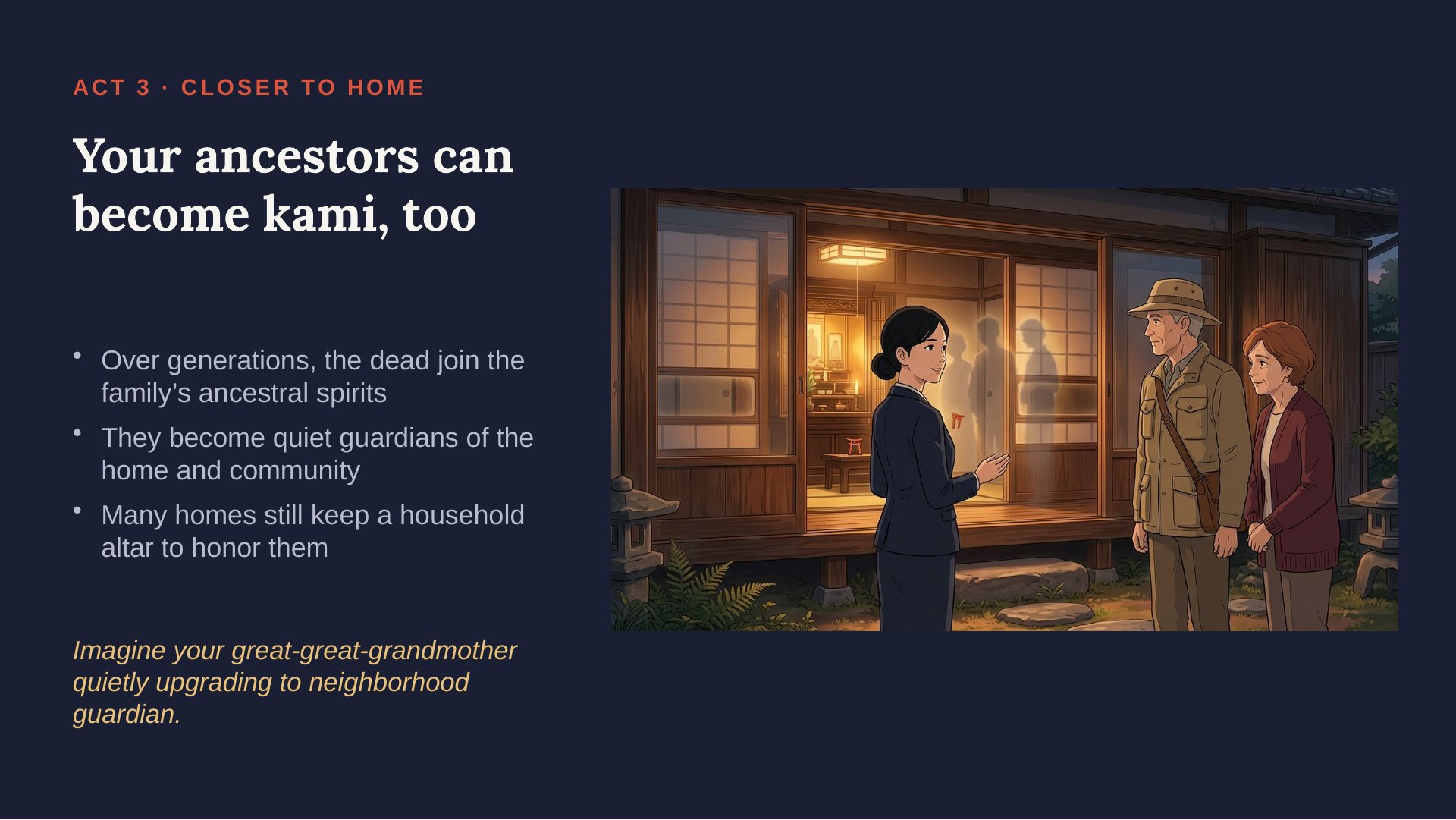
You don’t have to be famous. In traditional Japanese belief, the spirits of ordinary family members gradually join the ancestral spirits who protect the household and the village. That’s why many homes still keep a household altar, and why the summer Obon festival, when the ancestors are welcomed home, matters so much.
Act 4 · Putting it together
God and kami start from different places
| God (Judaism, Christianity, Islam) | Kami (Japan) | |
|---|---|---|
| How many | One | Countless: “8 million” |
| Creation | Made the world from nothing | Emerged in a world already there |
| Gods and people | Separated by an absolute gap | Connected: people can become kami |
| Good and evil | God is wholly good | Each kami has wild and gentle sides |
| Where | Beyond the world | In mountains, trees, rocks and shrines |
Different starting points, not better or worse. Many Japanese people hold these ideas loosely and practically, rather than as a set of doctrines to sign up to.
Kami and Buddhas have shared Japan for over 1,000 years
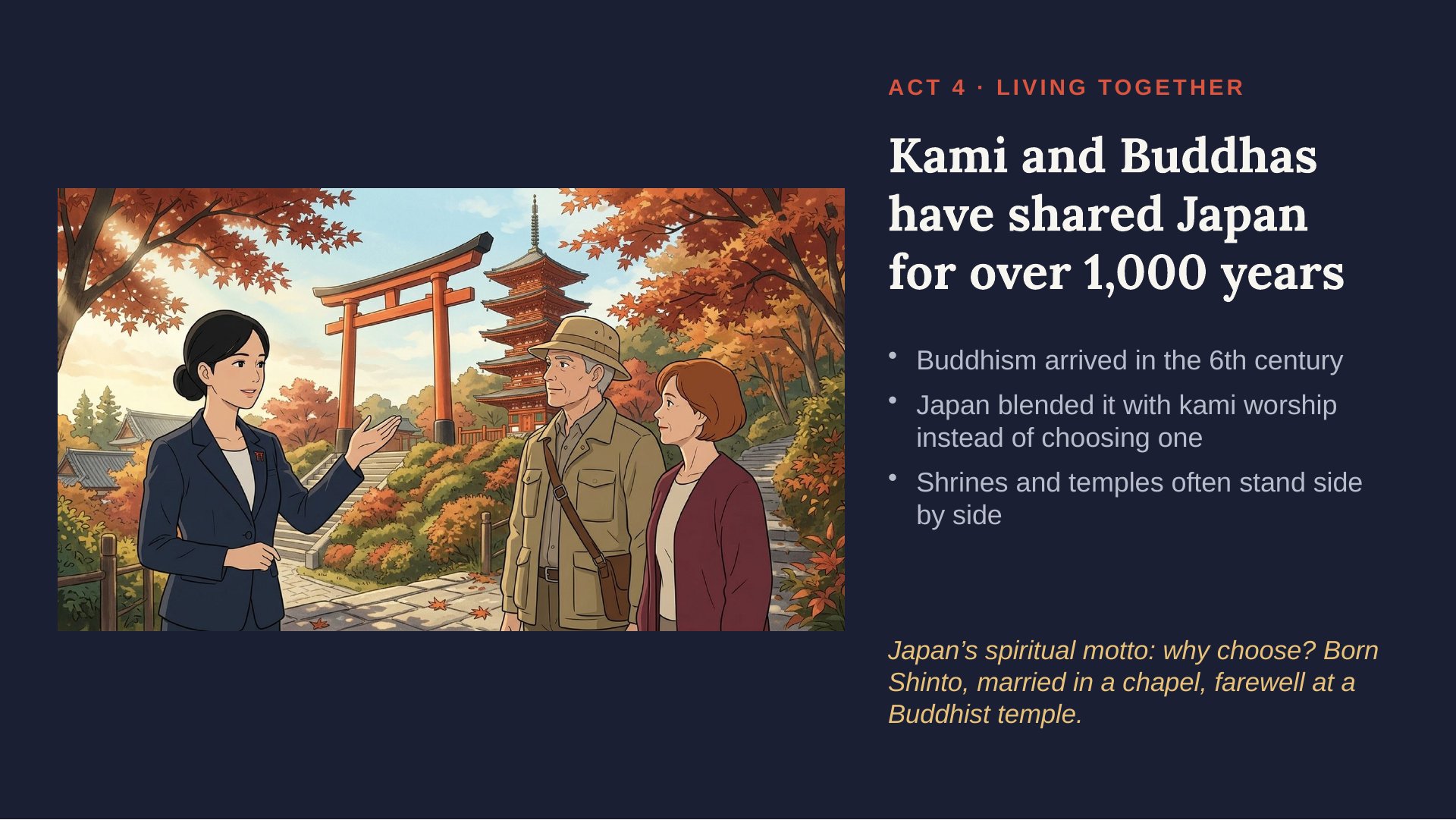
Buddhism arrived in Japan in the 6th century. Instead of choosing between the newcomer and the kami, Japan blended them: for about a thousand years, kami were often seen as local forms of Buddhas, and shrines and temples shared the same grounds. The government formally separated them in 1868, but daily life never quite did. Many families still visit a shrine at New Year, hold weddings in a chapel and say goodbye at a Buddhist temple.
Meet the kami in person
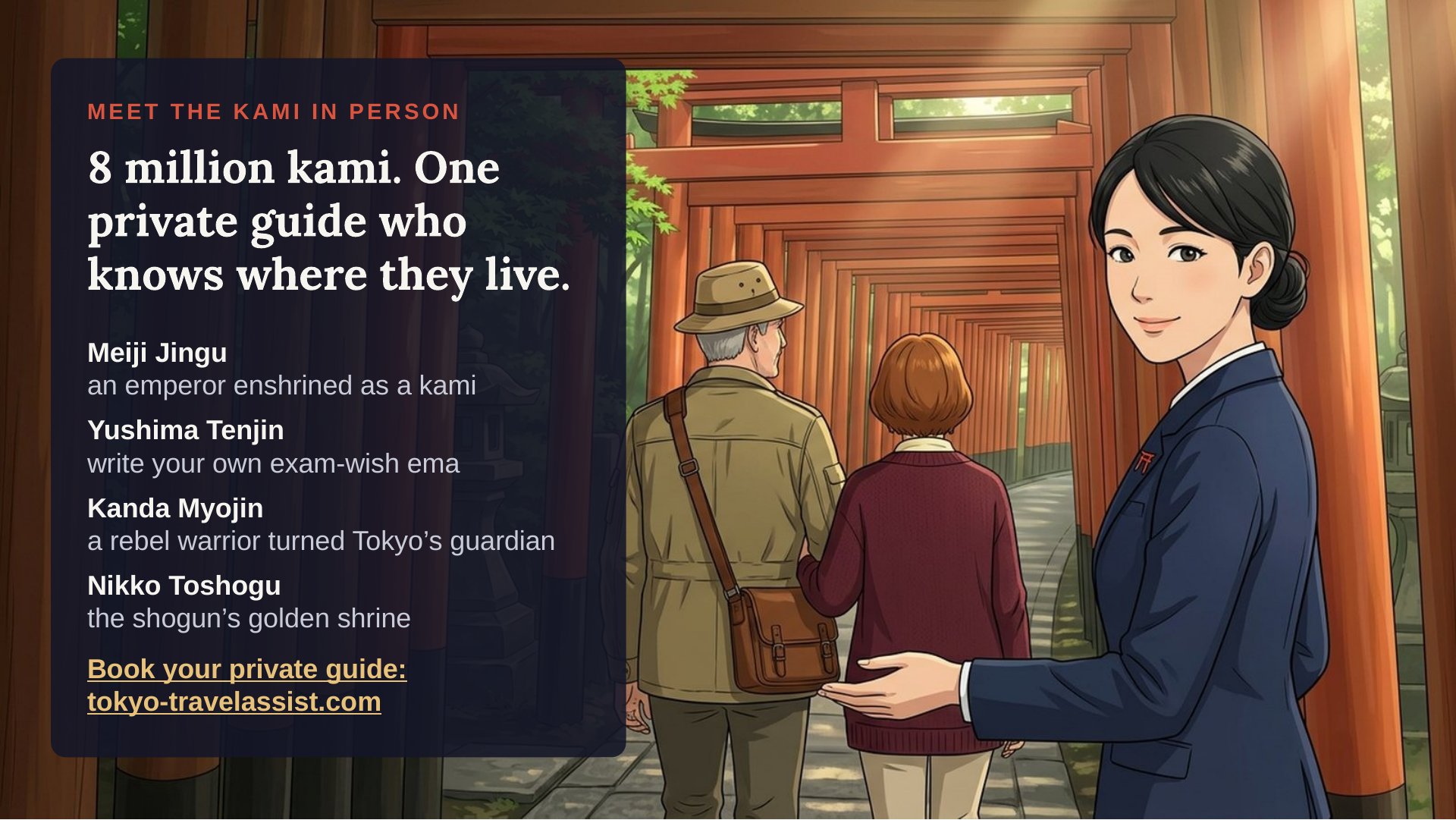
- Meiji Shrine: where an emperor and empress are enshrined as kami, in a forest planted by the nation. Essentials of Tokyo Tour →
- Nikko Toshogu: the shogun’s golden shrine among giant cedars. Nikko & Waterfall Tour →
- Tsurugaoka Hachiman Shrine: the samurai capital’s guardian, a short walk from the Great Buddha. Essentials of Kamakura Tour →
8 million kami. One private guide who knows where they live.
Tell us your dates and what caught your eye in this briefing. We’ll plan a day around you, by email, one conversation at a time.
More briefings from our guides: Private Guide Briefings. Dates are approximate, and beliefs vary from family to family; your guide is happy to go deeper on any of them.