The Silk Road’s Eastern Terminus: A Global Perspective on Ancient Japan
The Kofun Period (c. 3rd to 7th century AD) is a pivotal era in Japanese history, defined by the construction of monumental burial mounds, the Kofun, and the enigmatic terracotta figures, the Haniwa. For the international visitor, this period offers a profound re-evaluation of Japan’s ancient identity, presenting it not as an isolated archipelago, but as the easternmost terminus of the Eurasian cultural exchange. The Kofun and Haniwa are not just archaeological relics; they are powerful, silent witnesses to the emergence of a unified state and its deep, early connections to the wider world.
These colossal tombs served as political statements, visually enforcing the hierarchy of the emerging Yamato sovereignty. The Haniwa, placed around the mounds, depict the life, rituals, and people of the time, including the Toraijin (immigrants) who brought advanced technology and new cultural perspectives from the Asian continent.
Colossal Monuments: Kofun of International Scale
The sheer scale of the largest Kofun places them among the world’s most impressive ancient monuments, rivaling the pyramids of Egypt and the mausoleums of China. Their construction required immense resources and sophisticated engineering, demonstrating the power of the ancient Japanese state.
Area | Kofun Name | Location | Key Feature & International Appeal |
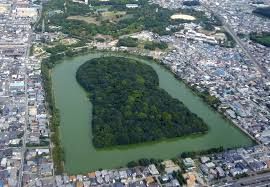
Kansai | Daisen Kofun (Emperor Nintoku’s Tomb) | Sakai, Osaka | One of the largest tombs in the world by area. Its massive, keyhole shape is a globally unique architectural form that immediately conveys the scale of ancient Japanese power. |
Kansai | Ōjin Tennō-ryō Kofun | Habikino, Osaka | Part of the Furuichi Kofun Group, this tomb is renowned for being the largest by volume in Japan (approx. 425m long), a testament to the peak of Kofun construction in the 5th century. |
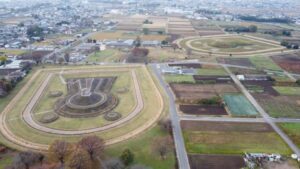
Kanto | Hodotaka Kofun Group | Takasaki, Gunma | Features three large keyhole-shaped tombs. The Hachimanzuka Kofun has been meticulously restored with thousands of Haniwa figures, offering a rare, visually stunning opportunity to see a Kofun as it originally appeared. |
Kyushu | Iwatoyama Kofun | Yame, Fukuoka | Believed to be the tomb of the powerful local ruler Iwai. It is distinguished by its unique accompanying stone figures (Sekijin and Sekiba), highlighting the distinct regional power structures in ancient Japan. |
The Silent Witnesses:The Mystery of the Foreign Face
While most Haniwa depict local warriors, farmers, and animals, one particular group has sparked a fascinating, though academically controversial, hypothesis: the Japanese-Jewish Common Ancestry Theory (Nichiyu Dōsoron).
The “Jewish Haniwa” and the Lost Tribes Hypothesis
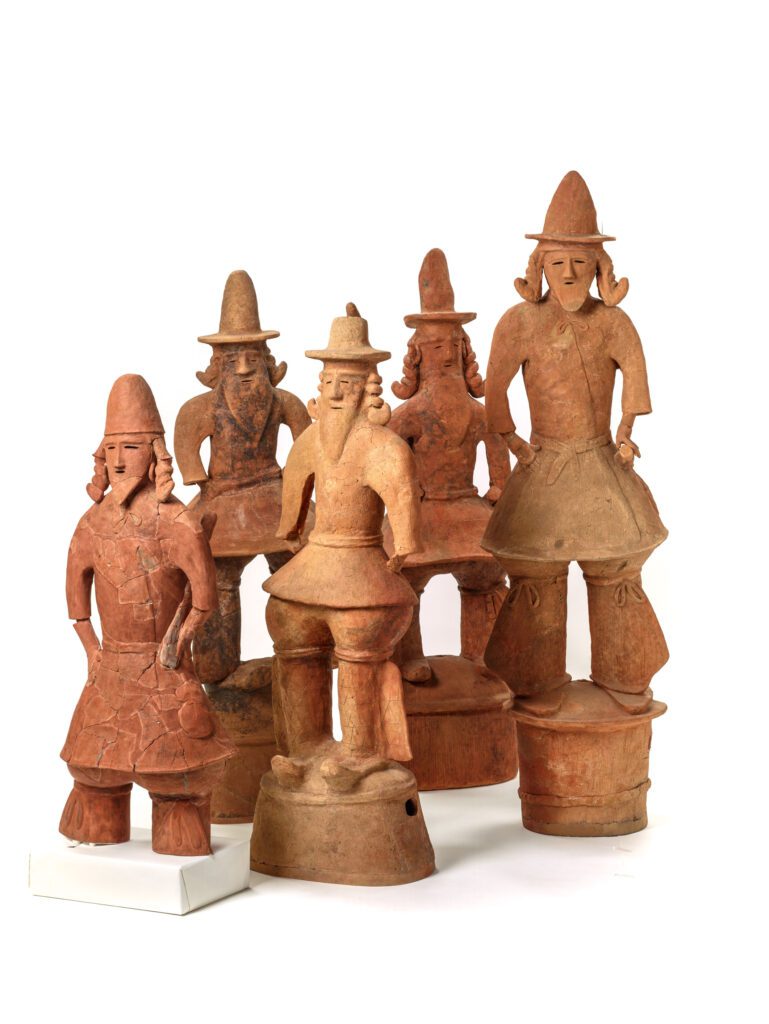
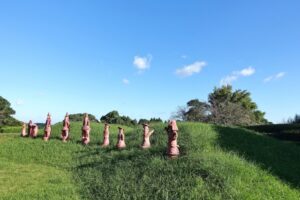 At the Shibayama Kofun Group in Chiba Prefecture, Haniwa figures were excavated that bear an uncanny resemblance to the attire and features of ultra-Orthodox Jews. These figures, often displayed at the Shibayama Kofun and Haniwa Museum, are depicted with:
•A high, pointed hat.
•A long, full beard.
•Long side-locks, or Payot (Pe’ot), which are characteristic of certain Jewish traditions.
This visual anomaly is cited by proponents of the theory as evidence that a portion of the Lost Ten Tribes of Israel, exiled by the Assyrians in the 8th century BCE, may have traveled the Silk Road and ultimately settled in Japan.
The Hata Clan: The Technologists Who Built Ancient Japan
The hypothesis often converges on the powerful Hata Clan (秦氏), a prominent group of Toraijin (immigrants) who arrived during the Kofun period. They were instrumental in developing early Japan, bringing with them:
•Advanced Skills: Expertise in sericulture, weaving, metallurgy, and civil engineering—skills that align with those historically associated with groups traveling the Silk Road.
•Cultural Parallels: Proponents note striking similarities between ancient Shinto rituals and Jewish practices, such as the purification rituals, the design of the mikoshi (portable shrine) resembling the Ark of the Covenant, and even linguistic connections.
While the Nichiyu Dōsoron remains outside the academic mainstream, it provides a compelling, romantic narrative that connects Japan’s ancient past to the global history of the Middle East and Central Asia. See this article more about Hata clane here.
The End of the Kofun Era: A Shift in National Identity
The construction of these massive tombs abruptly ceased in the 7th century. This dramatic shift was driven by a confluence of factors that marked the transition from the Kofun Period to the centralized, imperial state:
1.The Arrival of Buddhism: The introduction of Buddhism offered a new, less materially demanding form of funerary practice, shifting the focus from massive tombs to the construction of temples.
2.The Hōsōrei (Thin Funeral Edict): Issued in 646 AD as part of the Taika Reform, this edict legally restricted the size of tombs based on social rank, effectively ending the competitive, large-scale construction of Kofun.
3.Centralization: As the Yamato court consolidated power, the need for local warlords to visually assert their authority through monumental tombs diminished, with national energy redirected toward building a centralized capital and bureaucracy.
Experience the Mystery: Key Tourist Destinations
For travelers seeking to engage with this unique history and the intriguing hypotheses it inspires, these sites are essential:
•Shibayama Kofun and Haniwa Museum (Chiba): Visit the museum to see the actual Haniwa figures that sparked the “Jewish Haniwa” theory, offering a direct encounter with the diverse faces of ancient Japan.
•Jōmō Kōgen Haniwa no Sato Park (Gunma): Explore the fully restored Hodotaka Kofun Group, where you can walk among the thousands of Haniwa figures, gaining an immersive, visually impactful understanding of the Kofun landscape.
•Ōjin Tennō-ryō Kofun (Osaka): Stand before this colossal mound to grasp the sheer scale of the ancient state’s power, a monument that speaks a universal language of authority and engineering.
By exploring these sites, visitors can move beyond the standard historical narrative and engage with the profound, global mysteries embedded in the soil of ancient Japan.